 LWAYS OPEN
FRL DEEP RESEARCH
For the private TITAN Options Circle research community
Cernobbio is not, by itself, a trading signal. That distinction matters.
The 52nd TEHA Forum at Villa d’Este takes place from 4 to 6 September 2026 under the traditional framework of examining the world, Europe and Italy. The opening day is devoted primarily to global geopolitical, economic, scientific and technological challenges; Saturday turns to Europe, including competitiveness, defence, energy and Europe’s position in the Mediterranean and Balkans; Sunday focuses on Italy.
The strategic importance for investors therefore lies somewhere else.
Cernobbio provides a concentrated environment in which political leaders, policymakers, business executives, economists and institutional figures articulate how they believe the economic regime is changing. Participants announced for the 2026 forum include representatives of multiple governments and European institutions as well as senior political and business figures.
For TITAN methodology, the relevant question is consequently not:
“What was said at Cernobbio?”
It is:
“What information emerging from Cernobbio could change market expectations, and under what conditions would that change become sufficiently important to justify positioning?”
That turns a political-economic conference into a market-strategy problem.
- CERNOBBIO IS AN INFORMATION EVENT, NOT AUTOMATICALLY A MARKET EVENT
The first analytical discipline is to separate three layers.
FACT
Cernobbio is a major international economic and political forum. The 2026 programme addresses geopolitics, European competitiveness, defence and security, energy, innovation, growth and Italy’s economic agenda.
INTERPRETATION
These subjects overlap directly with variables that determine European equity valuation: economic growth, fiscal expenditure, energy costs, interest rates, industrial policy, defence spending and capital investment.
SCENARIO
Statements made during the forum could therefore contribute to changes in investor expectations. But a statement becomes strategically important only when markets begin to price a materially different probability distribution for future growth, inflation, interest rates, earnings or government policy.
This distinction prevents a common trading error: confusing important news with actionable information.
- THE REAL CERNOBBIO TRADE IS EXPECTATIONS VERSUS PRICE
Financial markets do not price conferences. They price changes in expectations.
An investor should therefore construct an expectation map before interpreting individual statements.
For Europe, the most important Cernobbio-related variables include:
European competitiveness and industrial policy
Defence and security expenditure
Energy security and energy costs
Fiscal policy
Infrastructure investment
Technology and innovation
Relations with the United States
European strategic autonomy
European growth prospects
The question is not whether policymakers discuss these subjects. That is already expected.
The question is whether new information materially changes what the market believed before the conference.
This produces a simple TITAN framework:
Information
Expectation change
Market confirmation
Risk/reward assessment
Instrument selection
Timing
Skipping one of these stages increases the probability of trading the headline rather than trading the market.
- THE CURRENT MARKET BACKDROP MAKES THIS PARTICULARLY IMPORTANT
Cernobbio begins during an unusually sensitive macroeconomic environment.
Global government bond markets have recently been under pressure as investors confront persistent inflation risks, higher energy prices, fiscal concerns and changing expectations for monetary policy. Reuters reported this week that government borrowing costs across several major economies had reached levels not seen for many years.
European equities, meanwhile, recovered somewhat on 3 September as bond yields retreated, after having suffered several sessions of pressure. The STOXX Europe 600 remained sensitive to oil prices, bond yields and expectations surrounding monetary policy.
The ECB dimension is particularly relevant. A Reuters poll published on 3 September found economists expecting another 25-basis-point increase at the ECB’s 10 September meeting amid above-target inflation and energy-related price pressure.
This means Cernobbio is taking place against a market already debating an uncomfortable combination:
Higher energy costs
Higher sovereign yields
Inflation pressure
Weak European growth
Fiscal constraints
Strategic investment requirements
That combination makes policy rhetoric potentially more consequential than it would be during a quiet macroeconomic regime.
- THE CERNOBBIO PARADOX: EUROPE NEEDS INVESTMENT WHILE CAPITAL IS BECOMING MORE EXPENSIVE
This is arguably the central strategic contradiction investors should watch.
Europe wants greater competitiveness, stronger defence capability, better energy security, more technological sovereignty and higher infrastructure investment.
All of these require capital.
But rising sovereign yields increase the cost of that capital.
The investment question therefore becomes less about whether Europe intends to invest and more about:
Who finances it?
How quickly?
Through which mechanisms?
At what cost?
And which industries capture the resulting capital flows?
This is where Cernobbio potentially becomes investable.
A credible policy mechanism is more important than an ambitious political objective.
For markets, “Europe must invest more” has limited informational value.
“Europe will invest through a defined financing mechanism, beginning on a defined timetable, directed toward identifiable industries” would have considerably greater value.
TITAN methodology therefore ranks implementation above rhetoric.
- THREE CERNOBBIO SCENARIOS
Rather than predicting what politicians will say, investors can prepare scenarios.
SCENARIO 1: PRO-GROWTH / PRO-INVESTMENT
Cernobbio produces credible signals favouring European investment, competitiveness, infrastructure, defence, energy independence and technological development.
Potential market interpretation:
Improved medium-term European growth expectations.
Possible beneficiaries could include industrials, defence, infrastructure, financials and selected technology companies.
But the bond market becomes critical.
If stronger investment expectations simultaneously push sovereign yields materially higher, equity gains could become selective rather than broad.
Strategic conclusion:
Potentially constructive for European equities, but only if financing conditions do not deteriorate faster than growth expectations improve.
SCENARIO 2: STAGFLATION / FISCAL CONSTRAINT
The debate emphasises energy insecurity, geopolitical expenditure, structural weakness, debt burdens and limited fiscal flexibility.
Potential market interpretation:
Higher inflation risk combined with insufficient growth.
This would be a substantially less attractive environment for broad European equity exposure.
Duration-sensitive equities could remain vulnerable while sectors with pricing power, defence-related demand or energy exposure could behave differently.
Strategic conclusion:
Do not confuse increased government expenditure with automatically bullish equity implications.
SCENARIO 3: RHETORIC WITHOUT REPRICING
This may ultimately be the most probable immediate outcome of many political conferences.
Important speeches are delivered.
Ambitious objectives are announced.
Markets barely move.
That is itself information.
If supposedly significant policy statements cannot push European equities through established resistance or cannot produce sector leadership, the market is effectively saying that the information was already discounted, insufficiently credible or economically immaterial.
Strategic conclusion:
No market confirmation means no requirement to manufacture a trade.
- MARKET STRUCTURE MUST OVERRULE THE NARRATIVE
This is particularly important for TITAN Options Circle members.
Suppose Cernobbio generates strongly constructive language about European competitiveness.
That does not automatically justify buying European equities.
The market must confirm the thesis.
The analytical sequence should include:
Does the EURO STOXX 50 respond positively?
Does the broader STOXX Europe 600 confirm?
Does market breadth improve?
Which sectors lead?
Are European banks participating?
Are industrials participating?
What happens to sovereign yields?
What happens to the euro?
Does the initial reaction survive the following trading session?
The relationship between these markets matters more than any isolated headline.
A strong European equity response accompanied by manageable bond yields represents a very different regime from equities initially rising while sovereign yields accelerate upward.
Price is the final voting mechanism.
- OPTIONS: WAIT FOR THE MARKET TO DEFINE THE ASYMMETRY
Cernobbio should not be treated like a scheduled corporate earnings release.
There is no single announcement time around which an options strategy can easily be structured.
Information emerges over several days, and some of the most important implications may concern policies whose implementation horizon extends months or years.
This argues against paying indiscriminately for short-dated optionality simply because the conference appears important.
Instead, TITAN methodology would examine four questions before considering an options structure:
Has the underlying market confirmed direction?
Has implied volatility already become expensive?
Is there a clearly identifiable catalyst after Cernobbio?
Can the maximum loss be defined relative to a credible upside scenario?
Options become interesting when asymmetry improves, not merely when uncertainty increases.
- IMPLIED VOLATILITY IS A PRICE
Investors sometimes describe volatility as risk.
For options investors, volatility is also a product with a price.
If implied volatility rises sharply before or during an event while the probable magnitude of the underlying move remains limited, the option buyer may be paying too much for uncertainty.
Conversely, if markets remain complacent while the probability distribution is genuinely widening, optionality can become strategically interesting.
The relevant comparison is therefore:
Implied move versus plausible realised move.
This is especially important around political and macroeconomic events because dramatic headlines do not necessarily translate into dramatic index moves.
The correct question is not:
“Will Cernobbio matter?”
It is:
“Is the market underpricing or overpricing the probability that information emerging from Cernobbio changes the European market regime?”
- DIRECTIONAL OPTIONS VERSUS DEFINED-RISK STRUCTURES
If a clear directional thesis emerges, simply buying calls or puts is only one possible expression.
A bullish European thesis accompanied by elevated implied volatility could make defined-risk call spreads more efficient than outright calls.
A bearish thesis where downside appears meaningful but bounded could similarly favour put spreads.
Where the primary thesis concerns volatility rather than direction, a different structure would be required.
The instrument must therefore follow the thesis.
Never construct the thesis around the derivative one wants to trade.
That distinction is central to disciplined derivatives research.
- TIMING: THE FIRST MOVE MAY BE THE LEAST RELIABLE MOVE
Cernobbio runs from Friday through Sunday.
That matters.
Friday information can be absorbed immediately by European markets.
Saturday and Sunday information cannot receive a complete cash-equity response until markets reopen.
The strategically important observation window may therefore extend beyond the conference itself.
A useful sequence is:
Pre-event positioning
Friday reaction
Weekend information accumulation
Monday opening reaction
Monday closing confirmation
Subsequent sector and bond-market confirmation
The highest-quality setup may therefore appear after the conference rather than during it.
Waiting costs nothing unless an investor has already decided that being first is more important than being right.
- INVALIDATION MUST BE DEFINED BEFORE ENTRY
Every Cernobbio-derived market thesis needs an invalidation mechanism.
Consider a hypothetical bullish European thesis based on stronger investment and competitiveness expectations.
It would begin losing credibility if:
European equities fail to sustain the initial breakout.
Market breadth deteriorates.
Bond yields accelerate sharply.
Cyclical sectors fail to participate.
The euro or credit markets signal renewed stress.
Political statements lack credible implementation mechanisms.
Conversely, a bearish thesis would weaken if equities absorb adverse headlines, yields stabilise and economically sensitive sectors begin outperforming.
The market’s refusal to decline after negative information can be as informative as its reaction to positive news.
- CERNOBBIO THROUGH THE TITAN RESEARCH FRAMEWORK
The TITAN approach can reduce the entire event to six analytical layers.
Layer 1: FACT
What was actually announced?
Layer 2: DIFFERENCE
How does it differ from what investors already expected?
Layer 3: TRANSMISSION
Through which economic mechanism could it affect earnings, rates, capital expenditure or valuation?
Layer 4: CONFIRMATION
Are equities, bonds, currencies and sectors confirming the interpretation?
Layer 5: ASYMMETRY
Is potential reward sufficiently large relative to defined downside?
Layer 6: EXECUTION
Which instrument, structure and timing best express the thesis?
This framework prevents investors from jumping directly from headline to position.
- WHAT WE WOULD WATCH AFTER CERNOBBIO
The conference itself is only the beginning of the research process.
The most useful evidence will come from the market.
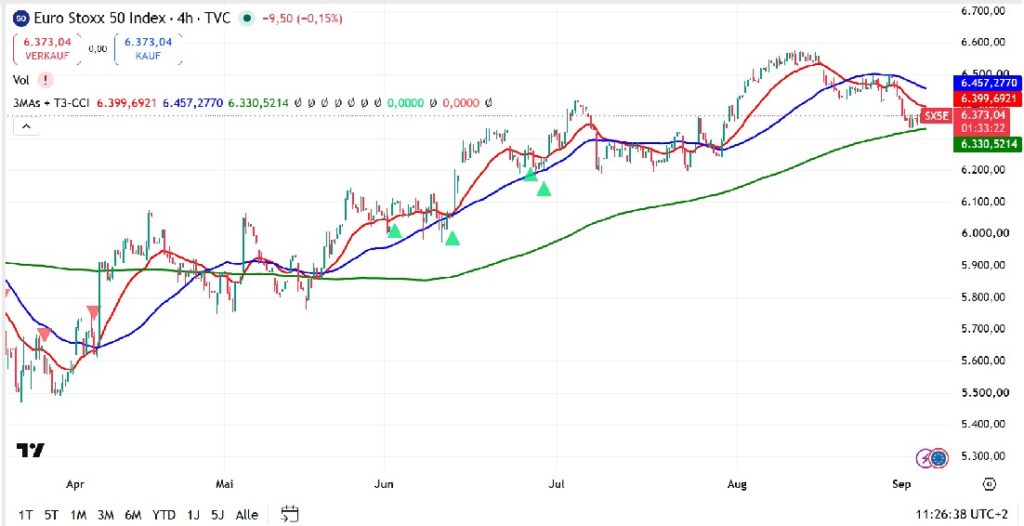
For European equities, watch whether the EURO STOXX 50 can strengthen relative to its recent trading structure.
For broader confirmation, watch the STOXX Europe 600.
For the macroeconomic constraint, watch European sovereign yields.
For monetary-policy expectations, watch the front end of the European rates curve.
For sector confirmation, watch banks, industrials, defence, technology, utilities and energy.
And above everything else, watch whether markets continue moving after the headlines disappear.
Persistence separates repricing from noise.
CONCLUSION: CERNOBBIO IS A TEST OF MARKET BELIEF
The strategic value of Cernobbio is not that influential people gather at Lake Como and discuss the future of Europe.
Investors already know Europe faces questions involving competitiveness, energy, defence, technology, fiscal capacity and geopolitical autonomy.
The potential market opportunity arises only if Cernobbio changes the perceived probability of how those problems will actually be addressed.
That is the difference between information and investable information.
For TITAN methodology, the approach is therefore deliberately disciplined:
Listen first.
Identify what is genuinely new.
Map the economic transmission mechanism.
Watch the bond market.
Demand equity-market confirmation.
Measure implied volatility.
Define the invalidation point.
Only then decide whether the resulting asymmetry justifies using capital.
Sometimes the correct strategic conclusion after an important event is not to trade it.
That, too, is a position.
DISCLAIMER
This material represents general financial market research and analytical discussion for informational purposes only and does not constitute investment advice, financial advice, portfolio management services or a recommendation to buy or sell any financial instrument. Investment decisions remain the responsibility of the individual investor