 LWAYS OPEN
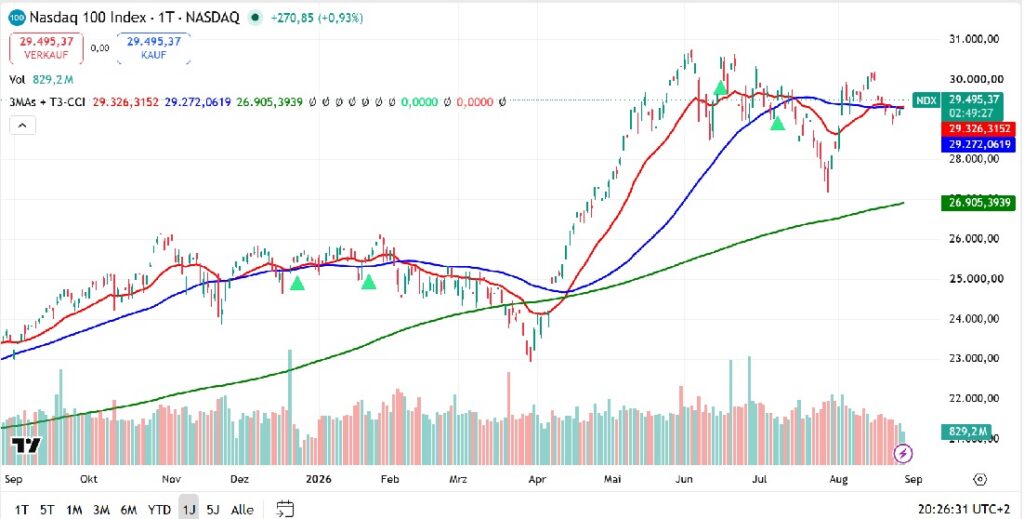
The strongest argument for diversifying an AI-heavy portfolio is no longer that artificial intelligence may disappoint. NVIDIA’s latest results suggest almost the opposite: AI infrastructure demand remains exceptionally strong. The strategic question is therefore more difficult. When an existing portfolio already participates substantially in a successful structural theme, should additional capital continue reinforcing the same exposure, or should new money be deliberately directed toward economically different sources of return? FRL examines a portfolio architecture that preserves selective AI participation while using incremental capital to reduce concentration, broaden earnings drivers and improve resilience across different market regimes.
Strategic Research Thesis
The central strategic research question is:
How should substantial available capital be deployed after the AI and semiconductor rally when the objective is to preserve participation in structural AI growth without allowing one investment theme to dominate future portfolio outcomes?
FRL’s thesis is that diversification at this stage should not primarily be understood as selling successful AI companies.
It should be understood as changing where the next unit of capital goes.
That distinction is fundamental.
A portfolio can retain meaningful exposure to NVIDIA (NVDA), selected semiconductor companies and other established technology leaders while simultaneously reducing its marginal dependence on the AI trade by directing additional capital toward businesses whose earnings are driven by different economic mechanisms.
The strategic objective is therefore not diversification for its own sake.
It is diversification of earnings drivers.
Financial infrastructure, healthcare, energy, industrial services and selected market-infrastructure businesses can potentially provide revenue and cash-flow exposures that depend less directly on GPU demand, hyperscaler capital expenditure or semiconductor valuation multiples.
This produces the core principle of the strategy:
STRATEGY FOLLOWS MARKET STRUCTURE.
The market structure currently supports continued AI participation. Portfolio structure, however, argues against automatically directing every additional dollar toward the same theme.
NVIDIA Changed the Question, but Not the Portfolio Problem
NVIDIA’s August 26 earnings report materially strengthened the fundamental case for AI infrastructure.
Fiscal second-quarter revenue reached $96.2 billion, up 106% year over year. Data Center revenue reached $89.0 billion, increasing 117%.
Those numbers make it difficult to argue that the AI investment cycle is currently experiencing fundamental collapse.
The market recognized this immediately. NVIDIA rallied strongly following the report and semiconductor shares broadly benefited.
That is Supporting Evidence for maintaining selective AI exposure.
But it is not automatically Supporting Evidence for increasing AI concentration.
This distinction is particularly important for portfolios that already accumulated substantial technology and semiconductor positions earlier in the cycle.
Investment decisions must consider not only whether an asset remains attractive but also what the portfolio already owns.
A hypothetical portfolio with 5% AI exposure faces a fundamentally different allocation decision from a portfolio where AI, semiconductors and correlated technology holdings already determine a large proportion of daily performance.
The same stock can therefore remain fundamentally attractive while becoming less attractive as the destination for incremental portfolio capital.
That is not a contradiction.
It is portfolio mathematics.
The current AI environment consequently creates an unusual strategic situation: the fundamental thesis remains powerful, but successful participation in that thesis can itself create concentration risk.
Diversification Means Adding Different Economic Engines
A common portfolio mistake is to define diversification by the number of ticker symbols.
Ten stocks are not necessarily more diversified than five.
A portfolio containing NVIDIA, Advanced Micro Devices (AMD), Broadcom (AVGO), Marvell Technology (MRVL), Arista Networks (ANET) and several other AI infrastructure beneficiaries may contain numerous securities but still depend heavily on a relatively narrow set of economic variables.
Those variables include hyperscaler capital expenditure, AI accelerator demand, semiconductor valuations, technology risk appetite and long-duration interest rates.
True diversification therefore requires different earnings engines.
This is where financial infrastructure, healthcare, energy and industrial businesses become strategically interesting.
Consider financial-market infrastructure.
Companies such as S&P Global (SPGI), CME Group (CME), Moody’s (MCO) and Nasdaq (NDAQ) participate in capital markets without depending on semiconductor demand.
Their economics derive from different combinations of ratings, indices, financial data, trading volumes, clearing, market infrastructure and capital-market activity.
They are not immune to economic cycles, but the sources of their revenues are structurally different from those of a semiconductor manufacturer.
Healthcare provides another economic engine.
Demand for pharmaceuticals, medical distribution and healthcare services is not determined primarily by whether hyperscalers increase AI capital expenditure next quarter.
Energy and energy infrastructure introduce yet another set of drivers: commodity flows, transportation, production economics and physical infrastructure.
Industrials can add exposure to manufacturing, aerospace, logistics, infrastructure spending and physical capital formation.
The strategic objective is not to predict which sector will outperform technology next month.
It is to prevent one economic assumption from controlling the entire portfolio.
Why Incremental Capital Matters More Than Existing Holdings
The most powerful portfolio-restructuring tool can sometimes be the cash that has not yet been invested.
Consider a portfolio that already contains successful AI positions and simultaneously holds substantial available capital.
There are two ways to reduce concentration.
The first is to sell existing technology holdings aggressively.
The second is to retain selected high-quality exposures but deploy new capital elsewhere.
The second approach can be considerably less disruptive.
It avoids forcing the portfolio to abandon businesses whose fundamental outlook remains attractive merely to satisfy an arbitrary diversification target.
Instead, portfolio weights change organically as new capital creates additional economic exposures.
This is particularly relevant after NVIDIA’s latest report.
There is currently insufficient fundamental evidence to conclude that the AI infrastructure cycle has broken. Therefore, a strategy based on indiscriminate liquidation of AI exposure would require a thesis that the available evidence does not presently support.
But adding another large block of highly correlated AI exposure creates a different problem.
It increases the amount of portfolio performance dependent on one narrative continuing to exceed already substantial expectations.
Incremental capital therefore has unusually high strategic value.
Cash is not merely an unproductive residual waiting to be invested.
It represents optionality.
It permits a portfolio to broaden its architecture without necessarily dismantling its strongest existing positions.
Building a Non-AI Allocation Around Quality Rather Than Fashion
Sector diversification can become dangerous when investors simply rotate from whatever has performed well into whatever has performed poorly.
That is not the framework discussed here.
The relevant question is not:
What has not rallied yet?
It is:
Which businesses introduce attractive economic characteristics that the existing portfolio currently lacks?
That distinction changes stock selection materially.
A financial-infrastructure company may be useful because it introduces recurring data, index, exchange or ratings economics.
A healthcare company may contribute relatively defensive demand and cash generation.
An energy-infrastructure company can provide exposure to physical assets and commodity throughput.
An industrial company may capture infrastructure investment and real-economy capital formation.
Quality remains essential.
Diversification into weak businesses does not reduce risk in an economically meaningful way. It merely exchanges concentration risk for business-quality risk.
The preferred characteristics remain familiar: durable competitive positioning, healthy cash generation, manageable leverage, credible capital allocation and businesses capable of functioning under more than one macroeconomic scenario.
This is particularly important in 2026 because monetary conditions remain restrictive.
The Federal Reserve has maintained its policy rate at 3.50%–3.75%, inflation remains above target and long-duration borrowing costs have become an important valuation constraint.
Balance-sheet quality therefore matters.
The strategic diversification basket should not simply be less technological.
It should also be financially robust.
Staged Deployment Versus Immediate Full Investment
A second strategic question concerns timing.
If substantial cash is available, should diversification occur immediately or progressively?
The answer depends on market structure.
Staged deployment has several advantages in the current environment.
First, equity markets remain highly sensitive to interest rates.
Second, the market has just absorbed a major NVIDIA earnings event.
Third, Jackson Hole introduces another potentially significant macro catalyst immediately afterward.
Fourth, strong individual companies can still experience substantial price volatility even when their long-term investment thesis remains intact.
Deploying capital in stages therefore separates the strategic decision from the tactical entry decision.
The strategic decision might be that a portfolio requires greater financial, healthcare, industrial or energy exposure.
That does not imply that the entire intended allocation must be established at the first available market price.
This distinction is especially useful when markets are trading near elevated valuations or following large event-driven moves.
Staged deployment also preserves optionality.
If markets decline, capital remains available.
If the initial thesis is confirmed, exposure can be expanded.
If new evidence contradicts the thesis, the portfolio has avoided committing the entire allocation before the information changed.
The opportunity cost is obvious: if markets rise continuously, staged deployment can underperform immediate investment.
That is the Contrary Evidence against excessive patience.
Cash has a cost when attractive assets appreciate while investors wait for a theoretically perfect entry that never arrives.
The strategic challenge is therefore not choosing between invested and uninvested.
It is determining how much optionality the current market environment justifies.
Correlation Is the Hidden Variable
Portfolio weights alone do not adequately describe concentration.
Correlation matters.
During calm markets, several technology holdings may appear to behave independently because company-specific earnings and news create different daily moves.
During risk-off periods, correlations can rise sharply.
Semiconductors, cloud infrastructure, high-growth software and AI beneficiaries may suddenly trade as variations of the same duration-sensitive risk asset.
This is why diversification should be evaluated under stress rather than merely under normal market conditions.
The important question is not whether two companies have different products.
It is whether they respond differently when the portfolio most needs diversification.
Financial exchanges, healthcare companies, energy infrastructure and industrial businesses can still decline during broad equity selloffs. Diversification does not eliminate market risk.
But their earnings drivers, valuation frameworks and sensitivities can differ sufficiently to reduce dependence on a single factor.
This becomes particularly important when Treasury yields rise.
Higher yields can pressure expensive growth valuations even when company fundamentals remain healthy.
NVIDIA itself demonstrates why quality matters within this framework. Its extraordinary current cash generation differentiates it from speculative AI companies dependent primarily on distant future earnings.
Yet even highly profitable technology companies remain subject to valuation compression.
Diversification therefore protects against more than fundamental failure.
It can also protect against multiple compression within a fundamentally successful sector.
Scenario Analysis
The portfolio architecture becomes clearer when examined across different market regimes.
Bullish Scenario
AI investment continues accelerating, NVIDIA and other infrastructure leaders continue delivering exceptional earnings, Treasury yields stabilize and economic growth remains healthy.
Under this scenario, retaining meaningful AI exposure allows the portfolio to participate in continued technology leadership.
The diversified positions may not outperform the strongest AI companies.
Their function is not necessarily to do so.
Their function is to ensure that the portfolio does not require perpetual AI outperformance to produce acceptable results.
Base Scenario
AI growth remains structurally strong but equity leadership broadens.
Technology earnings continue growing while financials, industrials, healthcare and selected energy businesses attract increasing capital.
This would be particularly constructive for a portfolio combining existing AI exposure with newly established non-AI positions.
Returns would have multiple potential sources rather than one dominant driver.
Risk Scenario
Long-term interest rates remain elevated or increase further, technology multiples compress and investors reduce exposure to crowded growth trades.
AI fundamentals might remain healthy while share prices decline because discount rates rise.
A broader portfolio would not be immune, but companies with different valuation structures, dividend characteristics, physical assets or less duration-sensitive earnings could provide relative resilience.
There is another risk scenario worth considering.
AI capital expenditure itself could eventually slow.
If hyperscalers begin demanding clearer returns on enormous infrastructure investments, the semiconductor value chain could experience significant expectation resets.
A portfolio already diversified before such a transition would be structurally different from one attempting to diversify after the market had recognized the problem.
The Counterargument
The strongest counterargument is straightforward.
Why diversify away from the market’s strongest structural growth theme?
NVIDIA has just produced 106% year-over-year revenue growth. Data Center revenue increased 117%. AI infrastructure demand remains extraordinary.
If these trends continue, directing capital toward slower-growing sectors could reduce portfolio returns.
There is merit to that argument.
Diversification always involves opportunity cost when the concentrated asset continues outperforming.
There is also a danger of diworsification: adding mediocre companies simply because they belong to different sectors.
A highly concentrated portfolio of exceptional businesses can outperform a diversified portfolio containing average businesses.
Therefore, concentration itself is not inherently wrong.
The problem emerges when portfolio success becomes excessively dependent on one macroeconomic, technological or valuation regime.
The relevant question is consequently not whether NVIDIA or AI remains attractive.
The question is whether the portfolio needs even more exposure to a risk factor it already owns extensively.
Those are different questions and can produce different answers.
What Would Invalidate the Thesis?
The Key Risk to this strategy is that diversification occurs too early or into economically inferior businesses while AI leadership continues expanding for years.
In that environment, new non-AI allocations could materially lag existing technology positions.
The thesis would also weaken if correlations between the newly introduced sectors and technology remained consistently high enough that the additional holdings failed to provide meaningful economic diversification.
A more fundamental Thesis Invalidation Point would occur if the supposedly differentiated companies were shown to have weak balance sheets, deteriorating cash flows or excessive sensitivity to the same interest-rate factors the strategy was intended to diversify.
Diversification must therefore be continuously tested rather than assumed.
The thesis would also require reassessment if AI valuations corrected substantially while underlying earnings continued accelerating.
At sufficiently different valuations, incremental capital allocation could once again favor AI and semiconductor companies because the concentration cost would have to be weighed against a materially improved expected return structure.
Portfolio strategy cannot be static.
Capital should follow the evolving relationship between fundamentals, valuation, correlation and market structure.
FRL Strategic Research Outlook
The most important conclusion from NVIDIA’s latest results is not that investors should abandon AI.
The evidence does not currently support that conclusion.
The more interesting strategic conclusion is that investors who already possess substantial AI exposure no longer need to use every additional unit of capital to express the same thesis.
That creates an opportunity to redesign portfolio architecture without dismantling the structural growth engine already in place.
Selective AI exposure can remain the growth component.
Financial infrastructure can introduce capital-market economics.
Healthcare can introduce different demand characteristics.
Energy can introduce physical-asset and commodity-linked cash flows.
Industrials can introduce exposure to infrastructure, manufacturing and real-economy capital formation.
Cash can preserve tactical optionality.
The result is not a rejection of technology.
It is a transition from thematic concentration toward multiple independent sources of portfolio return.
That distinction may become increasingly valuable as the AI investment cycle matures.
The first phase of a powerful structural trend often rewards concentration because leadership is clear and earnings expectations repeatedly move higher.
Later phases become more complicated.
Valuations rise. Expectations become demanding. Correlations increase. Macroeconomic variables matter more. Strong companies can remain fundamentally successful while producing less extraordinary equity returns.
Portfolio construction must evolve accordingly.
The evidence after NVIDIA’s August 26 report suggests that AI infrastructure remains one of the strongest structural investment themes in global markets.
But portfolio strategy asks a different question from company analysis.
Company analysis asks whether an investment thesis remains attractive.
Portfolio strategy asks how much of the portfolio should depend upon that thesis.
For portfolios already carrying substantial technology exposure, the current environment supports preserving selective participation while directing a meaningful share of incremental capital toward genuinely different economic engines.
That is not necessarily a rotation out of AI.
It is a diversification of what comes next.
And in the current market structure, that distinction matters.
Research Notice
This publication represents general financial-market and strategy research prepared by Final Resurrection Ltd. for the TITAN Options Circle. It is provided solely for informational and research purposes and does not constitute individualized investment advice, portfolio-management services, execution services or a recommendation to purchase or sell any security. References to companies, sectors and portfolio structures are analytical examples and should not be interpreted as personal investment instructions.