 LWAYS OPEN

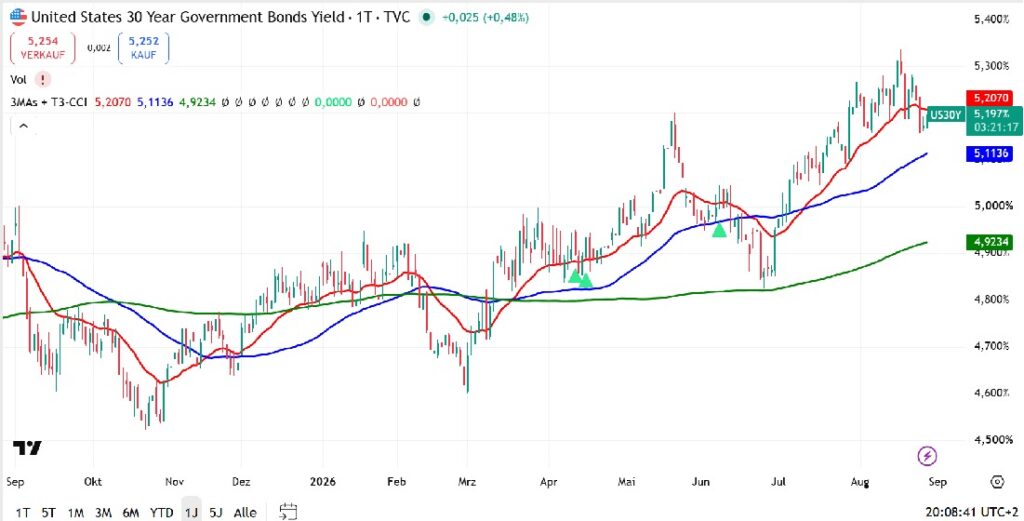
Federal Reserve Chairman Kevin Warsh arrives at Jackson Hole with an unusually difficult combination of persistent inflation, resilient economic activity and long-duration Treasury yields near levels not seen for almost two decades. For equity investors, the central question is therefore larger than whether the Fed raises rates at its September meeting. The more important issue is whether the market must adapt to a structurally higher cost of capital. FRL’s research thesis is that this distinction could increasingly determine relative equity performance, separating companies capable of financing growth internally from those whose valuations or business models remain heavily dependent on inexpensive capital.
Research Thesis
The central research question is: Will Jackson Hole signal a temporary period of restrictive monetary policy, or confirm that investors must price equities around a structurally higher cost of capital — and which stocks are most exposed to that transition?
FRL’s central thesis is that the greatest equity-market consequence of Jackson Hole may not be the next 25-basis-point move in the federal funds rate.
The more important variable is the long-term discount rate.
The Federal Reserve maintained its target range at 3.50%–3.75% in July, but the decision concealed meaningful disagreement. Three policymakers preferred an immediate 25-basis-point increase. Inflation remains materially above the Fed’s 2% objective, while the economy continues to expand and employment conditions remain relatively resilient.
At the same time, long-duration Treasury yields have risen sharply. The 30-year Treasury yield recently reached 5.337%, its highest level since 2007.
That creates a very different environment from the one in which much of the technology sector’s current valuation framework developed.
If Warsh signals that the Fed is prepared to tolerate higher market-determined long-term yields while maintaining a restrictive stance against inflation, the result could be a structural repricing of equity duration.
That would not affect every company equally.
Why Jackson Hole Matters More Than a Single Fed Meeting
Jackson Hole is not an FOMC policy meeting. No scheduled interest-rate decision will be announced on August 28.
Nevertheless, the event can be more important than an ordinary meeting because it provides the Federal Reserve Chair with an opportunity to define the intellectual framework behind future monetary policy.
That distinction is particularly relevant under Kevin Warsh.
Warsh has indicated skepticism toward excessive central-bank communication and forward guidance. He has expressed greater confidence in financial markets as mechanisms for determining the appropriate price of money.
If that philosophy becomes central to the Federal Reserve’s policy framework, investors may receive less explicit reassurance when bond markets become volatile.
That matters because long-term interest rates are already sending a message different from the relatively stable federal funds rate.
The policy rate remains 3.50%–3.75%. Yet the long end of the Treasury curve has moved substantially higher as markets confront persistent inflation, energy-price pressures, fiscal deficits and increasing government financing requirements.
This creates two separate monetary variables.
The first is the overnight rate controlled directly by the Federal Reserve.
The second is the long-term cost of capital established by the bond market.
For equities, the second may ultimately matter more.
Mortgage rates, corporate borrowing costs, infrastructure financing, leveraged acquisitions and equity valuation models all respond significantly to longer-duration yields.
The Supporting Evidence for the thesis is therefore already visible: the bond market has tightened financial conditions even without another Fed increase.
The Contrary Evidence is equally important. If inflation moderates rapidly, geopolitical energy pressures decline and economic growth weakens, Treasury yields could fall independently of aggressive Fed easing. In that scenario, the current valuation pressure could prove cyclical rather than structural.
AI and Semiconductors: Strong Earnings Meet a Higher Discount Rate
The timing of Jackson Hole is particularly important because it follows immediately after NVIDIA (NVDA) delivered another major confirmation of AI infrastructure demand.
That creates an unusual market experiment.
Investors have received powerful fundamental evidence supporting the AI capital-expenditure cycle at almost exactly the same moment that the bond market is challenging the valuation framework applied to long-duration growth assets.
NVIDIA itself is financially different from many speculative growth companies. Its enormous current revenues, margins and cash generation reduce its dependence on external financing.
The more significant exposure may therefore exist elsewhere in the AI ecosystem.
Companies such as Advanced Micro Devices (AMD), Broadcom (AVGO), Arista Networks (ANET), Marvell Technology (MRVL), Taiwan Semiconductor Manufacturing (TSM) and Lam Research (LRCX) participate in different parts of an expanding infrastructure chain.
Their fundamental sensitivity to Jackson Hole is indirect.
Their valuation sensitivity is not.
When long-term yields rise, the present value of future corporate cash flows falls. Companies carrying high earnings multiples because investors expect exceptional growth several years into the future are therefore disproportionately exposed to increases in discount rates.
This helps explain why semiconductor stocks can decline even when underlying AI demand remains strong.
There is a second-order effect as well.
The AI infrastructure boom requires extraordinary amounts of capital. Data centers require processors, networking, memory, cooling, land, power generation, transmission capacity and increasingly sophisticated financing structures.
Higher long-term rates increase the hurdle rate applied to these projects.
A hyperscaler with an exceptionally strong balance sheet can absorb that cost. A leveraged data-center operator, infrastructure developer or emerging AI company may not.
The result could eventually be a concentration of AI investment around the strongest balance sheets.
That would support established infrastructure leaders while creating greater financing risk for marginal participants.
The Magnificent Seven: Not All Duration Is Equal
The market frequently treats large technology companies as a single trade. From an interest-rate perspective, that is increasingly misleading.
Microsoft (MSFT), Alphabet (GOOGL), Amazon (AMZN), Meta Platforms (META) and NVIDIA possess substantial operating cash flows and can finance enormous investment programs internally.
Their primary exposure to higher rates is therefore valuation rather than immediate refinancing risk.
This distinction matters.
A highly profitable technology company trading at an elevated valuation can suffer multiple compression when Treasury yields rise while simultaneously continuing to produce excellent fundamental results.
Those two outcomes are not contradictory.
The more difficult situation occurs when valuation compression coincides with weakening earnings expectations.
This is why the post-Jackson Hole environment may increasingly reward demonstrated earnings power rather than thematic exposure alone.
For the largest AI beneficiaries, investors will likely focus on whether revenue and free-cash-flow growth can continue rapidly enough to offset a higher discount rate.
The structural question is no longer simply whether artificial intelligence will grow.
It is whether AI-related earnings can grow faster than the market’s required return on capital.
Financials Could Become One of the Most Important Relative Winners — With Conditions
Banks represent a more complicated interest-rate exposure.
Higher rates can improve asset yields and potentially expand net interest income. A steeper yield curve can also improve the economics of traditional banking, where institutions fund themselves at shorter maturities and lend at longer maturities.
This creates potential benefits for JPMorgan Chase (JPM), Bank of America (BAC), Citigroup (C) and other large financial institutions.
But higher rates are beneficial only up to a point.
If long-term yields rise because economic growth and nominal activity remain strong, financial institutions can benefit.
If yields rise because investors demand a larger fiscal or inflation risk premium, the consequences become less attractive.
Credit losses may increase. Commercial real-estate borrowers may face refinancing problems. Leveraged corporate borrowers become more vulnerable. Bond portfolios can experience mark-to-market pressure.
The financial sector therefore provides an important diagnostic signal following Jackson Hole.
Banks outperforming alongside a steepening yield curve would suggest that markets interpret higher rates as compatible with continued economic expansion.
Banks falling while Treasury yields rise would send a less constructive message: the market may be pricing financial stress rather than stronger nominal growth.
Utilities, REITs and Housing Face Direct Cost-of-Capital Pressure
Some sectors have considerably more direct interest-rate exposure than large technology companies.
Utilities are a prime example.
Companies such as NextEra Energy (NEE) require substantial ongoing capital investment. Their dividend characteristics also cause investors to compare them with fixed-income alternatives.
When Treasury yields rise, utilities face a double challenge: financing becomes more expensive while bonds become more competitive with dividend-paying equities.
Real estate faces similar pressures.
Real Estate Investment Trusts depend extensively on financing conditions, refinancing schedules and capitalization rates. Higher long-term yields can increase debt costs while reducing the present value investors assign to property income.
Housing is another important transmission channel.
Homebuilders such as D.R. Horton (DHI) and Lennar (LEN) are not simply exposed to the federal funds rate. They are heavily influenced by mortgage rates, which respond to longer-duration bond yields.
If Warsh reinforces the idea that the Fed will not actively suppress longer-term borrowing costs, housing could remain one of the clearest areas where restrictive financial conditions affect the real economy.
This is why investors should resist reducing Jackson Hole to a binary question of “rate hike or no rate hike.”
The yield curve matters more than the headline policy rate for many industries.
Capital-Intensive Growth Could Become the Critical Second-Order Trade
The most interesting consequences may occur outside the companies normally identified as “rate-sensitive.”
AI is becoming increasingly capital intensive.
Power companies must expand generation. Utilities require grid investment. Data-center operators require land and financing. Semiconductor manufacturers need fabrication capacity. Equipment suppliers require production expansion. Hyperscalers are committing extraordinary amounts of capital.
Higher financing costs therefore move through the AI value chain.
This creates a potential structural divide between cash-rich technology companies and capital-dependent infrastructure providers.
Over the Near Term of 0–12 months, market reaction is likely to be dominated by Treasury yields, rate expectations and valuation multiples.
Over the Medium Term of 1–3 years, financing costs may begin influencing actual capital-allocation decisions. Projects with weaker expected returns could be postponed or cancelled.
Over a Structural Horizon of 3–5+ years, a persistently higher cost of capital could alter industry structure itself.
Large companies capable of self-financing investment could gain competitive advantages. Smaller competitors might become more dependent on partnerships, private capital or consolidation.
This is particularly relevant to AI because infrastructure requirements are rising at the same time that the price of capital is becoming less forgiving.
The Second-Order Effect is therefore potentially significant: higher rates may not stop the AI investment cycle, but they could determine who is financially capable of participating in it.
What Warsh Could Signal on August 28
The most constructive outcome for equities would not necessarily be an explicit promise of lower rates.
It would be evidence that the Federal Reserve believes inflation pressures are becoming sufficiently contained to avoid additional tightening.
That could stabilize Treasury yields and reduce pressure on long-duration equity valuations.
A more hawkish message would emphasize persistent inflation, the resilience of economic activity and the need to preserve monetary credibility.
Such a framework would leave a September increase clearly possible and could reinforce upward pressure on shorter-duration yields.
The most consequential outcome, however, may concern the long end of the curve.
If Warsh emphasizes market price discovery and demonstrates little willingness to resist elevated long-term Treasury yields unless market functioning deteriorates, investors may have to accept that 10-year and 30-year yields can remain high even without repeated increases in the federal funds rate.
For equities, that could be the central Jackson Hole message.
The Counterargument
There is a strong counterargument to the higher-for-longer thesis.
Long-term Treasury yields have risen partly because of unusual circumstances: geopolitical conflict, energy-price shocks, fiscal concerns and uncertainty surrounding a new Federal Reserve leadership framework.
Those pressures need not persist indefinitely.
A moderation in energy prices could reduce headline inflation. Slower economic growth could weaken labor demand. Consumer spending could soften. Fiscal or geopolitical developments could reduce the term premium embedded in Treasury securities.
Under such circumstances, long-term yields could decline without the Federal Reserve needing to engineer a major easing cycle.
There is also an equity-specific counterargument.
Corporate America remains highly profitable, and leading technology companies possess balance sheets capable of absorbing financing conditions that would have been considered extremely restrictive for previous generations of growth companies.
NVIDIA’s latest results demonstrate the point clearly: exceptionally strong structural demand can overwhelm valuation headwinds for meaningful periods.
Higher rates therefore do not automatically imply lower technology prices.
Earnings growth can offset multiple compression.
That is why the relationship between Treasury yields and equities must be analyzed alongside corporate fundamentals rather than in isolation.
Risks to the Research Thesis
The Key Risk to FRL’s thesis is that investors overestimate the permanence of current inflation and bond-market pressures.
If inflation declines quickly toward the Federal Reserve’s objective, the entire higher-cost-of-capital framework could reverse. Long-term yields could fall, financial conditions could ease and duration-sensitive growth assets could regain valuation support.
A second risk is that productivity improvements — potentially driven partly by artificial intelligence — allow the economy to grow more rapidly without generating equivalent inflation pressure.
That would be particularly important because it could support corporate earnings while simultaneously reducing the need for restrictive monetary policy.
A third risk concerns fiscal and Treasury-market intervention. Changes in issuance composition, buyback programs or other measures affecting Treasury-market liquidity could influence long-term yields independently of conventional Fed policy.
The Thesis Breaker would be a sustained decline in underlying inflation toward 2%, accompanied by falling long-duration Treasury yields and continued strong real economic growth.
That combination would undermine the argument that investors are entering a structurally higher discount-rate regime.
Conversely, persistent inflation above 3%, combined with long-term Treasury yields remaining around historically elevated levels despite stable or higher policy rates, would strengthen the thesis materially.
FRL Research Outlook
Jackson Hole 2026 should be viewed less as a prediction exercise about the next Fed move and more as an opportunity to understand Kevin Warsh’s monetary-policy reaction function.
The distinction is crucial.
The market already knows that inflation remains too high. It knows that economic growth has not collapsed. It knows that the Federal Reserve is divided. And it knows that long-duration Treasury markets have become substantially more volatile.
What investors do not yet fully understand is how the new Fed leadership will respond when those forces conflict.
For AI and semiconductor investors, NVIDIA’s latest results have strengthened the fundamental side of the equation. The AI infrastructure cycle remains powerful.
Jackson Hole addresses the other side: what discount rate should investors apply to that growth?
For banks, the question is whether higher yields improve profitability or begin damaging credit quality.
For utilities, REITs and housing, the transmission is more direct: sustained long-term yields mean higher financing costs and stronger competition from fixed income.
For highly leveraged growth companies, the consequences may be more severe because higher capital costs can affect both valuation and the ability to finance expansion.
The balance of evidence therefore argues for viewing the market increasingly through the interaction of two variables: earnings durability and capital intensity.
Companies possessing strong current cash generation, defensible margins and the ability to finance investment internally are structurally better positioned to absorb a higher-rate environment than companies dependent on inexpensive external capital.
That distinction could become increasingly important across the AI ecosystem itself.
Jackson Hole may produce a sharp market reaction on August 28. But the lasting investment significance will not be determined by the first move in the Nasdaq, NVIDIA or Treasury yields after Warsh speaks.
It will be determined by whether investors conclude that the cost of capital is temporarily elevated — or has entered a fundamentally different regime.
That is the question with the greatest potential to reshape equity leadership over the next several years.
Research Notice
This publication represents general financial-market and investment research prepared by Final Resurrection Ltd. for the TITAN Options Circle. It is provided for informational and research purposes only and does not constitute individualized investment, financial or portfolio advice, a recommendation to buy or sell any security, or a guarantee of future investment performance.