 LWAYS OPEN

FRL DEEP RESEARCH
Research for registered members of the TITAN Options Circle private research community
Volkswagen has crossed a line that makes its current restructuring much more than another cost-cutting programme.
On 3 September 2026, the supervisory board approved what Volkswagen describes as the most extensive transformation programme in the Group’s history. The newly approved measures include another roughly 50,000 job reductions worldwide, on top of approximately 50,000 positions already targeted across Volkswagen, Audi, Porsche and CARIAD. The Group is therefore moving toward a reduction approaching 100,000 jobs by 2030.
But the headline number is not the investment thesis.
The deeper issue is whether Volkswagen can use this extraordinary restructuring to solve a structural problem that has developed over many years: an organisation built for greater volumes, higher Chinese profitability and a different competitive environment is now confronting Chinese EV competition, European overcapacity, trade barriers, technological disruption and a cost structure management itself considers inadequate.
For investors, Volkswagen is consequently becoming a particularly interesting turnaround case.
The essential question is no longer whether Volkswagen needs to change.
It is whether the company can change enough.
- THE 100,000 JOB NUMBER NEEDS TO BE UNDERSTOOD CORRECTLY
The restructuring did not suddenly begin this week.
In December 2024, Volkswagen AG and employee representatives agreed on the “Zukunft Volkswagen” programme. It included a socially responsible reduction of more than 35,000 positions at German Volkswagen locations by 2030, a permanent reduction of German technical production capacity by 734,000 vehicles and targeted annual labour-cost savings of €1.5 billion. Together with structural, production and development measures, Volkswagen expected more than €4 billion in annual medium-term cost effects from that agreement.
By June 2026, the broader restructuring target had reached approximately 50,000 jobs across Volkswagen, Audi, Porsche and CARIAD. Volkswagen said binding agreements covering more than 28,000 departures at Volkswagen AG had already been signed. Factory costs at Volkswagen’s German locations had meanwhile fallen by more than 20% on average during 2025.
Now comes the second and much larger stage.
The supervisory board has approved another approximately 50,000 reductions across the Group, bringing the potential total toward 100,000 positions by 2030. Reuters describes this as the most extensive restructuring in Volkswagen’s 89-year history.
That progression matters.
The additional cuts effectively tell investors that management concluded the first restructuring was insufficient for the competitive environment Volkswagen now expects.
- THE REAL PROBLEM IS NOT EMPLOYMENT. IT IS PRODUCTIVITY.
It would be easy to interpret 100,000 disappearing positions simply as evidence of corporate distress.
That misses the investment question.
Volkswagen remains an enormous industrial organisation with roughly 650,000 employees globally. The strategic issue is how much organisational infrastructure Volkswagen needs to design, manufacture, market and support approximately nine million vehicles annually in the automotive industry that is emerging.
Management has identified excessive complexity as one of the central problems.
Under Future Plan 2030, Volkswagen intends to streamline its model portfolio by as much as 50% and reduce offering complexity, including configurations and options, by as much as 75%. Production capacity is to be aligned with annual sales of approximately nine million vehicles.
This is potentially more important than the employment reductions themselves.
Every additional model, platform, drivetrain, software architecture, configuration and regional variation creates development, procurement, production, inventory, marketing and after-sales complexity.
Volkswagen is therefore attempting to attack several cost layers simultaneously:
Workforce
Production capacity
Model proliferation
Product configuration
Management structure
Development duplication
Technology duplication
Corporate holdings
Regional inefficiency
The transformation is better understood as an attempt to redesign Volkswagen’s industrial architecture rather than simply shrink payroll.
- WHY VOLKSWAGEN CAN NO LONGER RELY ON VOLUME
The traditional Volkswagen economic model benefited enormously from scale.
That becomes dangerous when capacity exceeds demand.
Volkswagen’s new plan assumes approximately nine million annual vehicle sales rather than depending upon substantial volume expansion. The implication is strategically important: management is attempting to construct a business capable of generating acceptable returns without requiring the global automotive market to rescue profitability through higher unit sales.
European overcapacity illustrates the problem.
Reuters reports that Volkswagen currently has European excess capacity exceeding 500,000 vehicles. Four German plants including Emden, Zwickau, Hanover and Neckarsulm face uncertain longer-term production allocations as existing models eventually run out.
Volkswagen’s earlier German restructuring already provided for a technical capacity reduction of 734,000 units.
This creates one of the fundamental lessons from the Volkswagen crisis:
Scale is an advantage only when the scale is economically utilised.
Unused automotive capacity becomes an expensive fixed-cost burden.
- THE NUMBERS SHOW WHY MANAGEMENT IS ACTING NOW
Volkswagen’s first-half 2026 results demonstrate the pressure.
Group revenue was €158.1 billion, almost unchanged year over year, while operating profit declined to €5.9 billion. Vehicle deliveries fell, and Volkswagen reported an operating margin of only 3.8%.
Management itself describes that margin as too low.
The contrast with the new 2030 target is striking.
Current H1 2026 operating margin: 3.8%
Future Plan 2030 operating-margin target: 9%
2030 targeted operating result: approximately €31 billion
Target annual vehicle sales: approximately 9 million
Planned capital expenditure plus R&D for 2027–2031: €135 billion
Target overhead costs: €37 billion
This is the financial heart of the Volkswagen thesis.
The company is not targeting a modest efficiency improvement.
It is attempting to more than double the profitability represented by its current first-half margin.
- THE 9% MARGIN TARGET CHANGES HOW THE STOCK SHOULD BE ANALYSED
For investors, Volkswagen should increasingly be analysed as a margin-recovery story rather than primarily a vehicle-volume story.
Consider the strategic difference.
If Volkswagen sold significantly more vehicles but retained a structurally weak margin, the value creation could remain disappointing.
If it sold approximately the same number of vehicles but materially reduced fixed costs, complexity and capital intensity, profitability could improve substantially.
This makes the pathway from 3.8% toward 9% one of the most important metrics for investors to monitor through 2030.
The investment thesis can therefore be reduced to a difficult question:
How much of Volkswagen’s current margin weakness is cyclical, and how much is structural?
Cyclical weakness can eventually disappear with stronger markets.
Structural weakness requires Volkswagen itself to change.
Future Plan 2030 is essentially management’s acknowledgement that a large part of the problem requires the latter.
- CHINA HAS CHANGED THE ECONOMICS OF THE VOLKSWAGEN EMPIRE
No structural analysis of Volkswagen is complete without China.
China was once one of Volkswagen’s greatest competitive strengths.
It has increasingly become one of its greatest strategic challenges.
Volkswagen reported that China’s overall vehicle market declined around 20% during the first half of 2026, while Chinese manufacturers continued expanding exports and intensifying competitive pressure in Europe.
But the longer-term problem runs deeper than one weak Chinese half-year.
Chinese manufacturers have become formidable competitors in battery-electric vehicles, software integration, digital customer experience, development speed and manufacturing economics.
Volkswagen therefore faces competition from Chinese manufacturers twice:
inside China itself;
and increasingly outside China as Chinese vehicles enter international markets.
The company has responded by moving toward greater regionalisation. Products, technologies and development are increasingly being tailored to individual markets rather than relying upon a single globally standardised architecture.
This is strategically sensible but difficult.
Volkswagen must obtain the advantages of regional adaptation without recreating the complexity it is simultaneously trying to eliminate.
- SOFTWARE REMAINS ONE OF THE MOST IMPORTANT TESTS
The automotive industry’s competitive frontier has moved.
Mechanical engineering remains essential, but software, semiconductors, batteries, electronic architecture, autonomous-driving capabilities, digital services and AI increasingly determine product differentiation.
Volkswagen has spent years attempting to reorganise its software capabilities through CARIAD.
The Future Plan now explicitly calls for harmonising key technology fields across the Group, exploiting Group-wide synergies and eliminating parallel structures.
This is critical.
Volkswagen owns an extraordinary collection of automotive brands and engineering capabilities. But organisational duplication can turn diversification into inefficiency.
The fundamental question is whether Volkswagen can make its size function like a platform.
Common technology should ideally spread development costs across Audi, Volkswagen, Škoda, CUPRA, Porsche and other brands while allowing those brands to retain meaningful differentiation.
If every brand requires substantially independent technology, software and development infrastructure, Volkswagen’s enormous scale can become a liability.
That is why technology consolidation deserves almost as much investor attention as factory closures.
- €135 BILLION: VOLKSWAGEN CANNOT SIMPLY CUT ITS WAY TO SUCCESS
There is another reason the restructuring is unusually difficult.
Volkswagen must shrink and invest simultaneously.
The Group plans approximately €135 billion of capital expenditure and research and development between 2027 and 2031.
This money is needed because Volkswagen cannot solve its competitive problem merely by eliminating employees.
It still has to finance:
new vehicle architectures;
battery-electric vehicles;
software;
automated driving;
AI;
battery technology;
manufacturing transformation;
regional products;
and future powertrain technologies.
This creates a difficult capital-allocation equation.
Too little restructuring leaves Volkswagen structurally expensive.
Too much indiscriminate cost reduction could damage product development.
Too much investment without adequate returns would consume cash.
The successful turnaround therefore requires productivity rather than austerity alone.
- THE GERMAN INDUSTRIAL MODEL IS PART OF THE INVESTMENT THESIS
Volkswagen is also more complicated than an ordinary listed company.
Its governance includes powerful employee representation and the state of Lower Saxony, while its German factories carry economic and political importance extending far beyond Volkswagen shareholders.
That historically makes radical restructuring difficult.
This is precisely why the unanimous supervisory-board approval of Future Plan 2030 matters.
The agreement indicates that management, employee representatives and major governance stakeholders have accepted that significant structural change is necessary. Reuters reported that even chief employee representative Daniela Cavallo ultimately described restructuring as necessary, although implementation and the burden placed on workers remain highly sensitive issues.
For investors, this does not eliminate execution risk.
But it reduces one important question:
whether Volkswagen’s governance structure would permit the restructuring to begin at all.
- FOUR FACTORIES REPRESENT A MUCH BIGGER QUESTION
Emden, Zwickau, Hanover and Neckarsulm are important not merely because of their employees.
Their uncertain future illustrates Volkswagen’s capital-allocation problem.
Automotive factories require enormous fixed investment.
Maintaining factories without economically justified production preserves employment temporarily but can destroy capital over time.
Closing productive facilities too aggressively, however, can eliminate capacity that might later become strategically useful.
The correct investor question is therefore not:
Will Volkswagen close four factories?
It is:
Can Volkswagen create a production network whose capacity matches realistic future demand?
That is a considerably more important question for long-term shareholder returns.
- VALUATION: CHEAP DOES NOT AUTOMATICALLY MEAN UNDERVALUED
Volkswagen has long appeared statistically inexpensive.
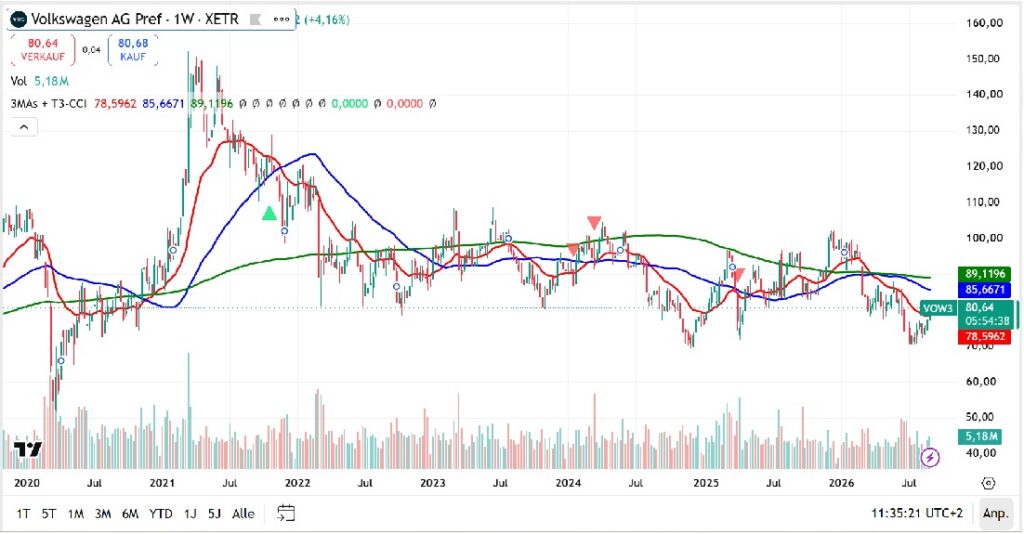
TradingView currently reports the Xetra-listed Volkswagen preference share at a trailing P/E around 7.4, with the shares substantially below their levels of a year ago.
Those numbers require caution.
Low valuation multiples can indicate opportunity.
They can also indicate that investors do not trust future earnings.
Volkswagen’s valuation therefore needs to be considered against three competing interpretations.
The optimistic interpretation:
The market excessively discounts Volkswagen’s structural problems and gives insufficient value to the potential earnings improvement from Future Plan 2030.
The neutral interpretation:
Volkswagen deserves a low multiple because execution risk, capital intensity, China exposure, governance complexity and automotive cyclicality remain unusually high.
The pessimistic interpretation:
Current earnings themselves are not an appropriate valuation anchor because the company may require years of restructuring expenditure and investment before sustainable profitability improves.
This is why simply describing Volkswagen as “cheap” provides little useful investment information.
- THE INVESTMENT EQUATION: MARGIN MULTIPLIED BY MULTIPLE
The potentially powerful part of a successful Volkswagen turnaround comes from two variables moving simultaneously.
First, earnings could rise if operating margins improve.
Second, investors might become willing to assign those earnings a higher valuation multiple if they become more predictable.
That creates the theoretical possibility of a double re-rating:
higher earnings;
higher valuation of those earnings.
But the reverse is equally possible.
If margins remain weak and confidence in the 2030 targets deteriorates, Volkswagen could remain a classic value trap: apparently inexpensive for years without generating corresponding shareholder returns.
The stock therefore needs evidence, not simply optimism.
- BULL, BASE AND BEAR CASE
BULL CASE
Future Plan 2030 is executed substantially as intended.
Complexity falls dramatically.
Overcapacity is removed.
Labour and overhead costs decline.
Technology platforms become genuinely shared across brands.
Volkswagen stabilises its position in China while maintaining European scale.
Approximately nine million annual vehicles become sufficient to produce substantially higher profitability.
Operating margin moves meaningfully toward the 9% objective.
In this scenario, Volkswagen could eventually deserve both higher earnings expectations and a higher valuation multiple.
BASE CASE
Volkswagen achieves meaningful cost reductions but implementation takes longer than management hopes.
European demand remains modest.
China stays intensely competitive.
Tariffs and regionalisation increase costs.
Some restructuring benefits are absorbed by continued investment requirements.
Margins recover but remain below the 9% target.
Volkswagen becomes financially stronger without becoming a fundamentally different business.
This would still represent improvement, but not necessarily the dramatic transformation implied by the headline restructuring.
BEAR CASE
Political and labour constraints slow capacity reduction.
Chinese competition intensifies.
European manufacturers lose additional market share.
Volkswagen continues carrying excessive complexity.
Software and technology programmes require further investment.
Tariffs and geopolitical fragmentation increase production costs.
The company cuts jobs but fails to generate corresponding productivity improvements.
Margins remain structurally weak.
In that scenario, 100,000 job reductions would represent evidence of contraction rather than successful transformation.
- WHAT WOULD CHANGE THE INVESTMENT THESIS?
Investors should not wait until 2030 to determine whether Future Plan 2030 worked.
Evidence should emerge progressively.
The most important indicators include:
Operating margin.
Overhead costs.
Automotive net cash flow.
R&D and capital expenditure efficiency.
Factory utilisation.
Vehicle deliveries relative to capacity.
European market share.
Chinese market performance.
BEV order growth and profitability.
Software-development progress.
Model and configuration reduction.
Execution of workforce reductions.
Capital allocation.
And ultimately free cash generation per vehicle.
Volkswagen’s first-half 2026 net cash flow was €3.2 billion, while management’s full-year outlook called for automotive net cash flow of €3 billion to €6 billion and net liquidity of €32 billion to €34 billion.
These financial measures will help reveal whether restructuring is producing genuine economic improvement rather than simply smaller headcount.
- WHAT THE MARKET SAID ABOUT THE PLAN
The immediate equity reaction was noteworthy.
Volkswagen preference shares rose sharply following approval of the restructuring plan, with Reuters reporting an increase of approximately 7.9% on 3 September.
That reaction should not be confused with proof that the turnaround will succeed.
But it does reveal something important.
Investors appear to assign economic value to Volkswagen becoming more aggressive about restructuring.
That makes subsequent price behaviour particularly interesting.
If the market progressively rewards evidence of execution, the equity story could evolve from restructuring speculation toward an earnings-recovery thesis.
If the initial rally fades despite successful headline announcements, investors may be signalling that implementation risk remains dominant.
- VOLKSWAGEN IS ALSO A TEST OF EUROPEAN INDUSTRIAL COMPETITIVENESS
There is a wider investment theme here.
Volkswagen is not alone.
European manufacturing faces high energy costs, expensive labour, regulation, geopolitical fragmentation and growing Chinese competition.
The automotive sector magnifies all of these pressures.
Volkswagen therefore represents something larger than one corporate turnaround.
It asks whether Europe’s mature industrial champions can restructure quickly enough to compete against younger, vertically integrated and increasingly technologically sophisticated Asian competitors.
Volkswagen possesses enormous strengths:
Global brands.
Scale.
Engineering expertise.
Distribution.
Manufacturing infrastructure.
Customer relationships.
Purchasing power.
Financial resources.
But those advantages matter only if the organisation can deploy them efficiently.
Scale without agility can become bureaucracy.
Brand heritage without technological competitiveness can become nostalgia.
Manufacturing capacity without demand becomes cost.
The transformation is ultimately about converting Volkswagen’s size back from a liability into an advantage.
CONCLUSION: THE 100,000 JOB CUTS ARE NOT THE THESIS — THE 9% MARGIN IS
The dramatic headline is approximately 100,000 positions.
The investment question is 9%.
Volkswagen is attempting to transform a Group producing first-half 2026 operating profitability of only 3.8% into one capable of achieving a 9% operating margin by 2030.
That requires far more than layoffs.
It requires Volkswagen to reduce complexity, eliminate excess capacity, improve productivity, rationalise technology, strengthen software capabilities, allocate capital more efficiently and compete successfully against increasingly powerful Chinese manufacturers while continuing to invest enormous sums in the future automobile.
There is therefore a major distinction between restructuring and successful restructuring.
The first has now clearly begun.
The second remains to be demonstrated.
For investors, that is what Volkswagen is worth understanding.
The stock does not require investors to predict the automobile industry of 2035 today.
It requires them to monitor whether Volkswagen can progressively close the enormous gap between the company it currently is and the company Future Plan 2030 says it intends to become.
That evidence should eventually appear in margins, cash flow, capital efficiency and market share.
Those numbers — rather than the number of jobs eliminated — will ultimately determine whether Volkswagen’s historic restructuring creates shareholder value.
DISCLAIMER
This information represents independent financial market research for informational purposes only and does not constitute investment advice, financial advice or a recommendation to buy or sell any financial instrument. Investment decisions remain the responsibility of the individual investor.