 LWAYS OPEN

Final Resurrection Limited & TITAN Options Circle | Research & Strategy Discussions
Published: 20 November 2026 | Strategy horizon: 23–27 November 2026
As AI-related selling spreads across global equities, cybersecurity has emerged as an unusual pocket of resilience. But chasing the last outperforming sector may offer less advantage than identifying when selective strength becomes sustainable leadership. A shortened Thanksgiving trading week makes that distinction particularly important.
The Last Strong Sector Is Not Necessarily the Best Opportunity
The most dangerous assumption in a falling market is that the last sector showing strength must be the safest place to invest.
Cybersecurity has recently provided an encouraging exception to widespread equity weakness. Palo Alto Networks delivered stronger results, raised its outlook and helped several industry peers outperform while semiconductor shares remained under pressure.
The obvious response is to concentrate attention on cybersecurity.
But the more important question is whether that strength represents the beginning of a sustainable leadership cycle—or merely a temporary concentration of demand in a market where investors are still reducing risk.
These outcomes require fundamentally different strategies.
There is another complication. The coming week contains an important cluster of US economic releases, followed immediately by Thanksgiving and a shortened Friday session. Investors will therefore have less regular trading time to evaluate potentially significant changes in inflation expectations, interest rates and market positioning.
In this environment, activity is not automatically an advantage.
The central strategic opportunity may be to preserve flexibility while the market reveals whether cybersecurity is becoming genuine leadership, whether a broader recovery is developing, or whether apparent resilience is simply the final stage before further selling.
1. The Starting Point: A Market That Is Rejecting Good News
A successful weekly strategy must begin with the market’s actual behaviour rather than a preferred economic narrative.
KNOWN FACTS
On Thursday, 19 November, the S&P 500 declined approximately 2% for its sixth consecutive losing session. More than 90% of its constituent companies finished lower.
Anthropic’s historic IPO initially supported enthusiasm for artificial intelligence, but that enthusiasm failed to sustain the broader market.
The Nasdaq Composite fell approximately 2.3%, while NVIDIA reversed early gains and finished lower.
On Friday morning, the selling extended across international markets. Reuters reported particularly substantial pressure on Asian equities and European technology companies.
Sources: Associated Press, 19 November | Reuters, 20 November
SIGNAL
The problem is no longer limited to an isolated decline in semiconductor valuations.
The selling has become sufficiently broad that even positive company-specific developments struggle to generate lasting support for major equity indices.
This is an important regime characteristic.
During a healthy advance, positive earnings announcements often reinforce existing momentum. In a deteriorating market, the same announcements may produce only temporary rallies as investors use higher prices to reduce exposure.
IMPLICATION
A one-week strategy should not begin by identifying the most oversold stocks.
It should begin by establishing whether the market is still rewarding positive information.
If good news continues to produce brief rallies followed by renewed selling, the immediate challenge is not insufficient investment opportunity. It is the absence of confirmed demand.
Why a market rebound may not be enough
Even a substantial one-day recovery would not necessarily invalidate the current defensive interpretation.
Short covering, options-related hedging adjustments and temporary reductions in selling pressure can produce sharp advances without establishing a sustainable trend.
The important distinction is between a rebound caused by the disappearance of sellers and an advance supported by a broadening group of buyers.
Only the second provides persuasive evidence of improving market structure.
2. Why Cybersecurity Is Different — And Why That May Not Be Enough
Cybersecurity deserves attention because its recent strength has a fundamental catalyst.
Palo Alto Networks reported fiscal first-quarter 2027 revenue of approximately $3.44 billion, an increase of 39% year over year.
Its next-generation security annual recurring revenue reached approximately $9.73 billion, up 66%, while remaining performance obligations increased 35% to approximately $21 billion.
The company also raised its full-year guidance.
These are measurable business developments, not merely changes in investor sentiment.
Source: Palo Alto Networks, Fiscal Q1 2027 Results, 18 November 2026
Palo Alto’s shares subsequently gained approximately 6.4% on 19 November.
Several cybersecurity peers, including CrowdStrike and Zscaler, also advanced, although performance was not uniformly positive across the entire group.
WHY THIS MATTERS
Enterprise cybersecurity spending has economic characteristics that differ from certain discretionary technology investments.
Companies can sometimes postpone new hardware projects or delay the expansion of computing infrastructure.
They may have considerably less flexibility when responding to operational security threats, regulatory obligations or vulnerabilities affecting critical business systems.
That distinction can create relative earnings resilience.
However, it does not eliminate valuation risk.
Cybersecurity companies remain exposed to technology-sector sentiment, customer budgets, acquisition execution, competitive pressure and the cost of capital.
Palo Alto itself has announced an agreement to acquire Applied Compute for approximately $4.5 billion, introducing another material capital-allocation consideration.
Strong business fundamentals and attractive short-term share-price asymmetry are not interchangeable.
The strategic question is therefore whether investors are rewarding a durable improvement in cybersecurity economics or temporarily concentrating their exposure in the few technology companies still producing positive surprises.
3. TITAN EDGE — When the Last Winner Becomes a Crowded Trade
The strongest non-obvious risk in the present market is the possibility that cybersecurity’s relative strength becomes a source of vulnerability.
This is a second-order effect.
When many sectors decline simultaneously, investors looking for long equity exposure may gravitate toward the small number of companies maintaining positive momentum.
That behaviour can reinforce those companies’ relative performance.
But the same process may increase their sensitivity to a subsequent deterioration in broader market sentiment.
If investors eventually decide to reduce total equity exposure rather than simply rotate between sectors, even fundamentally strong companies can face selling pressure.
The potential transition is from selective sector rotation to broad portfolio-level deleveraging.
The difference matters because cybersecurity can outperform the S&P 500 while still generating negative absolute returns.
The hidden concentration inside a cybersecurity ETF
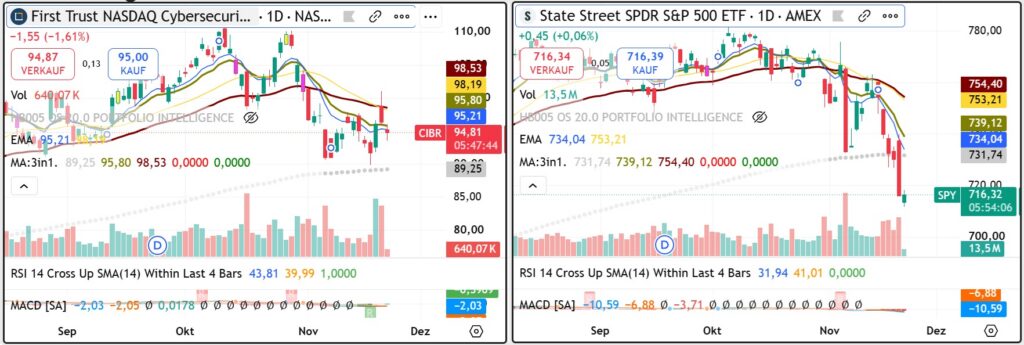
The First Trust Nasdaq Cybersecurity ETF, CIBR, provides an instructive example.
According to its holdings as of 19 November 2026:
- CrowdStrike represented approximately 8.75% of the portfolio.
- Palo Alto Networks accounted for approximately 7.86%.
- Broadcom, which also has significant semiconductor exposure, represented approximately 7.78%.
Together, those three holdings accounted for approximately 24.4% of the fund.
Source: First Trust, CIBR Holdings, 19 November 2026
This composition demonstrates why a cybersecurity ETF should not automatically be interpreted as a pure defensive instrument.
Its performance may reflect a combination of cybersecurity demand, exposure to broader technology businesses and concentration in a limited number of influential constituents.
THE ASYMMETRY
An investor who enters after an earnings-driven rally may face limited additional upside if expectations have already adjusted, while remaining exposed to a broader market decline.
By contrast, observing whether relative strength survives the next market setback can provide information before taking equivalent directional risk.
This does not mean cybersecurity must decline.
It means the value of confirmation rises when market leadership is unusually narrow.
The more concentrated the remaining strength becomes, the more important it is to distinguish genuine demand from temporary relative shelter.
4. The Three Strategic Choices for the Coming Week
The next week presents three meaningful analytical approaches. None should be treated as automatically superior under every market condition.
STRATEGY A — Preserve Flexibility Until the Market Stabilises
This is the reference framework while market breadth remains poor and volatility elevated.
The objective is not to predict the exact bottom.
It is to avoid confusing a temporary reduction in selling pressure with a durable reversal.
Approach
Maintain a higher threshold for establishing new directional exposure. Assess whether rallies survive into the close, whether more sectors participate and whether credit markets support the improvement.
The important advantage is optionality.
Capital that has not been committed remains available if market conditions improve or valuations become more compelling.
The opportunity cost is missing part of an abrupt rebound.
That cost must be weighed against the potential damage from repeatedly entering failed recoveries.
What changes the assessment?
A sustained improvement in breadth, volatility and relative strength across multiple sectors would weaken the case for continued observation.
STRATEGY B — Study Cybersecurity as a Conditional Leadership Candidate
Cybersecurity offers a distinct opportunity to investigate whether company-level strength can develop into sector-wide leadership.
However, the signal should pass three tests.
Test 1: Absolute strength
Does the cybersecurity sector advance in its own right, or merely fall less than the broad market?
Test 2: Participation
Do several companies—including Palo Alto, CrowdStrike, Zscaler and Fortinet—demonstrate sustained relative strength, rather than one earnings winner carrying the entire narrative?
Test 3: Persistence
Does the strength survive subsequent sessions and periods of broader market weakness without immediately reversing?
A combination of positive absolute returns, broad peer participation and sustained relative performance would provide materially stronger evidence than a single earnings-related rally.
If the sector fails these tests, the observed advantage may be much narrower than headlines imply.
STRATEGY C — Prepare for a Broad Recovery Without Anticipating It
An alternative opportunity arises if the market begins to stabilise beyond cybersecurity.
A convincing recovery would involve improving participation among semiconductors, industrial companies, smaller businesses and other economically sensitive sectors.
This does not require every sector to rise simultaneously.
It requires evidence that new demand is expanding rather than remaining concentrated.
What changes the framework?
Improving market breadth alongside stabilising volatility and reduced pressure on semiconductor stocks would suggest that the opportunity is moving beyond isolated defensive or earnings-related strength.
Until that happens, a recovery remains a scenario rather than an established development.
5. The Options Question: Does High Volatility Create an Advantage?
For the TITAN Options Circle, current conditions raise a separate question.
Elevated volatility can create substantial option premiums.
That observation is frequently interpreted as an opportunity to sell volatility or structure directional positions.
But high premiums are not inherently attractive.
They may compensate for a genuine increase in the probability or magnitude of adverse price movements.
An options strategy should therefore be evaluated according to the specific risk being expressed.
Directional exposure
A defined-risk debit spread can provide exposure to a confirmed directional thesis while limiting the maximum contractual loss to the net premium paid.
However, the limited maximum loss does not make the spread inexpensive.
Entry pricing, the volatility surface, strike selection and the remaining time to expiration all affect its attractiveness.
Income-oriented premium selling
Credit spreads offer defined contractual maximum risk when constructed correctly, but elevated implied volatility does not guarantee favourable expected returns.
Large price gaps can rapidly overwhelm the premium received.
Selling options solely because premiums appear unusually high risks misunderstanding what the market is charging for.
Existing equity exposure
Protective puts or collars may provide an analytical framework for evaluating downside protection.
Their usefulness depends on premium costs, liquidity, expiration dates and the amount of upside surrendered.
A covered call, by itself, does not provide substantial protection against a large decline in the underlying stock.
Why the Thanksgiving calendar matters
The week is especially sensitive to timing.
US equity markets will be closed on Thursday, 26 November, and will close early on Friday, 27 November.
The shortened trading schedule reduces opportunities to adjust positions after major midweek information becomes available.
Option prices generally incorporate expected non-trading periods; holidays do not create automatic free time-decay profits.
For short-dated positions, the relevant risks include event-driven gaps, widening spreads and limited opportunities to manage exposure.
TITAN IMPLICATION
In this environment, the value of an options structure must come from a clearly identified directional, volatility or hedging advantage—not from the assumption that high implied volatility or an approaching expiration automatically creates favourable asymmetry.
Without current option-chain information, implied-versus-realised volatility comparisons and executable bid-ask quotes, no specific structure can be judged attractively priced.
6. The Thanksgiving Week: A Five-Day Decision Framework
The calendar makes the week of 23–27 November unusual.
| Day | Primary analytical task | What matters |
|---|---|---|
| Monday, 23 Nov | Establish market structure | Does Friday’s weakness continue, and is cybersecurity still relatively strong? |
| Tuesday, 24 Nov | Test persistence | Can relative leaders sustain gains while broader participation improves or deteriorates? |
| Wednesday, 25 Nov | Reassess after macroeconomic releases | Do inflation and growth data change yields, volatility and equity leadership? |
| Thursday, 26 Nov | US Thanksgiving holiday | No regular US equity trading; reassess the information without assuming an executable US cash-market reaction |
| Friday, 27 Nov | Evaluate shortened session | Distinguish durable signals from thin-session price movements and reassess risk carried into the following week |
The US Bureau of Economic Analysis schedules its second estimate of third-quarter GDP and October personal income and outlays, including PCE inflation data, for Wednesday, 25 November, at 8:30 a.m. Eastern Time.
The New York Stock Exchange confirms that the regular equity session on Friday, 27 November, ends at 1:00 p.m. Eastern Time.
Sources: BEA Release Calendar | NYSE Trading Calendar
THE SECOND-ORDER EFFECT
A major economic surprise on Wednesday could change expectations for Federal Reserve policy just before a US market holiday.
The direction of Treasury yields alone will not reveal whether the development is favourable for equities.
Falling yields associated with easing inflation expectations may provide valuation support.
Falling yields associated with deteriorating growth expectations may coincide with additional pressure on corporate earnings assumptions.
The market’s response must therefore be interpreted through the combination of yields, credit spreads, sector performance and breadth.
7. Four Scenarios That Could Define the Week
SCENARIO 1 — The Selloff Broadens
Trigger: Renewed semiconductor weakness and deterioration in previously resilient sectors.
Market consequence: Greater correlation across equities, potentially reducing the protection offered by sector selection.
Confirmation: Negative breadth, persistent volatility and weakening performance in cybersecurity.
Invalidation: Sustainable improvement in participation and the emergence of several independent sources of equity strength.
Strategic implication: Selectivity becomes less effective when market-wide risk dominates company-specific fundamentals.
SCENARIO 2 — Cybersecurity Establishes Genuine Leadership
Trigger: Continued favourable earnings interpretation and sustained demand across multiple cybersecurity businesses.
Market consequence: A narrow but identifiable pocket of equity strength may persist despite broader weakness.
Confirmation: Positive absolute sector performance, improving cybersecurity-to-market relative strength and participation beyond the largest constituents.
Invalidation: Rapid reversal of earnings-related gains or deterioration across previously resilient peers.
Strategic implication: Relative leadership becomes more analytically credible, but the sector remains exposed to overall equity-market risk.
SCENARIO 3 — A Broad Relief Rally Develops
Trigger: Improving macroeconomic expectations, stabilising semiconductor shares and reduced demand for downside protection.
Market consequence: The strongest short-term rebounds may occur outside the sectors that previously held up best.
Confirmation: Positive breadth, improving cyclicals and smaller companies, and falling volatility alongside stable credit conditions.
Invalidation: Repeated intraday reversals or rallies concentrated in only a handful of large-cap names.
Strategic implication: The relative advantage of cybersecurity could diminish even if its shares continue rising.
SCENARIO 4 — Macro Data Reprice the Interest-Rate Outlook
Trigger: Wednesday’s inflation or growth figures materially alter expectations for the Federal Reserve.
Market consequence: Equity performance may become increasingly sensitive to changes in discount rates and earnings expectations.
Confirmation: Coherent moves across Treasury yields, the dollar, credit markets and sector leadership.
Invalidation: A short-lived market response that reverses without broader confirmation.
Strategic implication: The dominant driver may shift from AI-related valuation concerns toward a wider macroeconomic repricing.
These scenarios are conditional frameworks. No unsupported probabilities or price targets are assigned.
8. WHAT TO WATCH — Five Signals That Matter More Than the Headlines
1. Cybersecurity relative to the S&P 500
Measure: CIBR/SPY.
A rising ratio indicates cybersecurity outperformance. But the ratio should be evaluated alongside CIBR’s own absolute return.
Strengthening signal: The ratio advances while CIBR gains and multiple cybersecurity constituents participate.
Weakening signal: The ratio advances only because the S&P 500 falls faster, or reverses as the sector’s strongest companies weaken.
2. Semiconductor leadership and breadth
Measure: Semiconductor performance using SMH, together with participation among major semiconductor companies.
Strengthening signal for recovery: Semiconductor shares stabilise and broader participation improves.
Weakening signal: New semiconductor lows despite positive AI-related announcements.
The sector remains a useful test of whether investors are rebuilding confidence in the economics of AI infrastructure.
3. Market breadth beyond mega-cap technology
Measure: Advancing versus declining S&P 500 constituents and the relative performance of equal-weight versus capitalisation-weighted equity exposure.
Strengthening signal: Several sectors contribute to improving market performance.
Weakening signal: Index rebounds depend on a small number of highly weighted constituents while most stocks remain weak.
4. Volatility and credit-market confirmation
Measure: VIX together with US high-yield credit spreads.
Strengthening signal: Volatility declines while credit spreads remain stable or narrow and equity participation improves.
Weakening signal: Persistent volatility combined with widening credit spreads.
Credit stress would suggest that the correction is extending beyond equity valuation concerns.
5. Wednesday’s economic data and the bond-market response
Measure: PCE inflation, GDP revisions, two-year and ten-year Treasury yields, and subsequent equity-sector behaviour.
Strengthening signal: A macroeconomic response consistent with improving financial conditions and stabilising earnings expectations.
Weakening signal: Rising yields accompanied by renewed growth-stock selling, or falling yields accompanied by increasing credit stress and deteriorating breadth.
The important signal is not the direction of one indicator but the consistency of the wider market response.
9. Conclusion — The Strategy Is to Let the Market Earn Our Confidence
The coming week does not require a prediction that cybersecurity will continue rallying.
Nor does it require the assumption that a heavily sold market must immediately recover.
The most useful strategy is a conditional framework that distinguishes three states: unresolved market-wide selling, selective sector leadership and an increasingly broad recovery.
Cybersecurity currently deserves attention because its relative resilience has identifiable fundamental support.
Yet even that strength must be tested against concentration, valuation, market breadth and the possibility of broader risk reduction.
The Thanksgiving calendar increases the importance of these distinctions because important economic information will arrive before an extended interruption to regular US trading.
The strategic advantage is not simply identifying where the last buyers are. It is establishing whether those buyers are strong enough to support a sustainable opportunity.
Capital flexibility, disciplined confirmation and a willingness to change the interpretation when the evidence changes may therefore matter more than the number of positions initiated during the week.
WIEDER WAS GELERNT
A market with only one visibly strong sector teaches an important lesson about the difference between relative performance and genuine investment opportunity.
Investors naturally search for strength when most assets are declining. But finding the least vulnerable sector does not establish that its future return distribution has become attractive.
The distinction matters because relative winners may continue receiving capital while other sectors weaken, creating an appearance of resilience that can disappear if market-wide selling intensifies.
A more useful analytical process asks three questions: Is the sector rising in absolute terms? Is strength distributed across several companies? And does the advantage survive changes in the broader market environment?
These questions are applicable during corrections, sector rotations and speculative investment booms alike.
They also help distinguish an attractive business from an attractive moment to accept market risk.
The last sector standing is a signal worth studying—not a strategy worth following blindly.
DISCLAIMER
This publication provides general financial-market research and analytical discussion for informational purposes only. It does not constitute investment or financial advice, portfolio management, or a recommendation to buy or sell any financial instrument.
Investment decisions remain the responsibility of the individual investor. Options and derivatives involve additional risks, including potentially rapid losses, liquidity constraints and volatility-related pricing changes.
Research is based on information available on 20 November 2026, before completion of that day’s regular US trading session. All forward-looking scenarios are conditional analytical assessments.
© 2026 Final Resurrection Limited | FRL DEEP RESEARCH