 LWAYS OPEN

20 November 2026 | Research cut-off: European afternoon, before the regular US market opening
Anthropic’s record-breaking IPO raised billions and briefly pushed its valuation above $2 trillion. Yet its shares weakened immediately afterward. The central investment question lies beyond the stock price: whether explosive enterprise demand can generate sustainable cash returns against unprecedented computing commitments and an increasingly complex capital structure.
The Real Question Is Not Whether Anthropic Can Grow
The most consequential number in Anthropic’s IPO prospectus is not its $1.5 trillion valuation, its extraordinary revenue growth, or even the $104 billion accounting loss reported for the first nine months of 2026.
It is the approximately $900.9 billion in disclosed infrastructure and purchasing commitments supporting the company’s ambition to become one of the world’s dominant artificial intelligence providers.
That figure fundamentally changes how investors should evaluate the business.
Anthropic is no longer simply a fast-growing AI developer selling access to increasingly capable software. It is becoming a business whose competitive position depends on securing, financing and efficiently utilising enormous quantities of computing capacity over many years.
The distinction matters because revenue growth and economic value creation are not the same thing.
Thursday’s record-breaking IPO demonstrated exceptional demand for exposure to frontier artificial intelligence. Friday’s premarket retreat demonstrated that public-market investors are less certain about the price they should pay for that exposure.
Neither observation resolves the underlying investment case.
The real issue is whether Anthropic can convert its rapid commercial adoption into durable margins, internally generated capital and returns sufficient to justify both its valuation and its future infrastructure requirements.
That is where the analysis must begin.
1. The IPO: Exceptional Capital Formation, Uncertain Price Discovery
CONFIRMED DEVELOPMENT
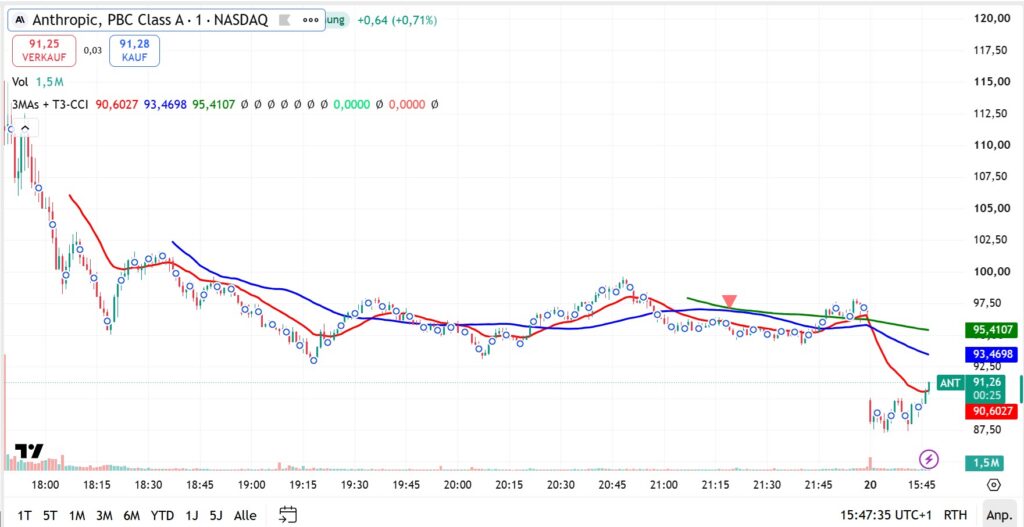
Anthropic priced its IPO at $83 per share on 18 November 2026, above the previously marketed range of $70–$78.
Trading began on Nasdaq under the symbol ANT on 19 November.
The shares opened at $111.50, briefly reached $115.10 and closed their first session at $97.17.
That closing price represented a gain of approximately 17.1% from the IPO allocation price but a decline of approximately 12.9% from the opening trade.
On Friday, 20 November, the shares fell as much as approximately 13% in premarket trading, reaching around $85.70, according to the Financial Times. The stock therefore approached its original offering price before its second regular trading session had begun.
These observations describe different reference points. They should not be interpreted as a completed second-day trading result.
Sources: Anthropic IPO announcement | Reuters, 20 November | Financial Times, 20 November
The final offering structure is particularly important.
| IPO component | Amount |
|---|---|
| IPO price | $83.00 per share |
| Public offering, including exercised overallotment | Approximately $93.5 billion |
| Of which gross proceeds to Anthropic | Approximately $91.6 billion |
| Concurrent private placement to strategic investors | Approximately $26.0 billion |
| Combined gross transaction value, including selling shareholders | Approximately $119.5 billion |
The public offering included shares sold by existing shareholders. Those proceeds did not accrue to Anthropic.
FRL INTERPRETATION
The IPO’s success demonstrates substantial access to capital. It does not establish that secondary-market investors will support the same valuation once the constraints of offering allocations disappear.
A large capital raise reduces immediate financing pressure.
It does not reduce the economic returns that the company must eventually generate to justify its enterprise valuation.
The distinction between access to capital and return on capital is the first essential principle in evaluating Anthropic.
2. What the Financial Statements Actually Reveal
Anthropic’s financial profile is more complicated, and in several respects more encouraging, than its widely reported net losses suggest.
The SEC prospectus provides the following historical financial information.
Selected reported financial metrics
USD billions, rounded. The nine-month 2026 period is not directly comparable with the full-year 2025 period.
| Metric | FY 2025 | 9M 2026 |
|---|---|---|
| Revenue | $4.59bn | $33.24bn |
| Compute and infrastructure expense | $7.33bn | $18.81bn |
| Operating result | −$8.06bn | −$1.26bn |
| Reported net result | −$41.97bn | −$104.04bn |
| Operating cash flow | −$2.64bn | +$6.57bn |
Source: Anthropic’s final SEC prospectus, November 2026
Three conclusions follow.
Revenue growth is extraordinary—and commercially meaningful
Anthropic generated $33.24 billion in revenue during the first nine months of 2026, compared with $2.55 billion in the corresponding period of 2025.
The company also reported more than 11,900 customers generating at least $100,000 of revenue annually on a trailing-twelve-month basis as of 30 September 2026.
Approximately 79% of revenue during the first nine months of 2026 came from consumption-based arrangements.
This matters because the business is demonstrating measurable commercial demand, rather than relying exclusively on speculative expectations of future adoption.
However, consumption-based billing also creates sensitivity to usage patterns, customer optimisation and pricing.
Higher adoption does not automatically produce proportionately higher revenue if customers become more efficient in their use of models or if competition reduces the price of inference.
Operating economics have improved substantially
Compute and infrastructure expenses represented approximately 172% of revenue during the first nine months of 2025.
That ratio declined to approximately 57% in the comparable 2026 period.
This is a material improvement in operating efficiency.
It suggests that revenue growth has begun absorbing an infrastructure cost base that was committed before the associated customer demand fully developed.
Anthropic’s nine-month operating loss consequently narrowed to approximately $1.26 billion despite the extraordinary increase in business activity.
But the improvement should not be mistaken for proof of permanent operating leverage. Future capacity additions may create new periods in which costs rise before revenues catch up.
The $104 billion net loss requires careful interpretation
Most of Anthropic’s enormous reported net loss for the first nine months of 2026 was associated with accounting revaluations of convertible notes and related financial instruments.
The prospectus records approximately $94.3 billion of expense from changes in the fair value of convertible notes, derivatives and similar instruments.
These valuation-driven accounting effects are not equivalent to recurring operating cash expenditure.
The distinction is important.
A reader focusing exclusively on the headline net loss could substantially overstate the deterioration in the company’s underlying operating economics.
Conversely, removing these unusual accounting effects does not establish that Anthropic has achieved sustainable free-cash-flow profitability.
Both conclusions would be premature.
3. The Hidden Variable: Compute Economics, Not Revenue Growth
The central investment variable is the relationship between future AI revenue and the economic cost of delivering that revenue.
Anthropic has disclosed approximately $900.9 billion of aggregate purchase and lease commitments, substantially related to computing infrastructure.
According to its prospectus:
- Approximately $70.7 billion falls due within twelve months of 30 September 2026.
- Approximately $451.6 billion is expected to be incurred before the end of 2030.
- Much of the remaining amount extends through 2045.
- Approximately $186.2 billion relates to arrangements subject to specified termination rights or conditions before commencement.
The company also estimates another $150–$175 billion of payments under certain computing arrangements without fixed dollar commitments, which are excluded from the $900.9 billion figure.
These amounts are not equivalent to debt immediately payable, nor should they all be treated as unconditional liabilities of the same kind. Timing, contract conditions and accounting treatment matter.
Nevertheless, they indicate an exceptionally substantial long-term commitment to infrastructure.
THE INVESTMENT RESEARCH EDGE
The most important measure may ultimately be the amount of sustainable economic profit Anthropic can generate from each dollar of committed computing capacity.
Consider the underlying mechanics.
Anthropic must secure computing resources before it can reliably forecast the complete demand for future generations of AI models.
If customer adoption accelerates, early capacity commitments may provide a valuable competitive advantage by securing availability and favourable supply conditions.
If demand underperforms, customers optimise usage more aggressively, or model efficiency advances faster than expected, the company may face underutilised capacity or infrastructure whose economics have changed since contracts were signed.
This creates a structural asymmetry.
The cost of securing capacity may be partly fixed years in advance, while the revenue ultimately generated from that capacity remains exposed to competitive pricing and changing demand.
FRL INTERPRETATION
The economics of frontier AI may increasingly resemble a combination of software distribution and infrastructure-intensive industrial capacity management.
The software business rewards adoption, recurring usage and scale.
The infrastructure business requires long-term forecasting, financing discipline, asset utilisation and careful management of technology obsolescence.
Investors who value Anthropic exclusively as a rapidly scaling software company risk overlooking the second set of requirements.
That does not invalidate a premium valuation. It changes what must be demonstrated to sustain it.
4. Why Positive Operating Cash Flow Does Not Settle the Question
One of the most encouraging disclosures in the prospectus is Anthropic’s positive operating cash flow.
For the first nine months of 2026, the company generated approximately $6.57 billion from operating activities.
That compares with approximately $2.02 billion used in operating activities during the corresponding period of 2025.
This is genuine progress.
However, the full capital-allocation picture includes investing activities, lease arrangements and future contractual payments.
During the first nine months of 2026, Anthropic reported approximately $925 million in purchases of property and equipment and $1.96 billion in prepayments for leased assets and equipment.
Its total investing cash outflow reached approximately $36.55 billion, although much of that amount related to purchases of short-term financial investments rather than physical infrastructure.
It would therefore be misleading to classify the entire investing outflow as capital expenditure.
Equally, a simple calculation of operating cash flow minus conventional property and equipment purchases would not capture the full economic cost of future infrastructure commitments.
INVESTOR QUESTION
Can Anthropic generate sustained operating cash flow after financing the actual deployment, renewal and replacement of the infrastructure needed to remain competitive?
The question matters more than a single quarter’s reported cash generation.
5. A Less Obvious Dependency: The Investors Are Also Part of the Infrastructure Ecosystem
Anthropic’s capital structure contains an additional feature that deserves particular attention.
Alongside the public offering, the company completed a $26 billion private placement with strategic partners including AMD, Broadcom, Google, Micron Technology, Microsoft, NVIDIA and a TSMC-related entity.
These companies operate across the semiconductor, computing and cloud infrastructure ecosystem.
At the same time, cloud service provider marketplaces accounted for approximately 44% of Anthropic’s revenue during the first nine months of 2026.
This creates an unusually interconnected commercial structure.
Some participants in the broader ecosystem are involved in financing, supplying or distributing the products on which Anthropic’s growth depends.
WHY IT MATTERS
Strategic partnerships can deliver substantial benefits.
They may improve access to scarce computing capacity, reduce deployment friction, support customer acquisition and strengthen Anthropic’s position against competing AI developers.
But they also create questions about bargaining power, economic dependence and the distribution of returns throughout the supply chain.
For example, rising AI demand can create value for Anthropic while also generating revenue for its cloud and semiconductor partners.
The ultimate economics depend on how that value is divided.
A growing customer relationship does not necessarily imply that the AI developer captures the largest share of the value created.
Nor does participation in the private placement establish that suppliers will provide economically favourable capacity indefinitely.
THE SECOND-ORDER CONSEQUENCE
The strategic relationship between AI developers and infrastructure providers may help finance industry expansion while making it harder to distinguish independent customer demand from the broader financing and commercial arrangements supporting that expansion.
That is not evidence that reported revenue is fictitious. It is a reason to examine customer concentration, marketplace fees, contractual commitments and related-party dependencies carefully.
The strongest investment analysis must follow the cash flows across the ecosystem rather than evaluating each company in isolation.
6. Valuation: An Exceptional Company Can Still Carry Exceptional Expectations
Anthropic’s IPO price implied a fully diluted valuation of approximately $1.5 trillion.
At Thursday’s closing price, its fully diluted valuation approached $1.77 trillion.
By Friday morning, Reuters reported a fully diluted valuation of approximately $1.6 trillion following the decline in the share price.
Reuters described the valuation as approximately 40 times revenue over the preceding twelve months.
This represents a substantial premium based on the expectation that Anthropic will continue expanding rapidly while materially improving its profitability.
The commercial opportunity is significant.
However, the valuation is sensitive to several variables that are not yet proven over a long operating history:
- How long exceptional revenue growth can continue.
- Whether inference prices will remain economically attractive as competition intensifies.
- How much incremental computing investment will be required.
- Whether new model generations can sustain competitive differentiation.
- How much future cash flow ultimately accrues to common shareholders after infrastructure financing and dilution.
A valuation model based on rapid growth and substantial eventual margins can be highly sensitive to relatively small changes in these assumptions.
For that reason, the correct comparison is not simply Anthropic versus the valuations of established software companies.
The relevant question is how much future free cash flow the business can generate after accounting for the capital requirements that make its technology commercially possible.
No precise fair-value target can be justified from the available evidence without making substantial assumptions about long-term revenue, infrastructure renewal, margins and dilution.
7. BULL, BASE AND BEAR — Three Fundamental Outcomes
BULL CASE — Computing Scale Becomes a Competitive Advantage
Assumptions
Enterprise AI adoption continues expanding rapidly. Anthropic maintains meaningful differentiation in advanced reasoning, coding and enterprise workflows.
Capacity utilisation improves, inference efficiency rises and long-term infrastructure contracts provide attractive unit economics.
Operating cash flow grows sufficiently to finance a meaningful share of future infrastructure requirements.
What would confirm it?
Continued customer expansion, improved revenue per unit of computing capacity, strong enterprise retention, rising operating margins and increasingly resilient cash generation.
Investment implication
The company develops a durable economic advantage that could support a substantial valuation premium.
BASE CASE — Strong Growth, But Returns Remain Capital Intensive
Assumptions
Anthropic continues to grow, but competitive pressure increases and customers demand better pricing.
Computing efficiency improves, yet the company must continually reinvest to maintain its technological position.
Operating margins improve unevenly and free cash flow remains sensitive to capital-spending cycles.
What would confirm it?
Healthy revenue growth accompanied by substantial infrastructure spending, inconsistent margin expansion and continued dependence on external financing for major capacity additions.
Investment implication
The business remains strategically important, but its valuation becomes increasingly dependent on disciplined execution rather than the broader AI narrative.
BEAR CASE — Infrastructure Commitments Outrun Economic Returns
Assumptions
Model competition intensifies, pricing falls faster than operating costs, and some contracted computing capacity becomes economically unattractive.
The company experiences weaker utilisation, higher financing needs or more limited ability to convert revenue growth into sustainable cash flow.
What would confirm it?
Deteriorating unit economics, slower enterprise expansion, rising infrastructure expense relative to revenue, weakening operating cash conversion or substantial additional dilution.
Investment implication
Even continued revenue growth may be insufficient to prevent a significant valuation reassessment.
These scenarios are analytical frameworks, not probability estimates or forecasts of a particular share price.
8. WHAT CHANGES THE CASE?
Five observable developments will be especially important as Anthropic establishes its public-market reporting record.
1. Compute and infrastructure expense relative to revenue
This is the central operational indicator.
The comparable nine-month ratio improved from approximately 172% in 2025 to 57% in 2026.
Strengthening evidence: Further sustainable reductions without deterioration in service quality or reliance on temporary underinvestment.
Weakening evidence: Renewed expense acceleration that consistently exceeds revenue growth.
2. Enterprise customer expansion and spending depth
Anthropic has demonstrated substantial growth in high-value enterprise customers.
Strengthening evidence: Continued growth in high-spending customers and higher usage within established accounts.
Weakening evidence: Slower customer expansion, reduced consumption or evidence that usage growth depends on aggressive price reductions.
3. Operating cash flow versus infrastructure deployment
Strengthening evidence: Positive operating cash flow accompanied by improving cash generation after capital expenditure and lease-related payments.
Weakening evidence: Rising financing needs despite strong reported revenue growth.
The quality of cash generation matters more than the appearance of a positive operating cash-flow figure alone.
4. Pricing power and competitive differentiation
Strengthening evidence: Sustained demand for premium models, improving enterprise retention and successful monetisation of new capabilities.
Weakening evidence: Rapid commoditisation, weakening customer retention or a persistent decline in revenue generated per unit of computing resources.
5. Capital allocation, contractual commitments and dilution
Strengthening evidence: Transparent reporting on the deployment of committed capacity, disciplined infrastructure spending and reduced dependence on repeated equity financing.
Weakening evidence: Increasing contractual exposure without corresponding improvements in cash generation, or substantial additional shareholder dilution.
These indicators will provide considerably more insight into the underlying investment thesis than the volatility of the first few trading sessions.
9. Conclusion — The IPO Financed Expansion, Not the Investment Thesis
Anthropic has accomplished something exceptional.
It has demonstrated extraordinary enterprise adoption, rapidly improved reported operating economics and completed the largest public equity offering on record.
The company’s positive operating cash flow during the first nine months of 2026 is particularly important because it shows tangible progress toward supporting growth through its own operations.
Yet the scale of future infrastructure commitments creates a distinct long-term challenge.
The IPO improves Anthropic’s financial capacity to address that challenge. It does not establish that future investments will earn adequate returns.
For investors, the decisive distinction is between the value of artificial intelligence as a technology and the economic value ultimately captured by the companies financing and operating it.
Anthropic may become one of the most important enterprises in the global AI economy.
Whether its public-market valuation proves justified will depend less on the success of its initial offering than on the economics of the computing capacity it has committed to secure.
WIEDER WAS GELERNT
A major capital raise can strengthen a company’s balance sheet without making its equity valuation more attractive.
This distinction is especially important in industries where technological leadership depends on extraordinary investment commitments made years before the associated revenue is earned.
Conventional analysis often emphasises revenue growth, market share and the scale of a company’s addressable market. Those measures are useful, but they do not reveal how much capital must continually be committed to defend that growth.
Anthropic illustrates why investors should examine operating performance and future investment obligations together. Positive operating cash flow can coexist with very substantial long-term capital requirements, just as an enormous reported accounting loss can coexist with improving underlying business economics.
The transferable lesson is to evaluate not only how rapidly a company expands, but also how much economic value remains after financing the capacity required for that expansion.
Growth creates opportunity; the return on the capital required to sustain it determines economic value.
DISCLAIMER
This publication provides general financial-market and investment research for informational purposes only. It does not constitute investment or financial advice, portfolio management, or a recommendation to buy or sell any financial instrument.
Financial information reflects published company disclosures and market information available on 20 November 2026. Forward-looking scenarios represent independent analytical interpretations, not forecasts or guarantees of future performance.
© 2026 Final Resurrection Limited | FRL DEEP RESEARCH