 LWAYS OPEN


The semiconductor correction has created an unusual setup ahead of NVIDIA’s August 26 results. AI infrastructure fundamentals remain exceptionally strong, yet semiconductor price structure has weakened while broader equity indices remain comparatively resilient. Broadcom, TSMC and Cadence provide three distinct ways of participating in the AI capital-expenditure cycle, but their technical structures differ materially. The strategic question is therefore not simply whether NVIDIA will deliver strong results. It is whether enough weakness has already been priced into these adjacent AI exposures to justify accepting substantial event risk before the market receives NVIDIA’s next fundamental confirmation.
Strategic Research Thesis
The fundamental AI investment cycle remains powerful, but the tactical case for establishing exposure before NVIDIA earnings is considerably less uniform than the underlying industry narrative suggests.
NVIDIA enters its fiscal second-quarter announcement after reporting first-quarter revenue of $81.6 billion, including $75.2 billion from Data Center, and guiding to approximately $91 billion of second-quarter revenue. Expectations are therefore not merely high; they are embedded in an industry valuation framework that increasingly requires continued evidence of extraordinary capital deployment.
This matters for Broadcom, TSMC and Cadence because NVIDIA’s report functions as more than a company-specific earnings event. It is effectively a real-time audit of AI infrastructure demand.
Yet the three companies represent different positions in that ecosystem.
TSMC monetises manufacturing demand across NVIDIA and competing accelerator architectures. Broadcom participates directly in custom AI accelerators and networking infrastructure. Cadence supplies critical electronic-design automation, intellectual property and system-design tools required to create increasingly complex chips.
The strategic thesis is therefore selective:
The recent correction has improved the long-term valuation entry context for parts of the AI infrastructure ecosystem, but current market structure does not justify treating Broadcom, TSMC and Cadence as equivalent pre-earnings opportunities. Strategy must follow market structure.
NVIDIA Earnings Are Becoming an Industry Event
NVIDIA’s August 26 report has unusual importance because the company has become one of the clearest quantitative indicators of global AI capital expenditure.
Fiscal Q1 2027 revenue reached $81.6 billion, up 85% year over year, while Data Center revenue reached $75.2 billion, up 92%. Management subsequently guided toward approximately $91 billion of Q2 revenue.
At this scale, the market increasingly focuses on second-order questions rather than merely whether NVIDIA beats quarterly expectations.
How rapidly are hyperscalers deploying new AI capacity? Is accelerator supply still constrained? How quickly is Vera Rubin entering production? Are networking requirements expanding with compute? Are customers maintaining their capital-expenditure trajectories? Can margins remain exceptionally high as infrastructure becomes more complex?
Those questions directly affect the investment interpretation of Broadcom, TSMC and Cadence.
A strong NVIDIA report accompanied by robust forward commentary would reinforce the economic case for the entire AI infrastructure stack. A numerically strong quarter accompanied by more cautious forward commentary could produce the opposite market reaction.
That distinction is crucial.
Strong earnings are not necessarily the same thing as a positive earnings event.
Market Structure Is Sending a Warning
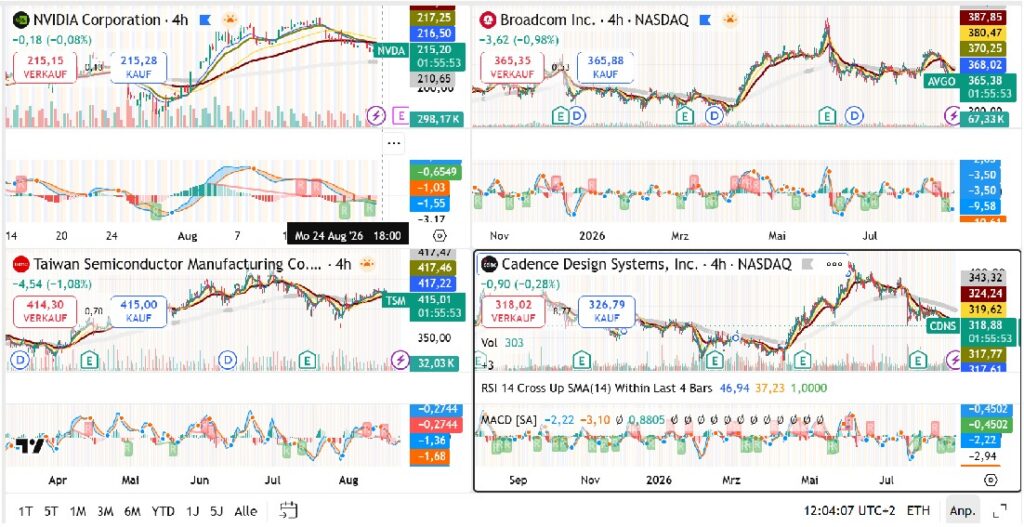
The supplied four-hour charts show a market that is considerably more complicated than the long-term AI growth narrative.
The S&P 500 and QQQ remain relatively close to elevated levels. The Magnificent Seven index is consolidating rather than collapsing. NVIDIA itself remains above important intermediate and longer-term trend measures.
Semiconductors are behaving differently.
The Philadelphia Semiconductor Index has weakened, and recent selling has pushed several individual semiconductor-related securities below important moving averages. At the same time, the VIX has moved higher, although levels around the mid-teens do not indicate systemic market stress.
This divergence matters.
When semiconductor stocks underperform while the broad market remains resilient, investors should not automatically interpret lower prices as bargains. Relative weakness can indicate that the market is reducing the valuation premium attached to a particular sector.
The immediate question is whether that repricing has gone far enough.
TSMC: The Strongest Structural Setup of the Three
TSMC occupies perhaps the most strategically interesting position because it does not require NVIDIA to remain the sole dominant AI architecture.
The foundry benefits from the increasing complexity and volume of advanced semiconductor production itself.
TSMC reported second-quarter revenue of $40.20 billion and guided Q3 revenue to $44.6–45.8 billion. July consolidated revenue reached NT$467.58 billion, 44.7% above the prior-year period, bringing year-to-date growth to 37%.
Those figures provide tangible evidence that advanced semiconductor demand remains strong despite the recent weakness in semiconductor equities.
The supplied four-hour chart also distinguishes TSMC from Broadcom and Cadence.
Around $419, TSM is trading close to its major moving-average cluster. Its longer-term moving average remains upward sloping, while price has stabilised after the decline from July highs.
That does not eliminate downside risk. A disappointing NVIDIA outlook could push TSM through the support zone around the longer-term trend structure.
But among the three securities examined here, TSMC currently presents the clearest combination of strong fundamental evidence and relatively intact technical structure.
There is also an important diversification argument.
AI customers increasingly develop proprietary accelerators alongside NVIDIA GPUs. That development potentially creates competitive risk for NVIDIA but does not necessarily create equivalent risk for TSMC. NVIDIA, Broadcom customers and hyperscaler-designed accelerators can all require advanced foundry capacity.
TSMC therefore represents exposure to the infrastructure layer beneath the architecture competition.
Broadcom: Exceptional AI Growth, Damaged Price Structure
Broadcom presents almost the inverse analytical problem.
Fundamentally, its AI business is expanding at extraordinary speed.
Fiscal Q2 revenue reached $22.187 billion, while AI semiconductor revenue reached $10.8 billion, increasing 143% year over year. Management indicated that Q3 AI semiconductor revenue could reach approximately $16 billion, representing growth of more than 200% year over year.
The strategic exposure is compelling.
Broadcom is becoming increasingly important in custom AI accelerators and high-speed networking, positioning the company as one of the principal beneficiaries of hyperscalers seeking alternatives and complements to NVIDIA’s architecture.
Yet the chart is substantially weaker than the fundamentals.
AVGO has retreated sharply from its August highs and, around the levels shown in the supplied chart, trades below all three principal moving averages.
That creates a classic conflict between fundamental conviction and market structure.
Buying weakness simply because a company has exceptional long-term fundamentals ignores the possibility that the market is repricing the valuation multiple rather than questioning the business.
Broadcom also has its own major event shortly after NVIDIA: fiscal Q3 results are scheduled for September 2.
An investor establishing exposure before NVIDIA therefore accepts two closely spaced information events.
That can produce considerable upside if NVIDIA validates AI infrastructure spending and Broadcom subsequently confirms accelerating custom-AI demand. But it also creates compounded event risk if expectations across the AI complex are being reset.
For Broadcom, therefore, the key missing ingredient is not fundamental evidence. It is technical confirmation that sellers have exhausted themselves.
Cadence: Strong Business, Weakest Tactical Structure
Cadence demonstrates why excellent businesses can still present difficult tactical setups.
Its second-quarter operating performance was strong.
Revenue increased to $1.584 billion from $1.275 billion one year earlier. Backlog reached a record $8.1 billion. Core EDA revenue grew 18%, IP revenue increased more than 40%, and System Design and Analysis revenue increased 37%.
Management raised its 2026 revenue outlook to approximately 19% growth and increased its non-GAAP EPS outlook.
The fundamental relationship to AI is also structurally attractive.
More complicated chips require more sophisticated design tools. Advanced packaging, chiplets, custom accelerators and increasingly complex systems can expand engineering requirements even when individual semiconductor companies compete against one another.
Cadence therefore represents an enabling layer of the AI semiconductor ecosystem rather than a simple directional wager on NVIDIA GPU shipments.
The difficulty is price structure.
Around $319 in the supplied chart, CDNS is below its short-, intermediate- and longer-term moving averages. The longer-term trend measure is around $347, leaving a meaningful technical gap that would need to be recovered before the earlier bullish structure could be considered restored.
Of the three securities analysed here, Cadence currently has the greatest conflict between business momentum and price momentum.
That does not invalidate the long-term investment case.
It does argue against assuming that strong fundamentals alone provide sufficient tactical justification for accepting NVIDIA event risk.
What Is Already Priced In?
This may be the most important question.
The market already knows that AI infrastructure spending is enormous.
It knows NVIDIA is growing rapidly.
It knows TSMC has constrained advanced manufacturing capacity.
It knows Broadcom’s AI semiconductor business is expanding dramatically.
And it knows Cadence benefits from increasing semiconductor design complexity.
The investment question is therefore not whether these developments are positive.
The question is what incremental information could force investors to increase or decrease the valuation they assign to those developments.
For NVIDIA, approximately $91 billion of Q2 revenue is already embedded in company guidance. The more important information may therefore concern future demand, product transitions, customer capital expenditure and margins.
This creates asymmetric event dynamics for related stocks.
A strong quarter that merely confirms existing expectations may not be sufficient to reverse weak semiconductor price structures.
Conversely, evidence that AI infrastructure spending is accelerating beyond already elevated assumptions could trigger rapid re-rating across the ecosystem.
This is precisely why buying before earnings and buying after confirmation are economically different strategies.
The first accepts uncertainty in exchange for potentially capturing the event gap.
The second sacrifices part of that potential initial move in exchange for new information.
Neither approach is universally superior.
The correct analytical framework depends on market structure and the amount of event risk the investor is deliberately choosing to carry.
Scenario Analysis
Bullish Scenario
NVIDIA reports results and guidance demonstrating that hyperscaler AI infrastructure spending remains exceptionally strong, while management provides convincing evidence of sustained accelerator, networking and next-generation platform demand.
Semiconductor risk appetite improves.
In this environment, TSMC’s intact longer-term structure could allow it to participate quickly in a sector recovery. Broadcom could benefit disproportionately if investors reconnect its rapidly expanding custom-AI business with renewed confidence in hyperscaler spending. Cadence could begin rebuilding its damaged technical structure if the market broadens the AI trade from hardware into design infrastructure.
Base Scenario
NVIDIA produces another strong quarter but largely meets already elevated expectations.
The immediate reaction becomes mixed.
Rather than generating a broad semiconductor rally, investors differentiate between companies according to valuation, earnings visibility and technical structure.
Under this scenario, TSMC’s relatively resilient structure becomes particularly relevant, while Broadcom and Cadence may require their own catalysts before recovering decisively.
Risk Scenario
NVIDIA’s results remain fundamentally strong but forward guidance, margins or management commentary suggest that the extraordinary growth rate of AI infrastructure investment is beginning to normalise.
The market interprets this as justification for further multiple compression across AI equities.
In that environment, Broadcom’s and Cadence’s already weakened technical structures could remain vulnerable, while TSMC’s moving-average support would face a significant test.
The key risk is therefore not an AI recession.
The key risk is that excellent AI growth proves insufficient relative to extraordinary market expectations.
The Counterargument
The strongest argument for establishing exposure before NVIDIA earnings is straightforward: waiting for confirmation can mean paying substantially higher prices.
If NVIDIA materially exceeds expectations and provides stronger-than-anticipated forward commentary, semiconductor stocks could gap higher before investors have an opportunity to react.
Broadcom’s recent correction could then appear excessive relative to its AI growth. Cadence’s fundamental momentum could attract investors seeking AI exposure outside the most crowded hardware names. TSMC could benefit from renewed confidence that advanced-node manufacturing demand remains structurally constrained.
There is also a broader argument.
The recent semiconductor correction has already removed some speculative excess without producing evidence that AI infrastructure spending itself has collapsed. TSMC’s monthly revenue, Broadcom’s AI growth and Cadence’s backlog all point in the opposite direction.
Waiting for perfect technical confirmation can therefore become expensive.
But that argument does not eliminate the distinction between opportunity and timing.
A lower price is useful.
A lower price combined with improving market structure is considerably more informative.
What Would Invalidate the Thesis?
The thesis would need to be reconsidered in either direction if NVIDIA materially changes the industry’s fundamental evidence.
A substantially stronger-than-expected forward demand picture accompanied by renewed semiconductor breadth would weaken the argument for tactical caution. Particularly important would be simultaneous recoveries in the Philadelphia Semiconductor Index and the damaged technical structures of Broadcom and Cadence.
Conversely, evidence that hyperscaler AI capital expenditure is slowing, accelerator demand is normalising materially, next-generation deployments are being delayed, or infrastructure economics are deteriorating would undermine the assumption that current semiconductor weakness primarily represents valuation adjustment rather than fundamental deterioration.
At company level, failure of TSMC’s longer-term trend support would weaken its relative technical advantage.
For Broadcom, continued inability to recover its major moving averages despite positive AI industry news would represent significant contrary evidence.
For Cadence, persistent trading below its longer-term trend structure despite strong operating performance would suggest that valuation compression remains unfinished.
FRL Strategic Research Outlook
The evidence does not support treating Broadcom, TSMC and Cadence as a single pre-NVIDIA earnings trade.
Their fundamental exposure to AI is strong, but their market structures are materially different.
TSMC currently has the most constructive strategic configuration of the three. Fundamental demand remains exceptionally strong, advanced manufacturing capacity retains strategic scarcity value, and the stock remains close to an important rising longer-term trend structure.
Broadcom has arguably the most explosive direct AI growth profile, but its technical structure has deteriorated sharply. That creates potentially substantial recovery leverage if NVIDIA validates hyperscaler spending, but also greater downside sensitivity if semiconductor multiple compression continues.
Cadence remains fundamentally impressive but technically the least convincing. Record backlog and accelerating AI-related design demand provide a strong structural thesis, yet price remains below the principal trend measures visible in the supplied chart.
The conclusion is therefore more nuanced than simply buying semiconductor weakness ahead of NVIDIA.
The recent correction has improved the strategic entry landscape, but it has not removed event risk.
For investors evaluating deployment before August 26, the critical distinction is between anticipating confirmation and paying for confirmation.
Anticipation offers the greater potential benefit from an earnings-driven gap but accepts substantially more uncertainty.
Confirmation may require accepting a higher entry price, but it provides new information about the durability of the AI capital-expenditure cycle and, crucially, whether the semiconductor market itself is prepared to respond positively to that information.
That final point should not be underestimated.
Markets occasionally decline after excellent earnings because the underlying results were already discounted.
The most useful signal after NVIDIA therefore may not be NVIDIA’s numbers themselves.
It may be how Broadcom, TSMC, Cadence and the Philadelphia Semiconductor Index react to those numbers.
Strategy follows market structure. In the present setup, TSMC retains the strongest structure, Broadcom offers powerful fundamentals but requires technical repair, and Cadence requires the clearest evidence that its downward repricing has reached exhaustion. NVIDIA’s August 26 results may provide precisely the catalyst needed to distinguish between those outcomes.
Research Notice
This publication represents general financial-market and strategy research prepared by Final Resurrection Ltd. for research and educational purposes. It does not constitute individual investment advice, portfolio management, investment execution, a solicitation, or a recommendation to buy or sell any security or financial instrument.
Equities exposed to earnings events can experience substantial price gaps and volatility. Options, warrants and other leveraged instruments can involve significantly greater risks, including rapid time-value loss and the possible complete loss of invested capital. Current option-chain data should be verified at the time of analysis.