 LWAYS OPEN
By FRL DEEP RESEARCH Final Resurrection Limited | Investment Research
Technology’s October correction is exposing a potentially important change in equity leadership. Energy infrastructure, consumer staples, insurance and selected defensive businesses are attracting attention. But the strongest investment case may not belong to the sector rising fastest. It may belong to businesses whose cash-flow economics are improving while investors reassess growth expectations.
The next market leaders may be hiding in plain sight
One of the most revealing developments in the October 2026 equity correction is that some companies associated with relatively unexciting industries are outperforming businesses at the centre of the artificial intelligence revolution.
The contrast is striking.
While semiconductor stocks have suffered a sharp reversal, the supplied S&P 500 performance screen shows Targa Resources gaining approximately 60% year to date, J.M. Smucker advancing 30%, and Ross Stores rising 31%. Meanwhile, consumer staples businesses such as Kimberly-Clark and Kenvue have demonstrated positive performance over the past month.
At first glance, the message appears simple: investors are rotating out of technology and into defensive stocks.
But that explanation is incomplete.
Targa Resources is not a conventional defensive business. Ross Stores depends on consumer spending. Insurance businesses face their own underwriting and pricing cycles. Even food manufacturers must contend with commodity costs, competition and changing consumer preferences.
These companies do not share one economic model.
What they may share is something more important: their investment cases depend less directly on investors continually increasing the valuation assigned to distant future earnings.
The opportunity is therefore not necessarily to abandon growth and buy defensive sectors indiscriminately.
It is to identify businesses where earnings durability, capital allocation and cash-flow generation can support returns even if the market becomes less willing to pay premium valuations for future growth.
1. What the market evidence actually shows
The supplied TradingView S&P 500 performance screen contains 226 symbols, rather than the full index. Its displayed rows provide a useful starting sample, but not a statistically representative picture of the entire US equity market.
Several companies nevertheless stand out.
| Company | 1 month | 6 months | YTD |
|---|---|---|---|
| Targa Resources (TRGP) | +3.05% | +25.00% | +60.42% |
| J.M. Smucker (SJM) | +4.68% | +36.29% | +30.08% |
| Ross Stores (ROST) | +4.52% | +5.70% | +31.18% |
| Kimberly-Clark (KMB) | +6.98% | +7.76% | +4.33% |
| Kenvue (KVUE) | +5.11% | +8.06% | +9.50% |
| American Tower (AMT) | +4.44% | +3.91% | +5.71% |
| Arthur J. Gallagher (AJG) | +3.52% | +13.79% | −0.87% |
| Moody’s (MCO) | +3.46% | +7.25% | −4.84% |
Source: user-supplied TradingView performance screen, October 18, 2026. These are displayed performance figures, not independently reconciled total shareholder returns. Past performance does not establish current valuation attractiveness.
The important observation is not simply that these shares have risen.
It is that different economic exposures are displaying relative strength while the technology sector is under pressure.
That raises a more useful research question:
Which businesses can sustain earnings and free cash flow without depending on falling interest rates, expanding valuation multiples or uninterrupted enthusiasm for AI-related investment?
The answer requires examining business models, not merely ranking recent share-price performance.
2. Four areas worth investigating beyond technology
A. Energy infrastructure — Exposure to energy demand without relying entirely on oil prices

Targa Resources (NYSE: TRGP)
Energy infrastructure · Structural growth with commodity and financing risks
The key investment question is whether growing demand for natural gas processing, transportation and natural gas liquids infrastructure can translate into durable cash flow without requiring disproportionately higher capital expenditure.
Targa is particularly interesting because it provides exposure to the infrastructure supporting energy production and consumption, rather than simply representing a direct bet on crude oil prices.
Its assets include natural gas gathering, processing and natural gas liquids infrastructure. Contract structures and throughput volumes can make parts of the business less directly sensitive to daily commodity-price fluctuations than upstream oil producers.
But infrastructure does not eliminate risk. Commodity-linked exposure, producer activity, construction costs and financing requirements still matter.
FRL interpretation: In a market worried about inflation and energy security, infrastructure with contracted or recurring revenue characteristics may deserve closer attention than businesses whose earnings depend almost entirely on commodity-price appreciation.
The central question is whether incremental infrastructure investments generate attractive returns after financing costs.
With TRGP already up more than 60% year to date in the supplied screen, valuation discipline is especially important. A strong business can become a weak investment if too much future growth is already priced in.
B. Consumer staples — Pricing power is more important than defensive reputation

Kimberly-Clark (NASDAQ: KMB)
Consumer staples · Cash-flow resilience and margin discipline
Kimberly-Clark provides an example of a business whose investment case depends heavily on brand strength, operating efficiency, input costs and the ability to protect margins when consumer purchasing power is under pressure.
Consumer staples are often labelled defensive because households continue purchasing essential goods even during economic slowdowns.
That description is useful but insufficient.
Consumers can trade down to cheaper alternatives. Retailers can negotiate aggressively. Higher transport, energy and packaging costs can reduce margins.
The relevant question is therefore not whether demand disappears. It is whether a company can preserve profitability when costs and consumer behaviour change.
For Kimberly-Clark, the research priorities are organic volume growth, price/mix, gross margins, cash conversion and the financial consequences of restructuring or portfolio changes.
FRL interpretation: Consumer staples become more attractive when earnings durability is accompanied by improving operating economics. Defensive demand alone does not justify any valuation.
C. Insurance — A business where disciplined pricing can matter more than economic growth

Progressive Corporation (NYSE: PGR)
Financials · Underwriting quality and investment income
Progressive offers a fundamentally different investment case from technology, built around insurance underwriting, risk selection, claims management and the returns generated from invested premiums.
Insurers can benefit from higher yields on newly invested assets, but they also face claims inflation, regulatory constraints, competitive pricing and catastrophe exposure.
For Progressive, the central metric is the combined ratio: claims and underwriting expenses relative to earned premiums.
A combined ratio below 100% indicates an underwriting profit before investment income.
This is a more useful measure of business quality than a simple increase in insurance premiums. Premium growth can be misleading if claims costs rise faster.
FRL interpretation: Insurance offers an interesting alternative earnings mechanism in a higher-rate environment, but the case depends on underwriting discipline rather than on interest rates alone.
D. Off-price retail — Consumer pressure can create opportunities as well as risks

Ross Stores (NASDAQ: ROST)
Consumer discretionary · Value-oriented retail and inventory economics
Ross Stores illustrates why businesses outside traditional defensive sectors may still benefit from a more price-conscious consumer.
In August, Ross reported second-quarter fiscal 2026 sales growth of 13% and comparable-store sales growth of 10%, primarily driven by customer traffic. It also raised its outlook for the second half of the year. These figures provide more substantial evidence than recent share-price momentum alone.
Ross Stores, Inc.
+1
The business model can benefit when consumers seek branded products at discounted prices and when inventory availability improves purchasing opportunities.
But one particularly important accounting detail deserves attention.
Ross reported approximately $253 million in tariff-related refunds during the quarter, contributing about $0.60 to earnings per share. Excluding this benefit, its operating margin still improved, but the reported headline profit improvement overstated the underlying recurring margin expansion.
sec.gov
This is precisely the type of distinction fundamental investors should make.
FRL interpretation: Ross has demonstrated genuine operational momentum, but the sustainability of comparable-store sales and normalised margins matters more than a single exceptional earnings figure.
3. THE HIDDEN VARIABLE: Who can turn revenue into recurring free cash flow?
The decisive factor across these sectors may be neither growth nor defensiveness.
It may be the amount of incremental capital required to produce each additional dollar of sustainable earnings.
This is especially important in an environment of elevated interest rates.
Consider the differences:
| Business model | Principal economic driver | Hidden investment risk |
|---|---|---|
| AI infrastructure | Computing demand and capacity utilisation | Capital intensity, depreciation and refinancing |
| Energy midstream | Volumes, contracted capacity and fees | Expansion capex and return on invested capital |
| Consumer staples | Volume, pricing and brand economics | Margin erosion and non-recurring benefits |
| Insurance | Underwriting margin and investment income | Claims inflation and inadequate pricing |
| Off-price retail | Store traffic, inventory sourcing and merchandise margins | Consumer slowdown and temporary profit benefits |
The common analytical framework is straightforward:
\[ \text{Free Cash Flow} = \text{Operating Cash Flow} – \text{Capital Expenditure} \]
But the more revealing measure is how much recurring free cash flow a company can generate relative to its enterprise value and the capital required to sustain growth.
A business can report accelerating earnings while producing disappointing free cash flow if it must continually reinvest enormous sums.
Conversely, a mature company with modest revenue growth may generate attractive economic returns if it converts a large proportion of operating profits into cash and reinvests selectively.
A surprising complication: Even defensive earnings can contain temporary benefits
Two companies in the supplied screen illustrate this problem.
Ross Stores benefited from tariff-related refunds during its second quarter.
Kimberly-Clark also identified one-time tariff refunds among the contributors to its second-quarter 2026 adjusted profit performance. The company reported adjusted gross margin of 38.8%, an improvement of 190 basis points, while noting both productivity benefits and temporary effects.
Kimberly-Clark Corporation
That does not invalidate either company’s operating progress.
It means investors must separate sustainable operating improvements from benefits that may not recur.
There is an additional complication for Kimberly-Clark: its planned acquisition of Kenvue. Corporate disclosures in October describe exchange offers and consent solicitations relating to Kenvue debt, making financing, integration and combined-company cash generation important to the investment case.
Kimberly-Clark Corporation
A consumer-staples business undergoing a major acquisition cannot automatically be evaluated as though its historical balance sheet and earnings profile were unchanged.
The research edge is therefore not simply to identify which companies have performed well during the technology correction. It is to determine how much of their reported earnings power is genuinely repeatable and how much capital investors must commit to obtain it.
4. Which sectors offer the strongest research opportunities?
The following is FRL’s qualitative research-priority assessment, not a buy ranking or a valuation-based recommendation.
| Research priority | Sector or business model | Investment attraction | Principal qualification |
|---|---|---|---|
| 1 | Quality insurance | Underwriting economics and investment income | Claims inflation and pricing competition |
| 2 | Select consumer staples | Recurring demand and potential cash-flow resilience | Valuation, weak volumes and acquisition risks |
| 3 | Off-price retail | Potential benefit from consumer trade-down | Earnings normalisation and consumer spending |
| 4 | Energy infrastructure | Energy security and infrastructure demand | Capital intensity and elevated expectations |
| 5 | Select healthcare | Demand drivers less directly tied to technology spending | Regulation, patents and company-specific valuations |
Healthcare deserves inclusion even though it is not prominent in the displayed rows. Reuters reported rotation toward healthcare and consumer businesses during the October 15 session, while its October 16 analysis described energy and utilities outperforming technology and communication services.
Reuters
+1
For an investor considering markets beyond the United States, the same principles can be applied to European healthcare, global consumer staples, insurance and energy infrastructure.
But geographical diversification alone is not sufficient. Currency exposure, country-specific regulation, sector composition and valuations must also be examined.
A European market that is less exposed to technology may offer diversification, but it does not automatically offer superior prospective returns.
5. Three scenarios for the next phase of sector rotation
Bull case
A broadening equity market
Technology stabilises while earnings growth expands across healthcare, industrials, financials and consumer businesses.
The equal-weighted S&P 500 strengthens relative to the capitalisation-weighted index. Corporate profit growth, rather than merely defensive rotation, supports wider participation.
Confirmation: Improving earnings revisions and sustained relative strength across multiple sectors.
Base case
Selective leadership replaces concentrated technology leadership
Technology remains volatile. Companies with reliable cash generation and demonstrable pricing or operating advantages attract relatively more attention.
Sector leadership rotates frequently, with valuations limiting the upside of even fundamentally sound businesses.
Confirmation: Stable aggregate earnings expectations but persistent dispersion between sectors and individual companies.
Bear case
The technology correction becomes an economy-wide earnings problem
Higher energy costs and financing pressures weaken consumption, investment and corporate margins.
Defensive businesses outperform relatively but may still experience absolute share-price declines.
Confirmation: Broad negative earnings revisions, weaker employment and consumer indicators, and deterioration in credit conditions.
No probabilities or price targets are assigned because the evidence does not support a reliable numerical forecast.
6. WHAT CHANGES THE CASE?
Five measurable developments should determine whether non-technology leadership represents a sustainable investment opportunity or merely a temporary defensive response.
1. Earnings revisions outside technology. A sustained improvement in expected earnings for healthcare, consumer staples, financials and industrials would provide fundamental confirmation of broader leadership. Rising share prices without improving earnings may instead reflect valuation expansion.
2. Free cash flow and capital expenditure. Compare operating cash flow with maintenance and growth capex, debt obligations and shareholder distributions. The important question is whether growth creates incremental value after the capital required to produce it.
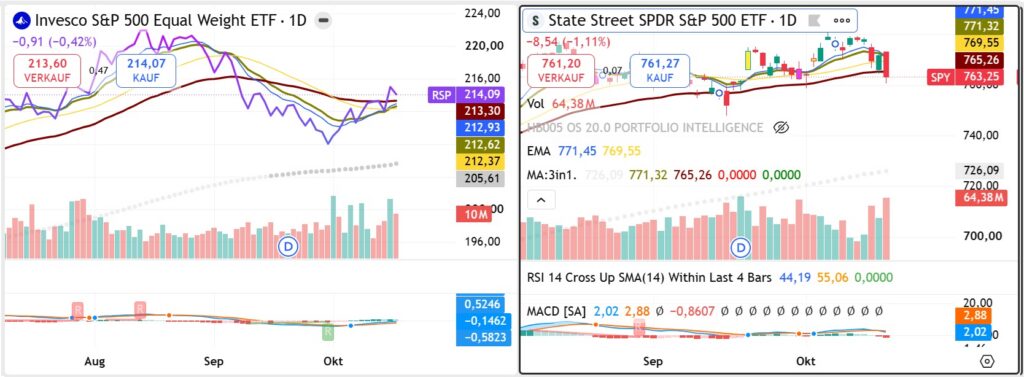
3. Market breadth and equal-weight performance. The relationship between the equal-weighted S&P 500 and its market-cap-weighted counterpart can help distinguish genuine broadening from a few isolated outperformers. However, equal weighting also changes sector exposures and introduces a regular rebalancing effect.
TradingView
4. The interest-rate and energy-price combination. Sustained high yields alongside expensive energy would put different pressures on businesses: higher financing costs for capital-intensive companies, increased input costs for manufacturers and possible demand pressure on retailers.
5. Valuation versus normalised earnings. A business reporting strong profits should be evaluated using sustainable earnings after removing exceptional gains, acquisition effects and unusual accounting items. This is particularly important for Ross Stores and Kimberly-Clark.
The thesis strengthens when share-price leadership is supported by improving recurring earnings and cash flow. It weakens when valuations rise faster than normalised business performance.
7. Conclusion: The better alternative to technology is not necessarily a defensive sector
The October correction is creating an opportunity to reconsider what constitutes a high-quality investment.
The relevant distinction is not simply technology versus non-technology.
It is between businesses whose valuations require exceptionally favourable future assumptions and those capable of producing durable economic returns under a wider range of conditions.
Energy infrastructure, insurance, selected consumer staples, off-price retail and healthcare all merit further fundamental investigation.
But their recent relative strength is only the beginning of the research process.
Some have substantial capital requirements. Others face earnings normalisation, acquisition risk, inflation exposure or already elevated valuations.
The strongest investment case will combine resilient business economics, disciplined capital allocation, sustainable free cash flow and a valuation that does not require everything to go right.
The next phase of market leadership may be determined less by which companies promise the fastest growth and more by which companies can demonstrate the most economically valuable growth.
WIEDER WAS GELERNT
When a dominant market sector begins to decline, investors often search for the next sector with the strongest recent performance.
That approach can identify changing momentum, but it does not establish investment value.
A company can outperform because its business fundamentals are improving, because investors are temporarily seeking safety, or simply because its valuation is expanding. These explanations have very different implications for future returns.
The essential analytical lesson is to separate business performance from share-price performance and then examine the capital required to sustain that business performance.
Revenue growth, earnings growth and free-cash-flow growth are not interchangeable. Neither are defensive demand and defensive valuation.
This distinction applies equally to technology companies, insurers, energy infrastructure operators and consumer businesses.
Investors who examine normalised cash generation, reinvestment requirements and valuation can better distinguish durable competitive advantages from temporary market enthusiasm.
A successful investment is not merely a good business — it is a good business purchased at a price justified by the cash it can ultimately generate.
Disclaimer: This publication provides general financial-market and investment research for informational purposes only. It does not constitute investment or financial advice, portfolio management or a recommendation to buy or sell any financial instrument. All investments involve risk, including possible loss of capital. Company-specific and market conditions may change.