 LWAYS OPEN

Deck: THE REAL POST-FED QUESTION: WHO CAN FINANCE THE GROWTH?
The first Federal Reserve rate increase in more than three years changes the investment question.
The obvious interpretation is that higher rates are bad for growth stocks because they increase the discount rate applied to future earnings. That remains true. High-growth companies do not become immune to interest rates simply because their revenues or earnings are expanding rapidly.
But that is only the first-order effect.
The more important question now is:
Where does financing dependence sit inside the AI investment chain — and who ultimately carries the cost when capital becomes more expensive?
This distinction matters because the AI ecosystem is not one homogeneous trade.
Some companies are already converting AI demand into substantial present-day cash flows. Others must invest enormous amounts of capital today to capture revenues years into the future. Still others depend on customers continuing to finance historically large capital-expenditure programmes.
Higher rates therefore do not simply divide the market into “growth” and “value.”
They increasingly divide it into self-financed growth and capital-dependent growth.
That may become one of the most important distinctions of the next phase of the AI investment cycle.
1. EQUITY DURATION STILL MATTERS — BUT IT IS NOT ENOUGH
The concept of equity duration remains useful, but it needs to be applied carefully.
A company whose valuation depends overwhelmingly on profits expected many years from now is generally more sensitive to rising discount rates than a company generating substantial cash today.
But rapid growth alone does not automatically shorten equity duration.
A highly valued growth company can still have significant duration risk if a large proportion of its valuation depends on distant cash flows or terminal value. Rising Treasury yields can therefore compress its valuation multiple even while the underlying business continues to perform extremely well.
The more useful framework combines four variables:
Growth + Free Cash Flow + Valuation + Financing Dependence.
This produces a much stronger question than simply asking which company is growing fastest:
How much of today’s valuation is supported by cash already being generated, and how much depends on future growth that must still be financed and delivered?
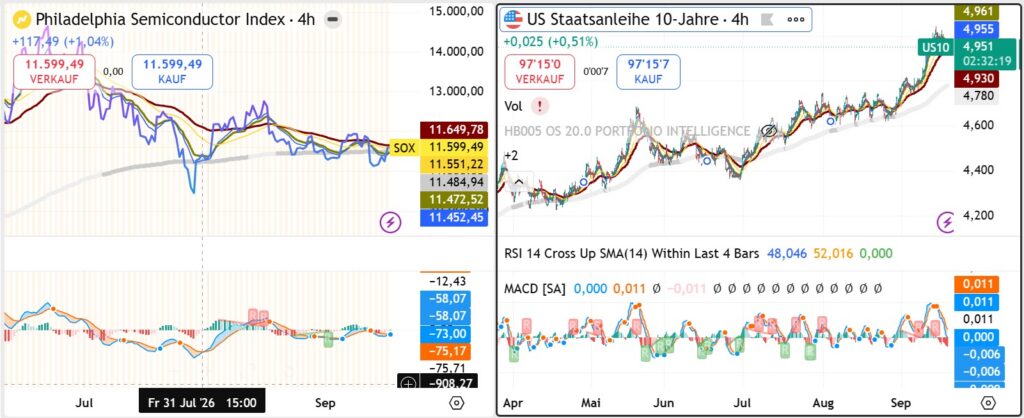
That distinction becomes increasingly important when the 10-year Treasury yield approaches 5%.
2. THE FIRST FED REACTION DOES NOT YET PROVE A NEW REGIME
The strong rebound in technology and semiconductor stocks after the Fed decision is important — but it should not be overinterpreted.
The Nasdaq gained strongly and semiconductor stocks recovered, demonstrating that investors were still willing to own AI-related growth despite tighter monetary policy.
But Treasury yields and oil prices also declined during the rebound.
That provides a simpler competing explanation: part of the technology rally may have represented relief from the simultaneous pressure of higher energy prices and higher bond yields rather than evidence that technology valuations have become structurally less sensitive to interest rates.
One trading session cannot distinguish between these explanations.
Therefore, the correct interpretation is not:
“The market has proved that AI can ignore higher rates.”
It is:
“AI demand remains strong enough to withstand the first monetary shock — but the durability of that resilience still needs confirmation.”
That confirmation must come from earnings, cash-flow conversion, credit markets and sustained price action rather than one post-Fed trading session.
3. THE AI CHAIN MUST NOW BE ANALYSED THROUGH ITS FINANCING STRUCTURE
The AI investment cycle can broadly be divided into three economic layers.
LAYER 1 — COMPUTE AND SEMICONDUCTORS
This remains the strongest part of the chain when demand is accompanied by substantial current cash generation.
Companies such as NVIDIA and Broadcom occupy strategically valuable positions because they sell scarce computing and networking infrastructure into an investment boom that is already producing significant revenues and cash flows.
That does not eliminate valuation risk.
If Treasury yields rise materially, valuation multiples can still contract. And if AI capital expenditure slows, earnings expectations can fall at the same time.
This creates a potentially dangerous double effect:
lower expected growth + higher discount rate.
Nevertheless, companies generating substantial free cash flow possess an important advantage in a higher-rate environment:
they do not require external capital simply to keep the growth engine operating.
That distinction deserves more weight than headline revenue growth alone.
4. THE SECOND-ORDER AI TRADE REMAINS POWERFUL — BUT IT IS NOT AUTOMATIC
The physical infrastructure required to support AI remains one of the strongest structural investment themes.
Data centres require electricity, grid connections, transformers, turbines, cooling systems, power-management equipment and increasingly complex electrical infrastructure.
That supports the strategic case for companies exposed to these bottlenecks, including Vertiv, GE Vernova and Constellation Energy.
But there is an important qualification.
Structural demand does not automatically equal attractive shareholder returns.
Investors must distinguish between:
- orders and realised revenue,
- backlog and free cash flow,
- revenue growth and margin expansion,
- capacity announcements and completed projects,
- nominal growth and return on invested capital.
GE Vernova’s large backlog, for example, provides visibility into future demand. But backlog must ultimately be converted into profitable revenue and cash.
Vertiv faces a similar test: extraordinarily strong demand is valuable only if production capacity, supply chains and pricing allow that demand to translate into attractive margins.
The infrastructure thesis therefore survives the Fed hike — but it becomes more selective.
The winners will not necessarily be the companies with the largest order books.
They will be those capable of converting scarcity into high-return, cash-generative growth.
5. ORACLE REVEALS THE HIDDEN RISK IN THE AI BOOM
Oracle may actually be more valuable to this analysis as a warning signal than as a straightforward investment beneficiary.
Its enormous contracted AI and cloud demand demonstrates that enterprise AI infrastructure spending is real.
But large commitments do not automatically produce attractive economics.
When enormous capital expenditures create strongly negative free cash flow, the financing side of the AI boom becomes impossible to ignore.
This exposes a fundamental asymmetry within the AI ecosystem.
A semiconductor supplier can receive cash for equipment sold today.
A data-centre operator or cloud provider may have to finance the infrastructure today in order to generate contracted revenues over many future years.
When capital is cheap, that distinction attracts less attention.
When Treasury yields approach 5%, it becomes critical.
The correct lesson from Oracle is therefore not simply:
“AI demand is enormous.”
It is:
Enormous AI demand can coexist with deteriorating free cash flow and rising financing requirements.
That makes Oracle an important indicator of the financial sustainability of the broader AI capital-expenditure cycle.
6. THE REAL BOTTLENECK MAY MOVE FROM CHIPS TO CAPITAL
For much of the AI boom, investors focused on physical scarcity.
First it was GPUs.
Then networking.
Then data-centre capacity.
Then electricity, cooling and grid connections.
The next scarcity may be different:
economically attractive capital.
The AI build-out requires extraordinary investment by hyperscalers, cloud providers, utilities, data-centre developers and infrastructure companies.
As long as corporate cash flows remain strong and credit spreads remain contained, that financing machine can continue functioning.
But if borrowing costs rise while credit spreads simultaneously widen, projects that looked economically attractive under cheaper capital assumptions can become less attractive.
This is why the next phase of AI investing cannot be understood solely through semiconductor demand.
Investors increasingly need to watch the credit transmission mechanism behind AI CapEx.
The crucial question becomes:
Can the companies financing the AI build-out continue earning returns above their rising cost of capital?
If the answer remains yes, the structural investment cycle can continue.
If the answer begins turning no, the weakness may first appear not in GPU demand statistics but in financing decisions, project delays and capital allocation.
7. OIL IS NOT A SECONDARY VARIABLE
Energy prices deserve substantially more attention than a conventional technology analysis might suggest.
Oil above $100 can simultaneously:
increase headline inflation,
raise transportation and industrial costs,
reduce household purchasing power,
keep inflation expectations elevated,
and increase pressure on central banks to maintain restrictive monetary policy.
That creates a potentially dangerous feedback loop:
Higher oil → higher inflation → tighter monetary policy → higher financing costs → lower valuation multiples.
The most difficult environment for growth equities would therefore not simply be another Fed hike.
It would be a combination of:
high oil + rising Treasury yields + widening credit spreads + slowing economic growth.
That would resemble a stagflationary pressure regime.
Under such conditions, even fundamentally strong AI companies could experience substantial valuation compression.
8. THE MARKET MAY NOT DIFFERENTIATE IMMEDIATELY
There is another important correction to the original thesis.
Markets do not always distinguish immediately between productive growth and speculative growth.
During periods of rapidly increasing risk aversion, investors often reduce exposure across entire sectors.
A company with excellent cash flow can therefore decline sharply alongside a highly leveraged competitor.
The distinction appears over longer periods through fundamentals, balance-sheet strength and capital allocation — not necessarily during the first phase of a market sell-off.
That means investors should not depend on the market immediately recognising quality.
Instead, the objective should be to identify financial strength before the market is forced to distinguish between companies.
9. A BETTER POST-FED INVESTMENT HIERARCHY
The Fed hike therefore does not invalidate the AI investment thesis.
It changes the selection mechanism.
FIRST PRIORITY: CASH-GENERATIVE AI EXPOSURE
Businesses already converting AI demand into substantial cash flows deserve the strongest strategic consideration.
NVIDIA and Broadcom remain important examples.
But valuation must remain part of the decision. A great company can still become a poor investment if too much future success is already reflected in the price.
SECOND PRIORITY: PHYSICAL BOTTLENECKS WITH PRICING POWER
Vertiv, GE Vernova and Constellation Energy remain strategically interesting because AI requires physical infrastructure that cannot be created instantly.
But investors must monitor execution, margins, capital intensity and return on invested capital rather than relying on backlog alone.
THIRD PRIORITY: CAPITAL-INTENSIVE AI BUILDERS
Companies undertaking enormous AI infrastructure programmes deserve greater scrutiny.
The decisive variables are no longer simply revenue growth or contracted demand.
They are:
Free cash flow, debt issuance, interest expense, credit spreads and return on incremental invested capital.
Oracle illustrates why this category requires particular discipline.
10. WHAT SHOULD WE WATCH NOW?
The next confirmation of the investment thesis should come from several markets simultaneously.
Treasury yields: A sustained move materially above 5% would increase valuation pressure and financing costs.
Credit spreads: Stable investment-grade spreads would suggest that corporate financing remains available on manageable terms. Significant widening would be an early warning that the AI CapEx financing channel is deteriorating.
Oil: Persistently elevated energy prices would increase the probability that inflation remains difficult to suppress.
Free cash flow: Revenue growth without cash conversion becomes increasingly dangerous as capital becomes more expensive.
Margins and ROIC: Infrastructure companies must demonstrate that huge demand is translating into economic returns rather than simply larger capital requirements.
AI CapEx guidance: Microsoft, Alphabet, Amazon, Meta, Oracle and other major infrastructure buyers remain critical indicators of whether the investment cycle continues accelerating.
Market breadth: Sustainable participation beyond a handful of AI leaders would provide stronger evidence of a healthy risk environment than a single-session semiconductor rally.
THE NON-OBVIOUS CONCLUSION
The Fed’s return to rate hikes does not necessarily end the AI investment cycle.
But it changes what investors should pay for.
The first phase of the AI boom rewarded scarcity.
The next phase may increasingly reward financial self-sufficiency.
That leads to a more robust investment principle:
Do not simply own the companies growing fastest from AI. Own the businesses that can convert AI demand into attractive cash returns without becoming increasingly dependent on expensive capital.
This also changes how we should interpret the post-Fed rally.
The market has not yet proved that growth can defeat higher interest rates.
It has shown something narrower — and potentially more useful:
Investors are still willing to finance the AI investment thesis while earnings remain strong, credit remains available and the macroeconomic pressure from yields and energy remains manageable.
That distinction matters.
Because the most important warning signal for the next stage of the AI cycle may not be NVIDIA falling through a technical support level.
It may be the moment when Treasury yields, energy costs and corporate credit spreads begin rising together.
At that point, the central investment question changes from:
“How large can AI become?”
to:
“Who can still afford to build it?”
And in a world of structurally more expensive capital, that may ultimately determine the winners.
Disclaimer
General financial-market research and analytical discussion for informational purposes only; not investment/financial advice, portfolio management or a recommendation to buy or sell any instrument. Investment decisions remain the responsibility of the individual investor.