 LWAYS OPEN
Research & Strategy Discussions | 9 October 2026 | FRL DEEP RESEARCH
The greatest risk to the artificial intelligence investment cycle may no longer be insufficient demand, but the widening gap between infrastructure investment, financing costs and cash generation. Nvidia’s weakness, resilient broad-market indices and elevated Treasury yields suggest that investors may be starting to distinguish technological success from financial sustainability.
The AI Boom May Be Working — and That Is Precisely Why the Financial Risk Is Growing
The most consequential development in the artificial intelligence market is not that Nvidia has fallen, or that OpenAI may have missed a widely circulated revenue expectation. It is that the market may be beginning to question whether the financing structure behind the AI infrastructure boom can sustain its own success.
That distinction changes the investment equation.
A technology can achieve extraordinary adoption, generate tens of billions of dollars in revenue and still produce disappointing investment returns if the capital required to support its growth expands faster than the economic value it creates.
This is the contradiction investors must now confront.
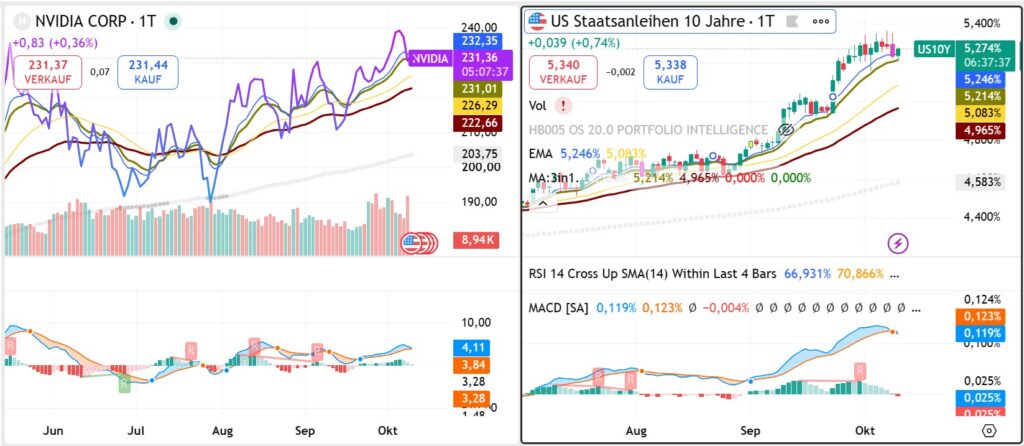
On 9 October 2026, Nvidia was trading around $230.60, the Nasdaq-100 ETF QQQ near $749.47, and the ten-year US Treasury yield around 5.28%, according to the intraday market snapshot examined for this report.
The broader S&P 500 remained comparatively resilient. Semiconductor shares, however, were showing signs of fatigue.
The important question is not whether artificial intelligence will continue growing.
It is whether the companies financing that growth will earn sufficiently attractive returns on the enormous amounts of capital being committed.
And, crucially, what happens to valuations if the answer takes longer to emerge than investors expect?
1. FACT: The Market Is Separating AI Growth From AI Investment Returns
The starting point is an unusual divergence.
Market snapshot supplied for 9 October 2026, approximately 16:42 CEST. Intraday observations, not closing prices.
| Indicator | Reference level | Strategic significance |
|---|---|---|
| Nvidia (NVDA) | $230.60 | Pressure on the AI infrastructure leader |
| Nasdaq-100 ETF (QQQ) | $749.47 | Fragile stabilisation |
| Philadelphia Semiconductor Index (SOX) | 12,549 | Weakness in semiconductor leadership |
| S&P 500 ETF (SPY) | $776.24 | Relative resilience of broader equities |
| US 10-year Treasury yield | 5.278% | Elevated cost-of-capital benchmark |
| VIX | 15.04 | Limited broad-market fear |
| WTI crude oil | $93.19 | Additional potential inflation pressure |
These figures reveal something more important than a weak trading session.
The broad market has not yet experienced a generalised liquidation. Volatility remains contained, while one of the most important beneficiaries of AI infrastructure spending is encountering selling pressure.
That is consistent with an early stage of selective repricing.
It is not proof that investors have abandoned AI, nor does it establish that the entire semiconductor industry is entering a downturn.
Instead, the pattern raises a more interesting possibility: the market is becoming increasingly selective about which companies deserve the valuation premiums associated with AI.
Why this matters
During the early phase of a major investment cycle, revenue growth often dominates the narrative.
Investors reward the companies supplying scarce technology, equipment and infrastructure.
In later phases, attention shifts toward returns on invested capital, depreciation, financing requirements and free cash flow.
The transition can be uncomfortable because share prices may begin adjusting before the underlying revenue growth slows.
SIGNAL: Strong industry demand may no longer be sufficient to protect elevated valuations.
IMPLICATION: Investors need to distinguish between beneficiaries of AI expenditure and beneficiaries of sustainable AI economics.
ACTION FRAMEWORK: Evaluate AI exposure by cash-flow quality, financing dependence and valuation sensitivity rather than treating the sector as a single investment theme.
2. The OpenAI Revenue Debate: A Warning About Measurement, Not Necessarily Demand
The reported disagreement surrounding OpenAI’s annualised revenue is particularly instructive.
The market discussion on 9 October centred on an approximately $50 billion annualised revenue figure compared with a previously circulated figure near $70 billion.
These figures should not automatically be interpreted as a $20 billion shortfall in actual annual revenue.
Annualised revenue, forward revenue run rates, gross revenue, net revenue and recognised accounting revenue are different measures.
An annualised run rate extrapolates a current revenue pace; it is not equivalent to audited revenue generated over a completed financial year.
Consequently, apparently conflicting figures can emerge without any underlying collapse in customer demand.
For investment analysis, the relevant questions are more demanding:
- How much revenue is genuinely recurring and economically attributable to the AI provider?
- How much of the reported growth depends on subsidised access, promotional pricing or distribution arrangements?
- What are the incremental computing and inference costs required to serve that revenue?
- How much cash must be invested before additional revenue becomes profitable?
- Who ultimately bears the financing and utilisation risk?
Even if OpenAI reaches a $70 billion annualised revenue rate, that achievement alone would not establish the profitability of the infrastructure supporting it.
Revenue growth measures commercial expansion.
Free cash flow measures whether that expansion is becoming financially self-sustaining.
The distinction matters enormously when infrastructure commitments extend across several years.
3. The $1.5 Trillion Question: Who Finances the Next Stage?
A financing estimate attributed to Morgan Stanley in the 9 October market discussion points to approximately $1.5 trillion of external AI infrastructure financing requirements through 2028.
This figure is a research estimate, not a confirmed financing shortfall or a forecast of losses. Its definition, scope and assumptions are essential to interpreting it correctly.
Nevertheless, it highlights the central strategic issue.
AI infrastructure is extraordinarily capital-intensive.
Advanced semiconductor systems require supporting investments in networking, data centres, cooling, electricity, land, equipment and increasingly sophisticated software.
The capital requirements do not end when the first generation of infrastructure becomes operational.
Hardware must be upgraded, utilisation must increase, and customers must generate enough economic value to justify continued expenditure.
At the same time, the cost of financing matters.
At a US ten-year Treasury yield near 5.28%, investors cannot evaluate long-duration growth assets as though capital were virtually free.
The Treasury yield is not itself the borrowing rate for every AI infrastructure project, but it influences discount rates, credit pricing and the relative attractiveness of competing investments.
Illustrative financing sensitivity
Financed capital
$1.5T
Rate increase
+1 pp
Annual interest impact
+$15B
Purely illustrative: assumes the entire $1.5 trillion is debt-financed, outstanding for a full year and repriced by one percentage point. Actual financing includes equity, internal cash generation and debt with different maturities and rates.
The calculation demonstrates why financing conditions can become strategically important even when demand remains robust.
The deeper issue is not simply the absolute amount of capital invested.
It is whether the returns on that capital consistently exceed its risk-adjusted cost.
A sector can experience remarkable revenue growth while generating disappointing returns for the owners of its capital.
That is the financial risk the market may now be starting to recognise.
4. TITAN EDGE: The AI Financing Loop May Be More Important Than the AI Revenue Surprise
The most important relationship is not between OpenAI’s reported revenue and Nvidia’s share price.
It is between the cash flows generated by AI customers, the financing capacity of infrastructure operators and the revenue expectations embedded in semiconductor valuations.
These three elements form an economic feedback loop.
The AI infrastructure financing loop
1. AI applications and customers
Subscriptions, enterprise adoption and usage revenue
Demand and revenue commitments
2. Cloud and infrastructure operators
Capital expenditure, leases, borrowing and investor funding
Equipment procurement
3. Semiconductor and equipment suppliers
Chip sales, networking equipment and infrastructure revenue
Capacity supports more AI services and future demand
The critical constraint
Can end-customer cash generation ultimately support the capital, financing and replacement costs throughout the chain?
The system is not necessarily problematic. Investment cycles frequently require financing ahead of realised demand.
However, the arrangement becomes vulnerable when multiple participants depend on continued capital availability and future growth to justify present expenditure.
The hidden transmission mechanism
Consider a hypothetical sequence.
An AI application provider experiences exceptional revenue growth but continues consuming substantial cash.
Its cloud infrastructure partners expand computing capacity to meet anticipated demand.
Those partners purchase more accelerators, networking equipment and related infrastructure, supporting strong revenues at semiconductor suppliers.
Investors interpret the suppliers’ results as confirmation that the AI investment cycle remains healthy.
But what happens if the original AI service providers cannot convert revenue growth into sustainable operating cash flow quickly enough?
Their infrastructure partners may reassess future capacity commitments.
Financiers may demand higher returns, additional collateral or shorter lending maturities.
Infrastructure operators may extend the useful lives of existing equipment, improve utilisation or delay new projects.
Semiconductor demand could then slow even while AI usage continues growing.
The second-order consequence is that the companies reporting the strongest current earnings may still be exposed to a deterioration in the financing economics of their customers.
That is not evidence that such a contraction has already begun.
It is a plausible transmission mechanism that conventional revenue-based analysis can overlook.
Why the financing risk is no longer theoretical
Reuters reported on 9 October that major companies were pursuing substantial financing arrangements to support advanced AI chip purchases and that Morgan Stanley estimated external AI infrastructure financing needs of $1.5 trillion through 2028.
Reuters
+1
These developments demonstrate that financing architecture is becoming an increasingly important component of AI industry economics.
They do not establish that every arrangement is circular or financially unsustainable.
A legitimate infrastructure financing transaction can involve strong collateral, creditworthy counterparties and attractive long-term returns.
The analytical task is to determine where economic risk ultimately resides.
In particular, investors should distinguish between:
- Financing backed by diversified customer demand and established cash flows.
- Financing dependent on a small number of AI customers.
- Financing supported by contractual commitments but exposed to technological obsolescence.
- Financing in which suppliers, customers or strategic investors provide overlapping forms of financial support.
The final category deserves particular scrutiny.
Where counterparties simultaneously act as suppliers, customers, investors or financing partners, reported sales may be economically legitimate while still being sensitive to the availability of external capital.
This is the essential distinction between accounting revenue and independently sustainable end-market demand.
5. Why Nvidia Is a Critical Market Signal — but Not a Verdict on AI
Nvidia occupies a unique position in the investment cycle.
It supplies technology that enables the infrastructure expansion.
Consequently, its financial performance is closely linked to the willingness and ability of customers to invest in computing capacity.
That does not mean Nvidia faces the same risks as a heavily indebted infrastructure operator.
Its economics, balance sheet and pricing power can be fundamentally different.
Nevertheless, the share price can become sensitive to changes in expectations for future customer spending.
On 9 October, Nvidia’s reference price of $230.60 was close to an observed technical support area around $230.
The stock had also retreated materially from its recent high near $243.
TradingView identifies $243.37 on 6 October as Nvidia’s all-time high at that point.
TradingView
The decline therefore occurred immediately after a period of considerable market optimism.
This creates an important distinction between business risk and valuation risk.
Nvidia’s business could remain highly profitable while its valuation declines if investors reduce the growth premium applied to future earnings.
Similarly, an improvement in financing conditions could support the stock without requiring an immediate acceleration in reported revenue.
The relative-strength question
The more revealing observation is that the S&P 500 was holding up better than Nvidia and parts of the semiconductor sector.
This suggests that the market was not yet pricing an economy-wide collapse.
Instead, it may have been reassessing the concentration of expectations within AI-related equities.
However, one session of relative underperformance is insufficient to establish a lasting rotation.
For confirmation, investors should examine whether semiconductor weakness persists across several sessions and whether other sectors begin outperforming on a sustained basis.
The strategic implication is clear: the direction of the Nasdaq alone may no longer be an adequate measure of AI investment risk.
6. How Do We Approach It? The TITAN Decision Framework
The appropriate strategic response is not to assume that every decline creates an opportunity, nor to treat every negative headline as evidence of a structural breakdown.
The objective is to separate three different risks.
| Risk | Key question | Relevant evidence |
|---|---|---|
| Demand risk | Is commercial AI adoption slowing? | Revenue growth, usage, customer retention |
| Financing risk | Is infrastructure becoming harder or more expensive to fund? | Credit spreads, funding terms, project delays |
| Valuation risk | Are equity prices discounting excessive future returns? | Earnings revisions, multiples, relative strength |
These risks can develop independently.
A revenue scare may be resolved quickly, while financing conditions remain difficult.
Alternatively, funding conditions could improve even as competitive pressure reduces the profitability of AI applications.
The investment approach should therefore depend on which risk is actually changing.
Stage 1: Establish whether the weakness is selective or systemic
A market in which semiconductor shares decline while the S&P 500 remains resilient requires a different interpretation from one in which equities, corporate bonds and credit-sensitive assets deteriorate simultaneously.
The former may represent sector repricing.
The latter could indicate a broader liquidity or financing problem.
Stage 2: Require confirmation across independent indicators
A rebound in Nvidia alone is not sufficient.
A more convincing improvement would combine semiconductor relative strength, recovering Nasdaq breadth and easing Treasury yields.
Conversely, a rebound driven by a handful of mega-cap stocks while financing conditions deteriorate would be less persuasive.
Stage 3: Separate opportunity from urgency
High-quality businesses can become attractive after valuation corrections.
But a declining share price is not automatically evidence of undervaluation.
Investors must determine whether the correction reflects a temporary adjustment in expectations or a genuine reduction in the long-term cash flows available to shareholders.
Stage 4: Treat leverage as a separate risk decision
Options and other leveraged instruments introduce variables that are not captured by the direction of the underlying stock.
Implied volatility, time decay, financing costs, bid-ask spreads and instrument structure can materially alter outcomes.
In particular, a call option may lose value even when the underlying stock eventually recovers, if the recovery occurs too late or implied volatility contracts sufficiently.
Under uncertain market conditions, defined-risk structures may provide clearer maximum-loss boundaries than open-ended leveraged exposure, although they do not eliminate the possibility of losing the entire premium.
The analytical priority is to understand the payoff distribution before choosing an instrument.
7. Three Scenarios That Could Define the Next Phase
The following scenarios use the 9 October intraday reference levels as technical observation points. They are conditional frameworks, not forecasts or statistically validated probabilities.
Scenario A — The financing scare fades
Nvidia reclaims $233 and subsequently $237, QQQ holds above $750.50–752, and the US ten-year yield falls below 5.25%.
Implication: The market may interpret the OpenAI controversy primarily as a measurement issue rather than evidence of weakening demand. Semiconductor relative strength improves.
Invalidation: Renewed yield increases or failure of semiconductor participation despite a broader-market recovery.
Scenario B — AI repricing without a broad-market breakdown
Nvidia remains below $233, QQQ struggles to regain momentum and semiconductor relative performance continues deteriorating, while SPY remains comparatively resilient.
Implication: The market may be rotating away from expensive AI exposure toward businesses with more predictable cash flows or less demanding valuations.
Invalidation: A sustained recovery in semiconductor leadership, supported by improving earnings expectations and financing conditions.
Scenario C — Financing pressure becomes systemic
Nvidia breaks below $230 and $227.50, QQQ loses $748.50 and then $747.75, while Treasury yields exceed 5.30–5.35%.
Implication: Valuation pressure could broaden, particularly if credit spreads also widen and market breadth deteriorates.
Invalidation: A sustained recovery in yields, credit conditions and equity-market breadth that reverses the breakdown.
The third scenario would be more consequential than an ordinary technology-sector correction because it would combine equity valuation pressure with potentially deteriorating financing conditions.
However, technical breaks alone would not prove a systemic credit event.
Confirmation would require evidence from credit markets, funding availability or corporate investment plans.
8. WHAT TO WATCH: Five Signals That Matter More Than the Next Headline
| Signal | Constructive development | Warning development |
|---|---|---|
| US 10-year yield | Below 5.25%, ideally 5.20% | Sustained move above 5.30–5.35% |
| Nvidia | Reclaims $233, then $237 | Breaks $230, then $227.50 |
| QQQ and SOX | QQQ above $752; SOX above 12,723 | QQQ below $747.75; SOX below 12,453 |
| Credit financing | Stable or narrowing spreads; funded projects progressing | Wider spreads, tougher collateral terms, delayed financing |
| AI cash conversion | Improving operating cash flow relative to infrastructure commitments | Rising capital needs without corresponding cash generation |
The first three signals address near-term market structure.
The final two address the structural investment thesis.
That distinction matters because a technical recovery can occur before fundamental financing questions are resolved.
Conversely, financing conditions can improve before the equity market fully recognises the change.
The most informative investment decisions emerge when market signals and economic fundamentals begin confirming one another.
9. The Strategic Conclusion: The Next AI Winners May Be Defined by Capital Efficiency
The investment debate is entering a more demanding phase.
Until recently, much of the market’s attention focused on identifying the companies best positioned to capture AI demand.
That remains important, but it is no longer sufficient.
The next phase may reward businesses that can translate AI adoption into sustainable cash generation without continually increasing their dependence on external financing.
This could include infrastructure suppliers with durable competitive advantages, cloud platforms capable of achieving attractive utilisation rates, and software businesses able to monetise AI without disproportionate capital requirements.
It could also benefit companies outside the AI sector if capital rotates toward more predictable earnings and lower valuation sensitivity.
There is no certainty that such a rotation will occur.
The evidence available on 9 October supports heightened caution and closer scrutiny, not a definitive conclusion that the AI investment cycle has ended.
The reported OpenAI revenue discrepancy may prove less economically significant than the initial market reaction suggested. Reuters reported that the discrepancy arose from differing revenue calculation approaches, while subsequent reporting indicated that OpenAI could still reach a $70 billion annualised run rate by year-end.
Investing.com
+1
Yet the episode exposed an important vulnerability: confidence in the infrastructure boom depends not only on technological progress but also on the credibility of the economic assumptions supporting its financing.
The most valuable question is therefore not whether AI demand will continue growing.
It is which participants can convert that growth into durable returns after accounting for the full cost of capital.
WIEDER WAS GELERNT
One of the most persistent mistakes in investment analysis is confusing the success of an industry with the profitability of investing in that industry.
A technological revolution can be entirely genuine while the financial returns earned by its participants vary dramatically.
The reason is straightforward but frequently overlooked: demand, revenue, profit and free cash flow are not interchangeable.
When an industry requires enormous upfront investment, the cost and availability of capital become part of its competitive structure.
This means that rising financing costs can alter future investment returns even before customer demand visibly weakens.
The practical lesson is to follow the money through the entire economic chain. Identify who provides the capital, who receives it, who assumes the risk and who ultimately generates the cash required to sustain the system.
Apply this framework to artificial intelligence, renewable energy, telecommunications, infrastructure or any other capital-intensive growth industry.
A successful technology does not automatically create a successful investment.
Research sources
The analysis draws on the following published reporting and the intraday market observations provided for 9 October 2026.
- Financial Times — OpenAI annualised revenue discrepancy, 9 October 2026.
- Reuters — Morning Bid: Feeding the AI beast, 9 October 2026.
- Reuters — OpenAI revenue methodology and investor reporting, 8 October 2026.
- MarketWatch — Bloomberg reporting on OpenAI’s year-end revenue target, 9 October 2026.
- TradingView — Nvidia price history and market data.
Research limitations: OpenAI’s financial figures are based on reported private-company information rather than independently audited public disclosures. The $1.5 trillion financing requirement is an external research estimate. Intraday prices are time-specific and may change materially. The scenarios and analytical conclusions represent FRL’s interpretation, not independently established outcomes.
Disclaimer
This publication provides general financial-market research and analytical discussion for informational purposes only. It does not constitute investment or financial advice, portfolio management, or a recommendation to buy or sell any financial instrument. All investment decisions remain the responsibility of the individual investor. Securities, derivatives and leveraged instruments involve risk, including potential loss of capital.