 LWAYS OPEN
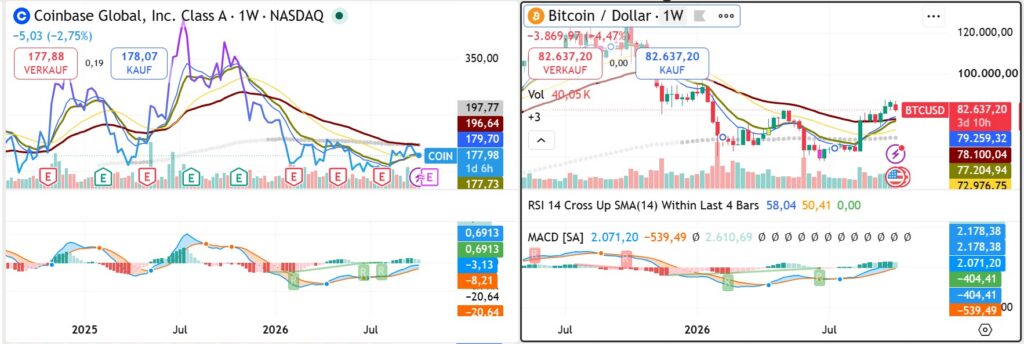
Coinbase is gaining market share and expanding beyond cryptocurrency trading, yet its shares remain under pressure. The critical question is whether stablecoins, derivatives and financial infrastructure can create durable earnings independent of crypto-market cycles—or whether an overlooked dependence on interest rates undermines that transformation.
The Investment Paradox: A Stronger Business Can Still Be a Weaker Stock
Coinbase presents a contradiction that conventional cryptocurrency analysis struggles to explain. Its trading market share has reached record levels, its product portfolio is expanding, and its stablecoin infrastructure is becoming increasingly relevant to institutional finance. Yet the shares are trading around $177.56 on 8 October 2026, materially below their recent trading range.
The obvious interpretation is that investors are losing confidence in cryptocurrency markets. But that explanation misses a more consequential possibility: Coinbase may be improving its competitive position while the economics of its business model become less attractive.
The distinction matters because Coinbase is no longer simply a leveraged expression of Bitcoin trading activity. It is increasingly a combination of an exchange, derivatives marketplace, stablecoin distribution network, custody platform and financial technology infrastructure provider.
Those businesses do not respond identically to market conditions.
Higher interest rates can support certain stablecoin economics while simultaneously weakening speculative activity and equity valuations. Lower rates may revive risk appetite but reduce income generated by stablecoin reserves.
The investment question is therefore not simply whether cryptocurrency prices recover.
It is whether Coinbase can convert its growing share of digital financial activity into sustainable earnings when the economic forces supporting its different businesses move in opposite directions.
1. What the Latest Financial Evidence Actually Shows
The most important evidence comes from Coinbase’s second-quarter 2026 results, published on 30 July, and its accompanying SEC disclosures.
10.3%
Crypto trading market share, Q2 2026
$20bn
Average USDC held in Coinbase products
14
Consecutive quarters of positive adjusted EBITDA
88%
Net revenue from sources other than BTC spot trading
Source: Coinbase Q2 2026 earnings release. The 88% metric does not mean 88% of revenue is independent of cryptocurrency activity.
investor.coinbase.com
+1
Market-share gains are real, but they do not establish earnings durability
Coinbase reported that its share of cryptocurrency trading volume increased from 9.1% in Q1 to 10.3% in Q2 2026. This represented its third consecutive quarterly market-share improvement.
Derivatives market share also increased, despite a double-digit contraction in the broader crypto derivatives market. Prediction-market contracts and revenue grew 106% quarter-over-quarter, with that business exceeding $100 million in annualized revenue.
These developments matter because they demonstrate that Coinbase can gain business even when its underlying market is experiencing difficult conditions.
investor.coinbase.com
+1
But investors should distinguish three separate outcomes:
- Market-share growth: Coinbase captures a greater proportion of industry activity.
- Revenue growth: That share translates into higher monetized activity.
- Economic profit growth: Incremental revenue exceeds the additional costs, incentives and capital requirements needed to generate it.
Only the third establishes sustainable shareholder value.
An exchange can gain market share by lowering prices, subsidizing activity or entering markets with less attractive economics. Without corresponding improvements in incremental profitability, market-share growth alone is insufficient evidence of value creation.
FRL interpretation: Coinbase’s competitive position appears stronger than its share-price performance suggests. The missing confirmation is whether the company can preserve that advantage without sacrificing the economics of each additional transaction.
2. The Business Is Diversifying, but Its Risks Are Not Yet Fully Independent
Coinbase’s strategic ambition is to become an integrated marketplace for financial assets and blockchain-based services—what management calls the Everything Exchange.
This involves several distinct economic engines.
| Business | Principal economic driver | Structural vulnerability |
|---|---|---|
| Spot trading | Volume × effective fees | Fee compression and crypto cycles |
| Derivatives | Trading activity and market share | Competition, volatility and regulation |
| Stablecoins | USDC balances × reserve yields × economic participation | Interest rates and distribution incentives |
| Custody and financing | Assets, balances and services | Asset prices, institutional competition and credit exposure |
| Base ecosystem | Network adoption and monetization | Limited visibility into durable profit contribution |
The strategic opportunity is significant: Coinbase could eventually serve customers who use digital financial infrastructure without actively speculating on cryptocurrencies.
But diversification must be measured by the independence of underlying cash flows, not by the number of products offered.
Custody revenue may still depend on cryptocurrency asset values. Staking revenue depends partly on token prices and protocol rewards. Derivatives activity may fluctuate with the same speculative cycles affecting spot trading.
Even businesses described as recurring can remain economically cyclical.
The strongest version of the Coinbase investment case requires a growing proportion of profits generated by customer relationships, infrastructure usage and payment activity that persist through cryptocurrency downturns.
That transformation is underway. It has not yet been conclusively demonstrated.
3. The Hidden Variable: Stablecoin Growth Does Not Automatically Mean Stablecoin Profit Growth
This is the central research finding.
Coinbase’s stablecoin business is often described as a structural growth opportunity. That assessment is reasonable, but incomplete.
The economic value of its USDC relationship depends on several interacting variables:
- The amount of USDC in circulation.
- The proportion held within Coinbase products.
- The yield earned on reserve assets.
- The contractual distribution of reserve income.
- Customer incentives and other costs of attracting and retaining balances.
Circle’s regulatory disclosures establish that Coinbase receives economics from USDC held on its platform and a contractual share associated with broader USDC circulation, after specified deductions.
SEC
+1
A simplified analytical model is:
\[ R_{\mathrm{USDC}}\approx B\times y\times s \]
Where \(B\) represents the relevant reserve balance, \(y\) the effective reserve yield, and \(s\) Coinbase’s effective economic participation. This is a conceptual model, not Coinbase’s reported accounting formula.
The evidence of yield compression
Coinbase’s Q2 2026 earnings presentation provides an unusually revealing comparison.
USDC balances versus stablecoin-related revenue
Average USDC market cap ($bn)Quarterly revenue ($m)
0100200300400Q2 2025Q3 2025Q4 2025Q1 2026Q2 2026
Source: Coinbase Q2 2026 earnings presentation, slide 40. Revenue includes the presentation’s stablecoin revenue and revenue on corporate balances; values rounded.
Two different units are plotted together to show their divergent directions, not their absolute relative scale.
SEC
+1
Between Q2 2025 and Q2 2026, average USDC market capitalization increased from approximately $61 billion to $77 billion, while the combined stablecoin-related revenue measure declined from approximately $332 million to $320 million.
That is a striking divergence.
The increase in underlying balances did not produce an increase in the associated revenue measure. Coinbase’s disclosures identify interest-rate and balance-mix effects as relevant drivers.
SEC
+1
This does not establish that stablecoin growth is unprofitable. Nor does it prove that the relationship with Circle is deteriorating.
It demonstrates something more useful: stablecoin adoption and stablecoin monetization are different investment variables.
The second-order implication
Suppose USDC circulation expands by 30%, while effective reserve yields fall by 25%, with all other economics unchanged.
The simplified revenue effect is:
\[ 1.30\times0.75=0.975 \]
The underlying stablecoin network would be 30% larger, yet associated reserve-based revenue would be approximately 2.5% lower.
This is an illustrative sensitivity, not a forecast.
The implication is important for valuation. If investors capitalize reserve-dependent revenue as though it were a rapidly growing software subscription stream, they risk paying a structural-growth multiple for an economically interest-sensitive business.
Conversely, if Coinbase can monetize payment processing, merchant services, settlement infrastructure and other fee-generating activities independently of reserve yields, the quality of its earnings could improve substantially.
The hidden variable is not USDC adoption alone. It is Coinbase’s ability to increase the economic value captured per dollar of stablecoin activity without relying on elevated interest rates.
4. Why the Interest-Rate Environment Creates a Two-Sided Risk
The supplied market context shows US Treasury yields at elevated levels, with the ten-year yield recently around 5.34%.
For Coinbase, that environment produces conflicting effects.
Higher short-term interest rates can support income from eligible stablecoin reserves, depending on actual portfolio yields and contractual arrangements. But elevated Treasury yields can also raise discount rates, reduce speculative risk appetite and pressure equity valuations.
Crucially, the ten-year Treasury yield is not a direct substitute for the yield earned on USDC reserves, which is more closely connected to shorter-duration instruments.
A rate-cutting cycle would not automatically resolve the problem. Lower rates could support cryptocurrency prices and trading activity while reducing reserve-related income.
The investment case therefore depends on which earnings component responds most strongly.
This is why a simple thesis—lower rates are good for crypto and therefore good for Coinbase—is analytically inadequate.
5. Profitability, Balance Sheet and Valuation: What Must Be Underwritten?
Coinbase reported the following second-quarter 2026 financial results:
| Q2 2026 reported metric | Amount |
|---|---|
| Total revenue | $1.2 billion |
| Transaction revenue | $599 million |
| Subscription and services revenue | $555 million |
| Adjusted EBITDA | $208 million |
| GAAP net loss | $359 million |
| Cash and cash equivalents | $8.6 billion |
Rounded company-reported figures. Adjusted EBITDA is a non-GAAP measure and should not be treated as equivalent to free cash flow.
SEC
+1
The contrast between positive adjusted EBITDA and a substantial GAAP net loss is important. A credible valuation requires reconciliation of noncash items, investment-related gains or losses, stock-based compensation, depreciation, acquisition accounting and other adjustments.
The balance sheet provides considerable financial resources, but gross cash should not be treated as excess equity value without accounting for debt, restricted or operationally necessary balances, and other claims.
The valuation problem at approximately $177.56
A share price alone cannot establish whether Coinbase is cheap.
A defensible valuation needs the current diluted share count, net debt or net cash, normalized earnings, sustainable free cash flow and a view of through-cycle profitability. No current independently verified enterprise-value multiple is asserted in this report.
The appropriate framework is a sum-of-the-parts analysis, with different valuation assumptions for different economic engines.
Trading and derivatives earnings should reflect cyclicality and fee competition. Stablecoin economics require explicit yield and balance sensitivities. Custody and infrastructure should be valued according to retention, recurring profitability and capital intensity—not merely assets serviced.
A premium valuation becomes more defensible if Coinbase demonstrates that infrastructure earnings are both material and less cyclical than trading revenue.
Until then, applying a single high-growth multiple to the entire business risks overstating earnings quality.
6. Competitive Position: Network Effects Are Valuable Only If Coinbase Captures Them
Coinbase possesses several potential competitive advantages: a recognized regulated platform, institutional relationships, custody infrastructure, access to liquidity and an expanding network of services.
The central strategic question is whether these capabilities reinforce one another economically.
For example, a customer who enters through cryptocurrency trading might subsequently hold USDC, use payment services, borrow against assets or access derivatives.
If that progression reduces acquisition costs and increases lifetime customer profitability, Coinbase’s integrated platform could create genuine operating leverage.
But competitors may capture much of the benefit through lower fees or more attractive customer incentives.
Circle, other stablecoin issuers, established financial institutions, decentralized exchanges and alternative derivatives platforms all participate in different parts of the value chain.
The existence of a large and growing digital financial ecosystem does not guarantee that any one participant captures a proportionate share of its profits.
The decisive competitive measure is not how much financial activity Coinbase touches. It is how much sustainable economic profit Coinbase retains from that activity.
7. Bull, Base and Bear: Three Different Futures for Coinbase
BULL CASE — The financial infrastructure transition succeeds
Coinbase sustains market-share gains, develops material fee-generating payment and infrastructure revenue, and expands operating profitability despite fluctuations in reserve yields. Derivatives and institutional services become larger contributors to earnings.
Confirmation: Rising normalized free cash flow, improving non-trading margins and demonstrably lower earnings sensitivity to crypto prices and interest rates.
BASE CASE — Diversification progresses, cyclicality persists
Coinbase remains a competitive and financially significant platform, but trading activity, reserve yields and cryptocurrency valuations continue to dominate earnings fluctuations. New products contribute growth without yet transforming the overall risk profile.
Confirmation: Continued market-share gains, positive adjusted operating performance, but uneven GAAP earnings and limited improvement in normalized cash-flow predictability.
BEAR CASE — Scale grows faster than economic value
Fee competition intensifies, reserve yields weaken, and new products require substantial investment or incentives. Trading activity remains subdued, while security, regulatory or credit-related costs add pressure.
Confirmation: Falling monetization per unit of activity, persistent negative normalized free cash flow, weakening margins or materially adverse regulatory developments.
These scenarios are conditional analytical frameworks, not probability-weighted forecasts or implied price targets.
8. What Changes the Case?
Five observable developments deserve particular attention in the next reporting periods.
| Indicator | Stronger investment case | Weaker investment case |
|---|---|---|
| USDC monetization | Revenue grows faster than balances after adjusting for rates | Balances expand while effective revenue yield declines |
| Trading economics | Market share and net revenue per unit of volume improve | Volume share grows through fee compression |
| Earnings quality | Normalized free cash flow and GAAP profitability strengthen | Adjusted metrics remain positive without cash conversion |
| Product diversification | Payments and infrastructure generate material recurring profit | New businesses add revenue but limited incremental earnings |
| Competitive and regulatory position | Broader adoption with sustainable economics | Higher compliance costs, reduced fee capture or adverse rule changes |
The most consequential evidence would be sustained growth in normalized operating profitability during a period when both cryptocurrency trading activity and reserve yields are weak.
That would demonstrate genuine diversification rather than merely a broader product portfolio.
9. The Price Chart: What the Market Is Currently Refusing to Confirm
The supplied 30-minute Coinbase chart shows a share price around $177.56, below all three displayed moving averages:
| Technical reference | Approximate level |
|---|---|
| Shorter moving average | $179.98 |
| Intermediate moving average | $183.94 |
| Longer moving average | $190.06 |
| Observed share price | $177.56 |
The averages are arranged bearishly, with the shorter average below the intermediate average and both below the longer average.
That configuration indicates deteriorating near-term price momentum, not an established recovery.
The chart suggests that $180 is an immediate area to monitor, followed by approximately $184 and $190. The recent low around $174–175 is an initial downside reference; these are observational zones, not validated fundamental valuations or precise execution signals.
A recovery above $180 would improve the immediate technical picture, but a more persuasive change in market behavior would require sustained strength through $184 and ultimately $190, ideally supported by trading volume.
The chart cannot explain whether Coinbase is fundamentally undervalued. It does, however, show that investors have not yet confirmed a positive reassessment of its earnings prospects.
For a structurally promising but cyclical business, that distinction matters.
10. Investment Conclusion: Buy, Sell or Wait?
FRL research assessment as of 8 October 2026: HOLD / WAIT FOR CONFIRMATION.
Coinbase has a credible structural growth opportunity, supported by measurable gains in market share, product expansion and stablecoin adoption.
The evidence is not yet sufficient to conclude that its earnings have become materially less dependent on cryptocurrency cycles and interest-sensitive revenue.
The share-price weakness alone does not establish a compelling valuation discount. Equally, it would be premature to interpret the technical downtrend as proof that the company’s long-term competitive position is deteriorating.
The research case becomes more constructive when improving monetization, normalized cash-flow generation and technical stabilization reinforce one another.
It becomes less attractive if market-share gains continue without corresponding improvements in sustainable profitability.
The central distinction is between a business gaining strategic relevance and an equity becoming more valuable. Coinbase may be achieving the first faster than it can demonstrate the second.
WIEDER WAS GELERNT
One of the most persistent errors in growth investing is confusing expansion of an underlying market with expansion of the economic value captured by a particular company.
Coinbase provides a useful example. Stablecoin circulation can increase substantially without generating proportional revenue growth, because reserve yields, contractual economics, customer incentives and competitive pressures intervene between adoption and profit.
Traditional analysis often concentrates on the most visible operating metric: trading volume, assets under custody, transaction counts or network activity. Those figures are important, but they describe scale rather than shareholder economics.
The transferable lesson is to identify the conversion mechanism between industry growth and sustainable free cash flow. In payments, that may be take rates. In cloud infrastructure, incremental margins. In banking, risk-adjusted spreads. In Coinbase’s case, it is the interaction between activity, monetization and the interest-rate environment.
Investors who understand that conversion mechanism are better equipped to distinguish durable competitive advantages from growth that primarily benefits customers or the broader ecosystem.
A growing market creates opportunity; only captured economic value creates an investment return.
Disclaimer: This report is general financial-market and investment research for informational purposes only. It does not constitute investment or financial advice, portfolio management, or a recommendation to buy or sell any financial instrument. Scenarios and interpretations are subject to uncertainty. Market prices referenced from the supplied chart are observations, not independently verified live quotes.