 LWAYS OPEN
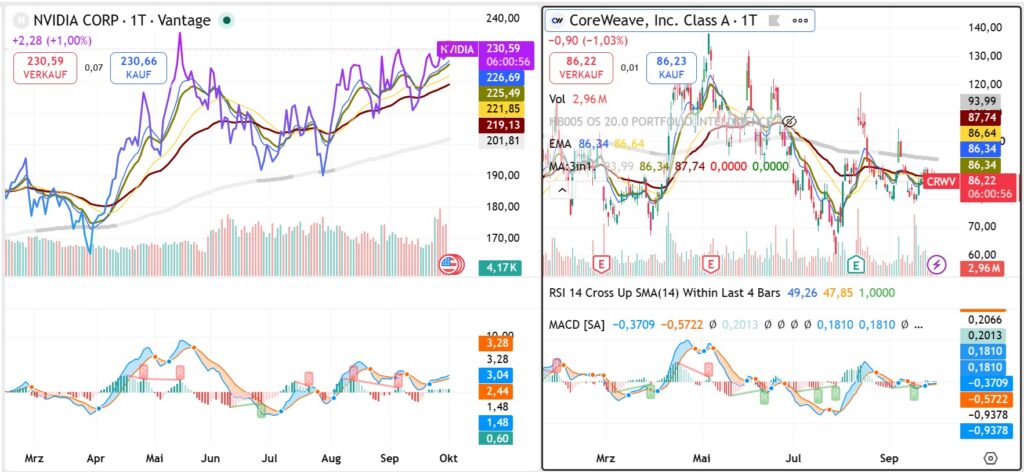
Circular financing does not prove that the AI boom is artificial. But as Nvidia becomes supplier, investor, infrastructure facilitator and ecosystem financier at the same time, investors need a new test: is AI demand becoming economically self-sustaining outside the capital loop?
THE REAL RISK IS NOT THAT THE REVENUE IS FAKE
The most important number surrounding Nvidia today may not be its quarterly revenue.
It may be $366 billion.
That is the amount of future commitments Nvidia disclosed as of July 26, 2026 across supply and capacity, cloud services, data-centre leases, equity investments and capital expenditures. At the same time, the company is working with Apollo, BlackRock, Blackstone, Brookfield, Goldman Sachs and KKR on financing platforms intended to mobilise more than $500 billion of third-party capital for AI infrastructure.
This does not mean Nvidia’s extraordinary growth is fictitious. Quite the opposite: its latest quarter produced $96.2 billion of revenue, including $89.0 billion from Data Center, alongside enormous profits and operating cash generation.
But something fundamental has changed.
Nvidia is no longer merely selling picks and shovels into an AI gold rush.
It is increasingly helping finance the miners, secure their infrastructure, support their cloud capacity, invest in their equity and create financing mechanisms through which still more Nvidia-powered infrastructure can be built.
That makes the next stage of the AI investment case considerably more interesting.
The question is no longer simply:
How many GPUs can Nvidia sell?
It is becoming:
How much economically independent demand ultimately exists behind those GPU purchases?
That distinction could define the next phase of the AI trade.
FACT: THE AI CAPITAL LOOP IS REAL
The term “circular financing” can sound more sinister than the underlying economics justify.
The Bank for International Settlements describes the phenomenon as an increasingly interconnected structure in which chipmakers and hyperscalers invest in AI companies or infrastructure providers that, in turn, purchase chips, cloud capacity and other services from the same ecosystem. The BIS warns that this can make financing relationships harder to observe and genuine economic exposure harder to value.
Nvidia provides an unusually clear example of why this deserves attention.
Its latest filing showed:
- $279 billion of supply and capacity commitments;
- $29 billion of cloud-service commitments;
- $25 billion of future data-centre lease commitments;
- $25 billion of equity-investment commitments;
- $8 billion of capital-expenditure commitments.
Total: approximately $366 billion.
The company has also entered arrangements helping selected customers secure land, power and data-centre capacity. Nvidia says these structures are intended to support customers whose growth can exceed what their own balance sheets and long-term credit profiles can comfortably finance.
Then consider CoreWeave.
In January 2026, Nvidia invested $2 billion in CoreWeave while the companies expanded their collaboration around more than five gigawatts of planned AI infrastructure by 2030. CoreWeave’s filings state that all GPUs then used in its infrastructure were Nvidia GPUs.
CoreWeave itself demonstrates why the picture is more complicated than the phrase “circular financing” suggests.
In April, Jane Street committed roughly $6 billion to CoreWeave cloud capacity and simultaneously invested $1 billion in CoreWeave equity.
That is economically important because it introduces something the simplistic bubble thesis tends to miss:
outside customers are also putting substantial capital into the system.
SIGNAL: NVIDIA IS EVOLVING FROM SUPPLIER INTO ECOSYSTEM ARCHITECT
Traditional semiconductor analysis follows a relatively straightforward chain:
customer demand → chip orders → semiconductor revenue.
The AI infrastructure cycle increasingly looks different:
capital → AI company → compute commitment → infrastructure provider → Nvidia systems → more capacity → more AI services → potentially more capital.
Nvidia can now participate at several points in that chain.
That is strategically powerful.
If insufficient financing prevents an AI cloud from purchasing GPUs, Nvidia can help expand the financing architecture.
If data-centre availability becomes the constraint, Nvidia can help facilitate infrastructure.
If smaller AI companies cannot fund sufficient compute, Nvidia can invest in the ecosystem supporting them.
And if institutional capital remains reluctant to treat GPUs and AI infrastructure as financeable long-duration assets, Nvidia can help create financial structures intended to bring new capital into the market.
This is vertical integration of a different kind.
Nvidia is not simply integrating manufacturing.
It is increasingly helping integrate capital formation into the AI compute stack.
THE SIGNAL BEHIND THE HEADLINE
The bearish interpretation of circular financing is easy:
Nvidia finances companies that buy Nvidia products, therefore reported demand may exaggerate genuine final demand.
That conclusion is too crude.
The more useful distinction is between financed demand and economically dependent demand.
Almost every major infrastructure revolution requires financing. Railways, electricity networks, telecom systems, aircraft fleets and power plants were not built exclusively from internally generated cash.
Financing itself is therefore not evidence of weak economics.
The real test comes one step later:
Can the infrastructure generate sufficient cash flows from customers outside the financing loop to service the capital that built it?
That is the variable investors should increasingly monitor.
CoreWeave offers an instructive example. Approximately 98% of its second-quarter revenue came from committed contracts, and it reported roughly $104 billion of revenue backlog at June 30, before more than $25 billion of additional commitments added early in the third quarter.
The quality of that backlog matters more than its headline size.
If independent enterprises, financial institutions, sovereign customers, developers and consumers increasingly pay economically attractive prices for AI inference and computing services, the circularity problem gradually solves itself.
Capital financed the infrastructure.
External demand validates it.
But if infrastructure expansion continues accelerating faster than independent monetisation, the opposite happens.
The capital loop becomes increasingly responsible for sustaining the demand loop.
That is where financial vulnerability begins.
THE SECOND-ORDER EFFECT: GPU DEPRECIATION BECOMES A FINANCIAL-MARKET VARIABLE
This is where the debate becomes more interesting than Nvidia’s income statement.
Nvidia wants AI compute infrastructure to become an institutional asset class.
In August it announced partnerships with Apollo, BlackRock, Blackstone, Brookfield, Goldman Sachs and KKR designed to mobilise more than $500 billion of third-party capital over time.
But lenders have to answer a question equity investors traditionally spend relatively little time considering:
What is a GPU worth several years from now?
Reuters reports that lenders are scrutinising collateral values, guarantees and the economically useful lives of AI processors as they evaluate Nvidia-linked infrastructure financing.
That creates an important second-order relationship:
technological obsolescence → collateral value → financing cost → infrastructure economics → GPU demand.
If successive Nvidia architectures dramatically outperform previous generations, that is excellent for Nvidia’s competitive position.
But rapid technological improvement can simultaneously reduce assumptions about the residual value of older GPUs.
Lower residual values mean lenders may demand more equity, stronger guarantees or higher yields.
That raises the cost of financing AI infrastructure.
And that eventually raises the utilisation and revenue hurdle that AI data centres must clear.
Paradoxically, therefore, Nvidia’s extraordinary pace of innovation can strengthen its technological moat while making the financing of the surrounding ecosystem more demanding.
That is a genuine second-order risk.
WHAT THE MARKET MAY BE MISSING
The debate is currently framed too narrowly as:
AI bubble versus AI revolution.
The more useful framework is:
Who ultimately carries the economic risk?
During the first phase of the AI boom, hyperscalers could fund enormous capital expenditure largely from exceptional existing cash flows.
The next phase increasingly introduces AI labs, neoclouds, infrastructure vehicles, private credit, leasing structures and supplier-supported financing.
The BIS notes that capital expenditure among the largest firms is beginning to outpace cash flows, increasing reliance on debt and private credit while simultaneously increasing financial interconnectedness.
That means the marginal AI dollar is changing.
And marginal financing often matters more to asset prices than average financing.
As long as AI utilisation and monetisation rise fast enough, financial engineering can accelerate an economically productive infrastructure build.
But if utilisation disappoints, interconnected financing can transmit the disappointment backwards through the chain:
lower AI monetisation
→ weaker cloud economics
→ lower infrastructure utilisation
→ weaker collateral economics
→ tighter financing
→ slower data-centre construction
→ lower incremental GPU demand.
That is the feedback loop investors need to understand.
The real circularity risk therefore isn’t accounting circularity.
It is economic reflexivity.
NVIDIA’S NUMBERS STILL ARGUE AGAINST THE SIMPLE BEAR CASE
Any serious analysis must acknowledge the other side.
Nvidia’s current financial performance remains extraordinary.
Second-quarter fiscal 2027 revenue reached $96.2 billion, up 106% year over year. Data Center revenue reached $89.0 billion, up 117%. Gross margin was approximately 75%.
For the first six months of fiscal 2027, Nvidia generated approximately $74.4 billion of operating cash flow.
This is not the financial profile of a company currently dependent on external financing to survive.
Nor does circular financing mean every Nvidia customer belongs to the same closed network.
The ecosystem increasingly includes enterprises, sovereign customers, financial institutions, industrial companies and other buyers whose economics ultimately depend on businesses far removed from Nvidia.
That expansion is precisely what investors should want to see.
But there is one balance-sheet development worth watching.
Accounts receivable rose to approximately $63.1 billion at July 26 from $38.5 billion at the January fiscal year-end, while Nvidia disclosed substantial concentration among several direct customers.
Rapidly rising receivables are not by themselves evidence of deteriorating revenue quality when revenue is expanding this quickly.
They do, however, make cash conversion and customer concentration increasingly important analytical variables.
THREE SCENARIOS FOR THE NEXT PHASE
1. External Demand Takes Over
Trigger: Enterprise, sovereign, industrial and consumer AI workloads expand sufficiently to absorb rapidly increasing compute capacity.
Consequence: Infrastructure utilisation remains high, older GPUs retain economically useful workloads, financing costs remain manageable and Nvidia’s ecosystem investments function as accelerants rather than subsidies.
Confirmation: Strong independent cloud customers, durable utilisation, continued cash conversion and expanding enterprise inference demand.
Invalidation: Capacity growth consistently outruns usage and pricing.
2. The System Works — But Returns Compress
AI adoption continues, but infrastructure supply grows even faster.
Compute becomes progressively cheaper. AI applications flourish, yet returns migrate away from infrastructure owners toward users and application providers.
Nvidia could continue selling enormous quantities of hardware while some customers earn progressively lower returns on that hardware.
The technology succeeds, but parts of the capital structure disappoint.
This scenario deserves considerably more attention than the simplistic choice between boom and bust.
3. The Capital Loop Becomes the Demand Loop
Trigger: AI monetisation disappoints while infrastructure commitments continue rising.
Cloud providers require increasing external financing merely to sustain expansion. Residual GPU values fall faster than expected and lenders demand greater protection.
The process then reverses:
financing becomes more expensive → marginal projects disappear → GPU orders slow → weaker utilisation further damages financing economics.
This is the scenario in which circular financing becomes genuinely dangerous.
Importantly, investors do not need AI technology itself to fail for this to happen.
They only need returns on AI infrastructure to fall below the returns assumed when the infrastructure was financed.
THE NEXT NVIDIA EARNINGS: DON’T JUST WATCH REVENUE
Nvidia’s fiscal third-quarter results, expected in November, provide the next natural checkpoint for this thesis. The exact reporting date should be confirmed through Nvidia Investor Relations when formally announced.
The headline numbers will matter.
But the more revealing information may sit underneath them.
WHAT TO WATCH
1. Accounts receivable versus revenue
Receivables rose substantially during the first half. Investors should monitor whether cash collection remains broadly consistent with Nvidia’s extraordinary sales growth.
2. Operating cash conversion
Revenue quality becomes more convincing when accounting growth continues converting into operating cash.
3. Equity investments and ecosystem commitments
Nvidia purchased approximately $42.4 billion of equity securities during the first six months of fiscal 2027 and disclosed $25 billion of additional equity-investment commitments.
Watch whether ecosystem financing continues expanding materially faster than the underlying business.
4. Customer diversification
The strongest answer to circular-financing criticism would not be an argument.
It would be evidence that independent enterprise, sovereign, industrial and application demand is broadening faster than ecosystem-supported demand.
5. Financing conditions for AI infrastructure
Watch credit spreads, required guarantees, collateral assumptions and the financing terms available to neoclouds and data-centre projects.
If capital providers increasingly finance AI infrastructure without Nvidia absorbing significant residual risk, that strengthens the investment thesis.
If Nvidia must progressively shoulder more of that risk itself, the signal becomes less comfortable.
TITAN ACTION FRAMEWORK
The circular-financing debate should not automatically produce either a bullish or bearish conclusion.
It should change what investors measure.
Do not ask only whether Nvidia beats revenue expectations.
Ask whether the quality of incremental demand is improving alongside the quantity.
Do not treat every Nvidia investment in an AI company as evidence of artificial demand.
Instead ask whether that capital ultimately produces independent third-party revenues.
Do not interpret rising AI infrastructure debt as automatically dangerous.
Ask whether utilisation, contractual cash flows and asset lives adequately support it.
And above all, distinguish between two fundamentally different systems:
Capital financing productive demand
and
capital financing additional capital-dependent demand.
They can look remarkably similar during an investment boom.
They behave very differently when capital becomes expensive.
CONCLUSION
Circular financing is not yet evidence that the AI investment cycle is unsustainable.
But it is evidence that the cycle is entering a more financially complex phase.
Nvidia’s extraordinary strategic position allows it to do something few semiconductor companies have ever been capable of doing: use the cash flows and market power created by its technological leadership to help expand the financial capacity of the ecosystem that consumes its technology.
That can extend the AI infrastructure boom.
It can also redistribute risk.
The decisive question is therefore not whether money moves in circles.
Modern industrial ecosystems are full of reciprocal investments, supplier financing and strategic capital relationships.
The decisive question is where the circle eventually opens.
If billions invested in AI infrastructure ultimately produce independent revenues from businesses and consumers willing to pay for economically valuable AI services, today’s financing structures may look like the capital formation that accompanied earlier transformational technologies.
If the system increasingly requires fresh capital merely to validate previous capital expenditure, the interpretation changes.
The next Nvidia earnings should therefore be read not merely as another test of GPU demand.
They are becoming a test of AI demand quality.
WIEDER WAS GELERNT
The transferable lesson is that revenue growth and demand quality are not the same variable.
During major infrastructure booms, investors naturally concentrate on units shipped, revenue growth, backlogs and capacity expansion. Yet financing can temporarily allow all four to rise faster than the underlying economic demand that must ultimately support them.
That does not make the growth artificial. It means the analytical job has to move one level deeper.
Follow the money beyond the first transaction. Ask who financed the buyer, who carries the residual asset risk, who ultimately consumes the output and whether that final customer sits outside the original capital loop.
This framework applies far beyond AI — to telecom networks, renewable energy, property, aviation and almost every capital-intensive investment cycle.
The strongest demand signal is not that somebody bought the asset; it is that somebody else can profitably use what the asset produces.
DISCLAIMER
General financial-market research and analytical discussion for informational purposes only; not investment/financial advice, portfolio management or a recommendation to buy or sell any instrument. Investment decisions remain the responsibility of the individual investor.
Research note: Nvidia has not yet formally confirmed the precise November Q3 reporting date in the primary material I found, so I deliberately did not state November 18 as fact in the article. Third-party calendars currently point to November 18, but for publication I would keep the wording “expected in November” until Nvidia Investor Relations formally announces it. This avoids turning an estimated earnings-calendar date into a purportedly confirmed fact.