 LWAYS OPEN
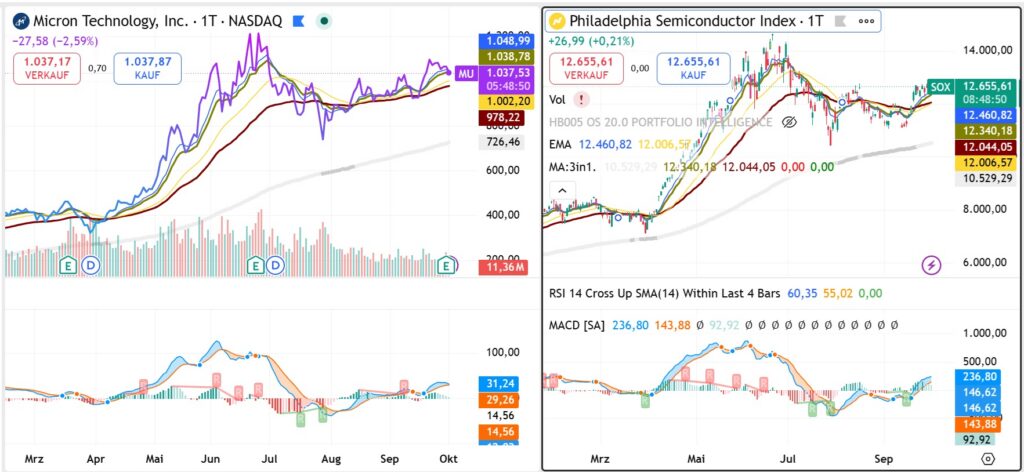
Micron has just delivered numbers that would once have looked impossible for a memory manufacturer. The investment question is no longer whether AI is driving demand. It is whether HBM, contracted supply and capital discipline have permanently changed the economics of memory — or merely created the strongest cycle yet.
THE MOST IMPORTANT MICRON NUMBER IS NOT $54.2 BILLION
Micron has just reported $54.23 billion of quarterly revenue, up from $11.32 billion a year earlier. GAAP gross margin reached 86.8%, operating cash flow hit $43.97 billion, and adjusted free cash flow reached $33.20 billion in a single quarter. For fiscal 2026, revenue was $133.19 billion and adjusted free cash flow $62.31 billion.
Those numbers are extraordinary.
But they are not the most important development in the Micron investment case.
That distinction belongs to what is happening behind the revenue.
Long-term customer commitments have risen from approximately $22 billion in June to $32 billion, while remaining performance obligations have expanded from roughly $100 billion to $150 billion. Micron is effectively gaining something memory producers historically lacked: greater forward visibility into demand and economics.
That matters because the classic memory investment problem was never insufficient technological importance.
It was uncontrolled cyclicality.
When prices rose, manufacturers added capacity. Supply eventually caught demand. Prices collapsed. Margins disappeared.
AI may now be interfering with that mechanism in three places simultaneously:
HBM consumes disproportionate manufacturing capacity. Customers are securing supply years ahead. And producers have learned what undisciplined capacity expansion does to returns.
If those three conditions persist, Micron may deserve to be analysed differently.
If they do not, today’s extraordinary earnings could represent precisely what investors have learned to fear in memory:
peak-cycle profitability disguised as a new paradigm.
FACT: THESE ARE NO LONGER NORMAL MEMORY ECONOMICS
Micron’s fiscal fourth quarter ended September 3, 2026.
The results were remarkable even relative to the extraordinary third quarter:
Revenue: $54.23 billion versus $41.46 billion sequentially.
GAAP gross margin: 86.8% versus 84.6%.
GAAP operating margin: 80.7%.
Operating cash flow: $43.97 billion versus $25.39 billion.
Adjusted free cash flow: $33.20 billion.
For the full year, Micron generated $89.68 billion of operating cash flow and $62.31 billion of adjusted free cash flow. It ended fiscal 2026 with $73.48 billion of cash, marketable investments and restricted cash.
The next quarter does not suggest an immediate reversal.
Micron guides fiscal Q1 2027 revenue to $61.5 billion ± $1.5 billion, with non-GAAP gross margin of approximately 86.25% and non-GAAP diluted EPS of $38.15 ± $1.00. Reuters reported that the revenue guidance exceeded the then-consensus estimate of $57.02 billion.
So the immediate fundamental signal is unusually clear:
Micron is not merely participating in the AI infrastructure boom. It is currently capturing exceptional scarcity economics from it.
The investor question is how long scarcity can survive.
DRIVER: AI IS CHANGING THE CAPACITY EQUATION
The obvious explanation for Micron’s results is HBM — high-bandwidth memory required alongside advanced accelerators in AI systems.
That is correct but incomplete.
The important economic property of HBM is not merely that it commands higher value.
It is that HBM competes for DRAM manufacturing capacity.
Samsung recently said HBM could consume nearly 30% of industry DRAM wafer capacity in 2027, versus roughly 20% currently. Because HBM and conventional DRAM ultimately draw from the same wafer-production base, expanding HBM can constrain conventional DRAM availability.
That creates a powerful second-order effect.
AI demand does not simply increase demand for premium memory.
It can tighten supply across other parts of the DRAM market.
The chain becomes:
more AI accelerators
→ more HBM demand
→ more DRAM capacity allocated to HBM
→ less effective capacity available elsewhere
→ tighter conventional DRAM supply
→ stronger pricing across the memory portfolio.
That helps explain something striking in Micron’s latest results.
The margin explosion is not confined to one AI business.
Micron reported Q4 gross margins of 83% in Cloud Memory, 90% in Core Data Center, 90% in Mobile and Client, and 84% in Automotive and Embedded.
That breadth matters.
The AI boom is influencing the economics of memory beyond the AI products themselves.
THE HIDDEN VARIABLE: HBM MAY BE CHANGING SUPPLY ELASTICITY
This is the intellectual centre of the Micron investment case.
Investors naturally focus on HBM demand.
They should pay equal attention to memory supply elasticity.
Historically, high memory prices contained the seeds of their own destruction.
Higher prices generated enormous cash flow.
Enormous cash flow financed new fabrication capacity.
New capacity created excess supply.
Excess supply destroyed pricing.
The cycle repeated.
The structural bull thesis for Micron therefore cannot simply be:
AI demand will keep rising.
Demand has risen dramatically in previous memory cycles too.
The stronger thesis is:
HBM and long-term customer commitments may make industry supply less responsive to short-term pricing signals than it was historically.
HBM requires advanced manufacturing, packaging and qualification. At the same time, shifting wafer capacity toward HBM reduces effective supply available for other DRAM products.
And customers increasingly appear unwilling to leave supply entirely to the spot market.
Micron’s strategic customer agreements now represent roughly $32 billion of commitments, largely supported by customer cash deposits, according to Reuters. Remaining performance obligations have climbed to approximately $150 billion.
This begins to change the economics from:
produce memory → hope demand absorbs it
toward:
secure customer economics → commit capacity → produce against greater visibility.
That is potentially a profound change.
But there is a catch.
THE $30 BILLION QUESTION: CAPITAL DISCIPLINE
Memory shortages eventually invite capacity.
Micron is already responding.
Gross property, plant and equipment expenditures reached $30.71 billion in fiscal 2026, almost double the prior year’s $15.86 billion. Net capital investment after government incentives was $27.37 billion.
The company is expanding manufacturing globally, with additional capacity planned in Japan and the United States. Initial wafer output from some new capacity is expected from mid-2027.
That creates the central tension in the investment case.
Today’s scarcity is extraordinarily profitable.
But those profits provide the industry with the financial capacity to solve the scarcity.
The correct analytical question is therefore not:
Will Micron increase capex?
Of course it will.
The question is:
Will industry capacity arrive faster or slower than structurally increasing AI memory demand?
That is the variable that determines whether today’s margins represent a new economic regime or an unusually elevated point in an old cycle.
WHY $150 BILLION OF RPO MATTERS
Remaining performance obligations of approximately $150 billion are particularly important because they provide a partial answer to the capacity problem.
If customers are committing economically meaningful volumes and deposits before Micron builds incremental supply, the risk profile of capacity investment changes.
Instead of adding speculative capacity into an opaque future market, Micron can increasingly match investment against visible customer requirements.
That could reduce one of the historical causes of memory oversupply.
It does not eliminate cyclicality.
Long-term agreements can still be renegotiated. Customer demand can change. Technology transitions can alter economics. Competitors can add supply.
But forward commitments change the information available when capital-allocation decisions are made.
That matters enormously in a commodity-like industry.
The difference between building capacity because prices are high today and building capacity because customers have committed economically to future supply is subtle.
Financially, it can be transformative.
MICRON IS ALSO BECOMING LESS OF A SINGLE-PRODUCT AI STORY
Another underappreciated development is product breadth.
Micron is now shipping or qualifying advanced memory and storage products across AI servers, conventional servers, AI workstations, mobile devices, automotive applications and emerging physical-AI platforms.
In the latest quarter, Core Data Center revenue reached $18.0 billion, up from $11.52 billion sequentially, while Cloud Memory generated $16.28 billion. Mobile and Client produced another $13.11 billion and Automotive and Embedded $6.82 billion.
Micron also reported that its server LPDDR SOCAMM revenue more than doubled sequentially, that PCIe Gen5 and Gen6 SSD products are shipping for KV-cache applications, and that it has secured design wins with every Tier 1 OEM customer for AI workstations.
This matters because AI’s memory intensity extends beyond training.
Inference, agentic systems, KV cache, AI PCs, edge AI and physical AI can all increase memory content per computing system.
The structural thesis therefore does not require HBM to remain the only growth engine.
It requires memory intensity per unit of compute to continue increasing.
That is a broader and potentially more durable proposition.
THE BULL CASE
The strongest bull case is no longer simply “AI needs HBM.”
It is that AI is simultaneously changing demand intensity, product mix, capacity allocation and customer contracting behaviour.
For that thesis to hold:
AI infrastructure spending remains strong.
Accelerator deployments continue requiring rapidly increasing quantities of HBM and advanced DRAM.
HBM continues absorbing substantial DRAM capacity.
That maintains tightness beyond the premium HBM market itself.
Long-term contracts become structural.
Customers continue securing memory through multi-year commitments and deposits rather than relying primarily on short-term procurement.
Industry supply remains disciplined.
Micron, SK Hynix and Samsung expand capacity without recreating the historical oversupply cycle.
Free cash flow remains structurally strong.
Higher capex is comfortably financed by operating cash flow rather than consuming the economics created by the AI boom.
If those conditions persist, Micron could become structurally less cyclical even though memory itself remains cyclical.
That distinction matters.
THE BEAR CASE
The bear case begins precisely where the bull case looks strongest:
86% gross margins.
Margins of this magnitude are an enormous economic incentive for additional supply.
The danger is not necessarily an immediate AI collapse.
A more conventional mechanism could be enough.
Micron, Samsung and SK Hynix expand capacity.
HBM manufacturing efficiency improves.
Advanced packaging bottlenecks ease.
New fabs ramp.
AI infrastructure growth remains strong but its rate of growth slows.
Then supply growth catches incremental demand.
Because semiconductor manufacturing has high fixed costs, even a modest movement from scarcity toward balance can have an outsized effect on pricing and margins.
That would expose the principal valuation trap in cyclical industries:
earnings multiples often look cheapest precisely when earnings are closest to their cyclical maximum.
The current numbers are therefore simultaneously evidence for the bull thesis and a warning against extrapolation.
BULL / BASE / BEAR FRAMEWORK
BULL — MEMORY HAS STRUCTURALLY CHANGED
Assumption: AI memory intensity continues increasing faster than effective industry supply.
HBM absorbs a growing proportion of DRAM capacity. Customer agreements provide visibility. Competitors maintain discipline.
Confirmation: Sustained high gross margins, increasing contracted backlog, strong HBM demand, continuing free cash flow despite higher capex and no material deterioration in conventional DRAM pricing.
Invalidation: Aggressive industry capacity announcements or falling contract prices despite rising AI volumes.
BASE — A BETTER CYCLE, NOT THE END OF CYCLICITY
AI structurally increases memory demand and raises Micron’s through-cycle profitability, but conventional semiconductor economics eventually reassert themselves.
Margins normalise from extraordinary levels while remaining materially better than historical trough economics.
Micron emerges as a higher-quality business without becoming a permanently high-margin one.
This is arguably the most important distinction investors must keep open:
structural improvement does not require permanent scarcity.
BEAR — THE OLD MEMORY CYCLE RETURNS
Capacity additions eventually outrun incremental demand.
HBM remains strategically important, but production becomes more efficient and supply becomes less constrained. Conventional DRAM and NAND prices weaken simultaneously.
Revenue growth slows while depreciation and fabrication costs associated with the investment programme continue.
The earnings denominator collapses.
What appeared to be a remarkably low valuation turns out to have been based on unsustainably high earnings.
Confirmation: weakening pricing, rising inventories, deteriorating utilisation, aggressive competitor capex and sequential gross-margin compression.
The key point is that the bear case does not require AI to fail.
It merely requires memory supply to catch up.
WHAT CHANGES THE CASE?
1. GROSS MARGIN
This may be the cleanest single indicator.
Micron reported 86.8% GAAP gross margin in Q4 and guides approximately 86% again for Q1 FY2027.
Sustained margins at extraordinarily elevated levels would indicate scarcity remains powerful.
Sequential deterioration would deserve attention even if revenue continues rising.
2. STRATEGIC CUSTOMER COMMITMENTS
The progression has already been striking:
$22 billion → $32 billion, while reported RPO increased from roughly $100 billion → $150 billion.
Continued expansion would strengthen the argument that memory procurement is becoming structurally more contractual.
A plateau or reversal would weaken it.
3. CAPEX VERSUS OPERATING CASH FLOW
FY2026 operating cash flow: $89.68 billion.
Net capital investment: $27.37 billion.
Adjusted free cash flow: $62.31 billion.
Today, the economics are extraordinarily favourable.
The warning signal would be capex continuing upward while operating cash generation begins declining.
4. INDUSTRY HBM CAPACITY
Samsung expects HBM to consume nearly 30% of industry DRAM wafer capacity next year.
As long as HBM expansion constrains conventional DRAM capacity, AI demand can support pricing far beyond HBM itself.
If manufacturing productivity improves enough to release substantial effective capacity, that scarcity premium could fade.
5. THE NEXT CUSTOMER — NOT JUST THE NEXT GPU
AI memory demand needs eventually to broaden beyond hyperscaler infrastructure expansion.
Enterprise inference, AI workstations, edge devices, robotics, automotive AI and AI-enabled consumer hardware need to absorb increasing memory content.
That would transform the thesis from:
AI data centres are creating a memory shortage
into:
AI is structurally increasing memory intensity throughout computing.
The second thesis is considerably more durable.
CONCLUSION
Micron’s latest numbers leave little ambiguity about current fundamentals.
They are exceptional.
The harder question is whether they are exceptional because the cycle is extraordinary or because the structure of the industry has changed.
There is now genuine evidence for structural change.
HBM consumes significant DRAM manufacturing capacity. AI increases memory intensity. Customers are committing capital and purchasing obligations further into the future. Micron is producing enormous free cash flow even while accelerating investment.
But none of that repeals semiconductor economics.
Scarcity produces profits.
Profits produce investment.
Investment eventually produces supply.
The investment case therefore rests less on forecasting another quarter of spectacular earnings than on watching whether contracted demand and increasing memory intensity can continue outrunning the industry’s ability to add effective capacity.
That is the real Micron contest.
Not AI versus no AI.
Demand visibility versus supply elasticity.
WIEDER WAS GELERNT
The most transferable lesson from Micron is that cyclical companies should not be analysed primarily from their current earnings — but from the mechanism that determines their next supply response.
Record revenue and margins tell us that demand currently exceeds supply. They do not tell us whether those profits are sustainable. To answer that, investors must follow what happens next: Do extraordinary profits trigger uncontrolled capacity expansion, or have technology complexity, customer contracts and capital discipline changed the industry’s response function?
This distinction applies far beyond memory semiconductors. Mining, energy, shipping and commodity chemicals repeatedly demonstrate the same principle: high prices are bullish for current earnings but can be bearish for future industry economics if they unleash excessive investment.
Micron’s AI opportunity becomes structurally different only if demand visibility improves faster than supply becomes elastic.
Never confuse an extraordinary shortage with a permanent scarcity.
DISCLAIMER
General financial-market and investment research for informational purposes only; not investment/financial advice, portfolio management or a recommendation to buy or sell any instrument.