 LWAYS OPEN
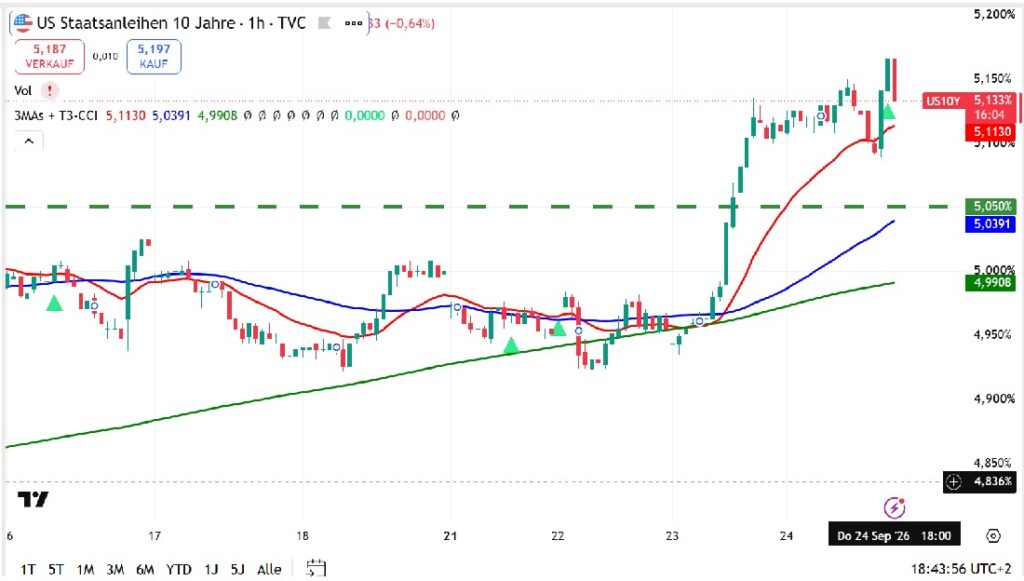
The temptation after a technology sell-off is to ask which stock has fallen far enough to buy. That may be the wrong question. With the U.S. 10-year Treasury yield above 5%, the more important signal is whether the discount-rate shock is stabilising — because that may determine whether today’s weakness becomes an opportunity or merely the first leg lower.
The market is watching NVIDIA. Investors should be watching something else.
A 3% or 5% correction in an AI leader can look attractive after a powerful rally. But a lower share price does not automatically mean a better risk/reward proposition if the rate used to discount its future cash flows is simultaneously moving higher.
That distinction has become unusually important.
The Federal Reserve raised its target range by 25 basis points to 3.75–4.00% on September 16, citing still-elevated inflation even as economic activity remained solid. Days later, the U.S. 10-year Treasury yield pushed above 5%, reaching roughly 5.11% on September 23 after a sharp daily increase.
Yet only two days earlier, the Nasdaq had closed at a record high and the Philadelphia Semiconductor Index had surged 4.3%, driven by renewed AI optimism.
That creates the real strategic question.
Are AI stocks becoming cheaper — or is the price investors should be willing to pay for AI earnings being repriced?
Those are not the same thing.
And that distinction changes how investors should approach the next buying opportunity.
FACT: This is a discount-rate shock before it is an AI earnings shock
There is currently little evidence that the fundamental AI investment thesis has suddenly collapsed.
What changed much more abruptly is the interest-rate environment.
The Fed’s September increase reversed the previous easing direction and lifted the federal-funds target range to 3.75–4.00%. At the same time, Treasury yields have moved sharply higher. The 10-year yield reached a 19-year high around 5.14% intraday on September 23, while the 30-year approached 5.42%.
This matters disproportionately for equities whose valuations embed substantial future growth.
The market is effectively running two calculations at once:
Earnings question: How much cash flow can AI businesses ultimately generate?
Valuation question: What multiple should investors pay today for those future cash flows?
AI enthusiasm can keep the first answer strong while rising Treasury yields simultaneously reduce the second.
That is why a high-quality AI company can deliver excellent operating performance and still experience multiple compression.
The current correction therefore should not automatically be interpreted as evidence that the AI thesis is weakening.
It may instead be evidence that the price of capital has changed.
WHAT THE MARKET MAY BE MISSING
The real buying signal may come from bonds before it comes from stocks
The obvious strategy after a technology decline is to monitor the stocks themselves: NVIDIA support, semiconductor momentum, Nasdaq levels and oversold indicators.
Those remain useful.
But they are downstream indicators.
If rising yields are causing the equity weakness, then watching NVIDIA to determine whether the yield shock is over reverses the causal chain.
The more useful sequence is:
Treasury yields → Nasdaq/QQQ → semiconductors → individual AI leaders.
That hierarchy creates an important investment advantage.
Imagine NVIDIA stabilises while the 10-year Treasury yield continues from 5.10% toward 5.20%.
The stock chart may initially appear constructive, but the valuation headwind is still intensifying.
Now consider the opposite configuration: NVIDIA remains below its recent high, but the 10-year yield retreats toward 5.00%, semiconductor breadth improves and the Nasdaq stops making new intraday lows.
The stock itself may look less technically impressive — yet the underlying environment has improved.
The first situation looks better on the stock chart. The second may offer the better risk/reward setup.
That is the non-obvious distinction.
SIGNAL: 5% is not a magical crash line
Investors should also resist turning the 5% Treasury yield into a binary threshold.
Markets do not suddenly become uninvestable at 5.01% and attractive at 4.99%.
What matters is the combination of level, direction, speed and equity response.
A 10-year yield around 5.10% that is rapidly accelerating higher is very different from a 5.10% yield that has stabilised after a repricing.
Likewise, a 5% yield accompanied by strong earnings growth and healthy market breadth may be absorbed by equities. The same yield accompanied by rising oil prices, renewed inflation pressure and expectations of further monetary tightening is more problematic.
This is why the current regime should be analysed dynamically rather than through one fixed number.
The crucial question is not:
“Is the 10-year above 5%?”
It is:
“Is the bond market still tightening financial conditions faster than corporate fundamentals can offset them?”
That is a much more useful framework.
SECOND-ORDER EFFECT: Higher yields change which AI companies deserve premium valuations
There is another consequence.
If long-term rates remain structurally higher, the market may become more discriminating inside the AI complex.
During periods of falling discount rates, investors can reward distant growth, optionality and large addressable markets.
At higher yields, the advantage shifts toward companies capable of converting AI demand into nearer-term revenue, margins and free cash flow.
This does not necessarily mean abandoning technology.
It means distinguishing between different kinds of technology exposure.
A company generating rapidly expanding current cash flows can withstand valuation compression better than one whose investment case depends heavily on profits many years into the future.
The second-order effect of a sustained 5% Treasury environment could therefore be greater dispersion within AI, not simply lower AI prices.
That distinction matters enormously.
The next phase of the AI trade may reward cash-flow delivery more than narrative duration.
IMPLICATION: Do not confuse a small pullback from record highs with capitulation
Timing matters.
The Nasdaq reached a record closing high on September 21, while semiconductor shares rallied strongly. The Nasdaq again reached an intraday record on September 22.
That means the market entered the present rate shock from elevated levels.
A modest decline immediately after record highs is therefore fundamentally different from a 10–15% correction after weeks of deleveraging.
This has an important capital-allocation implication.
There is little strategic necessity to deploy large cash reserves simply because the first meaningful red day appears.
Cash has option value.
When uncertainty is unusually high, holding liquidity gives investors the ability to buy one of two things later:
confirmation at slightly higher prices, or
greater value at substantially lower prices.
Paying a small confirmation premium can sometimes be preferable to attempting to capture the exact bottom while the macro driver is still deteriorating.
ACTION FRAMEWORK: A staged approach beats an all-or-nothing decision
The appropriate response is not necessarily “buy” or “do not buy.”
It is to define what evidence justifies progressively greater capital deployment.
Scenario 1 — Yields continue rising
If the 10-year Treasury remains above roughly 5.10–5.15% and continues moving higher, while QQQ and semiconductors make new lows, the rate shock remains unresolved.
The relevant signal would be deterioration across several markets simultaneously rather than weakness in one stock.
Approach: preserve liquidity and allow lower pre-defined limit orders to do their job rather than chasing falling prices upward.
Invalidation: yields reverse decisively and equity breadth improves.
Scenario 2 — Yields stabilise, equities stop deteriorating
Suppose US10Y remains around 5.05–5.15%, but stops accelerating. At the same time QQQ stops making new intraday lows and semiconductor relative strength improves.
That would represent the first meaningful change.
Not a new bull signal — but evidence that equities are beginning to absorb the new rate environment.
Approach: this is where a small first tranche becomes more defensible than a large deployment.
The purpose of the first tranche is not to identify the bottom.
It is to obtain exposure while retaining substantial capital if the thesis proves premature.
Scenario 3 — Bond and equity markets confirm each other
The more constructive configuration would be a retreat in US10Y toward roughly 5.05% or below, accompanied by improving QQQ and semiconductor breadth.
If yields subsequently move sustainably below 5% while technology continues strengthening, the market would be providing much stronger evidence that the discount-rate shock has peaked.
That combination matters more than NVIDIA crossing any single price level.
Approach: progressively increase deployment rather than waiting for perfect certainty.
Scenario 4 — Equities correct materially while yields remain high
There is also a different path to improved risk/reward.
Suppose Treasury yields do not fall materially, but Nasdaq corrects another 5–8%.
The macro environment would still be difficult — but valuations would have absorbed considerably more of the rate shock.
That could create selective opportunities even before the bond market turns.
The key is recognising that better entry prices and better macro conditions are two different routes toward improved expected returns.
The strongest setup would combine both.
The Treasury market is now part of the equity research process
The Treasury’s September auction schedule includes a seven-year note auction on September 24, following the week’s two- and five-year supply.
That matters because Treasury auctions provide real-time evidence of investors’ willingness to absorb government debt at prevailing yields.
The five-year auction preceding it came amid considerable bond-market stress, with the five-year yield reaching levels not seen at auction since 2006.
Investors in growth equities therefore need to monitor something they might once have considered primarily a fixed-income event.
Strong Treasury demand can help stabilise yields.
Weak demand can reinforce the upward yield move.
And when equity valuations are sensitive to discount rates, that bond-market signal can propagate directly into technology multiples.
This is precisely what second-order analysis requires: connecting markets that appear separate but are transmitting the same underlying risk.
WHAT TO WATCH
Five signals now matter more than attempting to identify the exact bottom in an individual AI stock:
1. U.S. 10-year Treasury yield.
Direction and velocity matter more than an arbitrary 5% line. A retreat toward 5.05% and ultimately below 5% would materially improve the backdrop; renewed acceleration above recent highs would weaken it.
2. QQQ/Nasdaq price behaviour.
Look for the market to stop producing successive intraday lows after the opening volatility. Stabilisation matters before recovery.
3. Semiconductor breadth.
The SOX should confirm rather than contradict Nasdaq stabilisation. A recovery driven by only one or two mega-cap names is weaker evidence.
4. AI leadership.
NVIDIA and other major AI beneficiaries remain valuable confirmation indicators, but they should be read after the bond market rather than before it.
5. Oil and inflation expectations.
With crude around the psychologically important $100 area during recent sessions, energy remains capable of transmitting geopolitical stress into inflation expectations and therefore into Treasury yields.
The strongest signal is not any one of these turning positive.
It is several turning together.
Conclusion: Buy evidence, not excitement
The strategic mistake in a volatile market is often not buying too early or too late.
It is using the wrong variable to decide.
When an equity correction is driven primarily by company fundamentals, company-specific analysis should dominate.
When it is driven by discount-rate repricing, the bond market deserves priority.
That is where the current situation becomes particularly interesting.
AI fundamentals have not suddenly disappeared. The Nasdaq was setting records only days ago. But the cost of capital has changed rapidly, and the Federal Reserve has just returned to tightening.
The sensible response is therefore neither indiscriminate dip-buying nor abandoning AI.
It is conditional capital deployment.
Keep liquidity available. Let genuinely attractive limit orders work. Deploy smaller initial tranches when the evidence improves. Increase exposure when rates and equities confirm each other.
The objective is not to predict the exact low.
It is to ensure that increasingly large amounts of capital require increasingly strong evidence.
WIEDER WAS GELERNT
Investors often look for the answer in the asset they want to buy. But sometimes the most important signal sits in an entirely different market.
When technology falls because earnings expectations deteriorate, study earnings. When technology falls because the discount rate is rising, study bonds. That distinction prevents investors from mistaking a cheaper share price for a genuinely improved investment proposition.
The transferable lesson is to identify the causal variable before reacting to the price movement. Then build a hierarchy of confirmation signals around it. In the present environment, Treasury yields lead; Nasdaq and semiconductor breadth confirm; individual AI stocks come last.
This framework also removes the impossible requirement of calling the exact bottom. Capital can instead be deployed progressively as evidence improves — while liquidity remains available if prices become substantially more attractive.
The best signal is not always found on the chart of the asset you want to buy.
Disclaimer
General financial-market research and analytical discussion for informational purposes only; not investment or financial advice, portfolio management or a recommendation to buy or sell any instrument. Investment decisions remain the responsibility of the individual investor.