 LWAYS OPEN
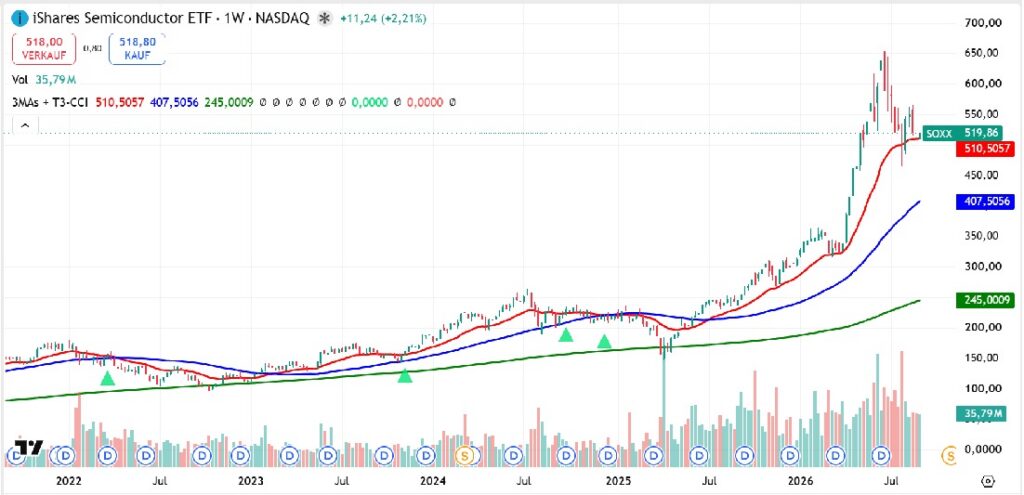
Treasury yields near 4.8% should theoretically pressure long-duration technology assets. Yet AI infrastructure spending, semiconductor revenues and capacity commitments continue accelerating. The reason may be structural: for the companies funding the AI buildout, the relevant constraint is increasingly not the price of money — but the availability and productivity of compute.
Inventory then travels backwards through the semiconductor supply chain.
Confirmation would include: hyperscaler capex reductions, declining AI infrastructure utilization, weaker cloud growth, semiconductor lead-time contraction, falling HBM or accelerator pricing and material downward earnings revisions.
What it means: the market stops treating AI infrastructure as a scarcity cycle and begins treating it as an overcapacity cycle.
That transition would matter far more fundamentally than another 25 or 50 basis points in Treasury yields.
10. WHAT CHANGES THE CASE?
Five measurable developments deserve particular attention.
1. Hyperscaler capex revisions
Microsoft, Alphabet, Amazon and Meta collectively provide one of the clearest leading indicators.
Further increases would strengthen the structural thesis.
Meaningful reductions would be among the earliest serious warnings.
2. Cloud revenue versus infrastructure spending
Capex alone is not bullish.
The critical question is whether Azure, AWS, Google Cloud and AI-related products generate revenue quickly enough to justify investment.
The gap between capex growth and monetization growth should become one of the most important metrics in AI research.
3. TSMC growth and advanced-node economics
TSMC sits beneath competing architectures and therefore provides an unusually valuable read-through on aggregate advanced-compute demand.
Revenue growth, advanced-node utilization, margins and capex guidance can reveal whether demand remains broad.
4. Memory and HBM supply economics
HBM has become an essential component of accelerator performance.
Changes in HBM pricing, capacity availability and producer margins could signal whether scarcity is strengthening or normalizing.
5. Semiconductor earnings revisions versus bond yields
If Treasury yields remain elevated while semiconductor earnings estimates continue rising, fundamentals can offset part of the valuation pressure.
If yields rise and earnings revisions turn negative, the investment regime changes materially.
That combination would deserve much greater attention than either variable alone.
11. What really matters for the investment case
The semiconductor sector is not immune to interest rates.
That would be the wrong conclusion.
At sufficiently high yields, valuations compress, financing becomes more expensive and marginal infrastructure projects become less attractive.
But today’s evidence suggests that rates have not yet displaced the stronger economic force: extraordinary demand for AI compute.
The distinction is between price sensitivity and demand destruction.
Semiconductor equities can correct sharply because their multiples are too high even while their businesses remain extraordinarily strong. Conversely, strong semiconductor revenue growth does not guarantee attractive investment returns if expectations embedded in valuations become impossible to exceed.
The central structural thesis therefore should not be:
“AI beats higher rates.”
It should be:
AI infrastructure investment can remain resilient to higher rates for as long as the economic value of incremental compute exceeds its rapidly rising all-in cost.
The day that relationship reverses will matter more than the next headline about the Federal Reserve.
A powerful investment lesson from the AI infrastructure cycle is that the variable markets discuss most is not necessarily the variable that controls the economics.
Interest rates are visible, measurable and updated every second. That makes them an obvious explanation for technology valuations. But a higher discount rate tells us surprisingly little about whether Microsoft needs another data center, whether TSMC’s advanced capacity remains scarce or whether an additional GPU can be monetized profitably.
Conventional analysis often studies macroeconomics and company fundamentals separately. The better question is where they intersect: at what point does a changing macro variable alter actual corporate capital-allocation behaviour?
This principle applies far beyond semiconductors. When analysing any capital-intensive structural trend, identify the economic constraint that would cause the marginal buyer to stop spending — and monitor that constraint rather than the loudest headline.
A cycle does not end when capital becomes expensive; it ends when the next unit of capital is no longer worth deploying.
Disclaimer
This publication provides general financial-market and investment research for informational and educational purposes only. It does not constitute investment or financial advice, portfolio management, an offer or solicitation, or a recommendation to buy, sell or hold any security, financial instrument or investment strategy. Investors should conduct their own research and consider their individual circumstances and risk tolerance.