 LWAYS OPEN

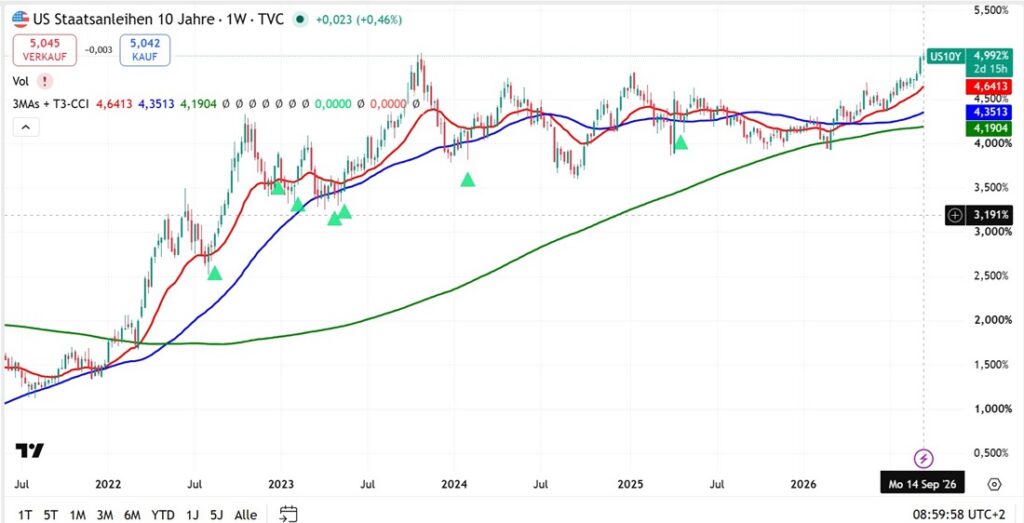
Deck: With U.S. inflation still above target, Brent crude near $108 and the 10-year Treasury yield testing 5%, the Fed faces an unusual problem: raising rates could hurt risk assets, but refusing to tighten may destabilise the bond market even more.
The most important signal ahead of today’s Federal Reserve decision is not that equities have weakened. It is where the pressure is coming from.
The S&P 500 remains close to historically elevated levels. The VIX is only around 17. Yet the U.S. 10-year Treasury yield has crossed 5%, Brent crude has climbed above $108, market breadth has deteriorated and semiconductors—the leadership group behind much of the equity advance—have begun to lose momentum. In other words, the market is not behaving like investors fear an imminent recession. It is behaving like investors are questioning whether the existing level of interest rates is restrictive enough to contain inflation.
That distinction changes today’s Fed debate.
Markets are pricing roughly a 93% probability of a 25-basis-point increase, which would lift the federal-funds target range from 3.50%–3.75% to 3.75%–4.00%.
The counter-intuitive possibility is therefore this:
A rate hike could initially hurt equities—but a decision not to hike could ultimately be more destabilising.
That is the signal behind today’s decision.
THE EVENT: THE FED IS NO LONGER FIGHTING YESTERDAY’S INFLATION
The Federal Open Market Committee concludes its two-day meeting today, 16 September. The policy statement is scheduled for 2:00 p.m. ET, followed by Chair Kevin Warsh’s press conference at 2:30 p.m. ET. This meeting also includes an updated Summary of Economic Projections.
The inflation backdrop has changed materially.
August CPI increased 0.4% month-on-month and 3.4% year-on-year, compared with a 0.1% monthly rise in July. Gasoline alone increased 3.9% and accounted for more than one-third of August’s monthly CPI increase.
The Fed’s preferred inflation measure was already uncomfortable before the latest energy shock. July headline PCE inflation stood at 3.7% year-on-year, while core PCE was 3.3%—both well above the Federal Reserve’s 2% objective.
At the same time, the labour market has not provided the Fed with an obvious reason to tolerate higher inflation. August nonfarm payrolls increased by 162,000, while unemployment remained at 4.1%.
This is crucial.
The Fed is not confronting high inflation alongside collapsing employment. It is confronting persistent inflation while employment remains comparatively resilient.
That gives monetary policy considerably less room to look through the latest price pressures.
FACT → REACTION → SIGNAL → IMPLICATION
FACT
Inflation remains materially above 2%. Oil has surged above $100. Employment strengthened in August. Long-term Treasury yields have moved toward 5%.
REACTION
Markets have rapidly repriced monetary policy.
Only one month ago, the probability of a September hike was around 33%. By Tuesday it had risen to roughly 94.5%. The 10-year Treasury yield breached 5%, reaching its highest level since 2007.
SIGNAL
The bond market is effectively telling the Federal Reserve:
inflation credibility now matters more than providing additional support to asset prices.
IMPLICATION
Today’s real policy choice may not be “hike versus protect markets.”
It may instead be:
tighten short-term monetary policy now—or risk markets tightening long-term financial conditions independently.
That is a very different problem.
THE SIGNAL BEHIND THE HEADLINE: THE FED MAY NEED TO HIKE TO STOP THE BOND MARKET FROM HIKING FOR IT
This is the most important—and least obvious—market signal.
Normally, investors think about monetary tightening through the federal-funds rate. The Fed raises overnight rates, borrowing becomes more expensive, economic activity slows and inflation eventually moderates.
But financial conditions can tighten without the Fed.
The Treasury market can do it.
When investors become concerned that inflation will remain too high, they demand greater compensation for holding long-duration bonds. Long-term yields rise.
And that matters far beyond Treasuries.
Mortgage rates, corporate borrowing costs, infrastructure financing, leveraged transactions, real-estate valuations and equity discount rates all become more restrictive.
That is exactly why the movement in the 10-year Treasury deserves more attention today than the first reaction in the S&P 500.
The benchmark yield crossed 5% on Tuesday, its highest level since 2007.
If the Fed unexpectedly held rates unchanged while inflation expectations continued rising, investors could interpret the decision not as monetary accommodation but as insufficient inflation control.
The consequence could be paradoxical:
the Fed keeps short rates lower, but markets push long rates higher.
That would be tightening without control.
Economists surveyed by Reuters explicitly identified this risk: failure to reinforce the Fed’s inflation-fighting credibility could produce a steeper Treasury curve and higher long-term borrowing costs.
This explains why today’s hike may be less about the additional 25 basis points themselves than about preventing a much larger repricing further out the yield curve.
OIL HAS CHANGED THE EQUATION
The second-order problem is energy.
Brent crude remains around $108 per barrel this morning after Tuesday’s sharp rise. Supply disruptions and geopolitical risks in the Middle East remain important, although prices eased slightly overnight following evidence of higher U.S. inventories.
Central banks cannot produce oil.
A rate hike will not reopen an export terminal or increase crude flowing through a pipeline.
But that does not mean monetary policy can ignore an energy shock.
The critical distinction is between a first-round price shock and second-round inflation.
Higher oil raises gasoline, diesel, freight and production costs directly. The larger monetary-policy danger emerges when those increases migrate into wages, services, inflation expectations and business pricing decisions.
And today’s starting point is uncomfortable because inflation was already above target before the latest energy surge.
That means the Fed’s tolerance for simply “looking through” the shock is lower than it would be if underlying inflation were already around 2%.
EQUITIES ARE NOT YET PRICING A MACROECONOMIC ACCIDENT
Here the market becomes especially interesting.
If investors genuinely believed a severe monetary-policy mistake or recession was imminent, one would normally expect substantially greater demand for volatility protection.
That is not what the supplied market structure shows.
The VIX is around 17, while the S&P 500 remains relatively close to its highs.
Tuesday’s S&P decline was only 0.45%, despite the 10-year Treasury yield breaking 5% and crude surging. The Nasdaq fell 0.78%.
But underneath those headline indices, conditions were considerably weaker.
NYSE decliners exceeded advancers by 2.56 to 1; on Nasdaq the ratio was 2.33 to 1. The S&P produced only 14 new 52-week highs against 18 new lows, while Nasdaq recorded 52 new highs versus 264 new lows.
That is an important divergence.
The index is displaying resilience. The average stock is displaying considerably more stress.
This is not yet a panic regime.
But it is no longer an environment in which the headline index alone gives an adequate picture of risk.
THE SEMICONDUCTOR WARNING
The Philadelphia Semiconductor Index adds another layer.
Semiconductors have been one of the critical transmission mechanisms between the AI investment boom and broader equity-market performance.
That makes weakness in SOX more significant than weakness in an ordinary industry group.
Reuters reported that the semiconductor index failed to recover meaningfully from Monday’s rout, gaining only 0.4% Tuesday despite the preceding decline.
The supplied charts reinforce the distinction.
Nvidia around $212 remains far above its longer-term trend structure, but short-term momentum has weakened. The SOX has also lost momentum while QQQ and SPY remain much closer to their highs.
That creates an important test:
Can the broader market continue to hold near its highs if semiconductor leadership stops doing the heavy lifting?
For now, the answer remains unresolved.
But the combination of AI-capex uncertainty and a 5% risk-free benchmark creates a materially higher hurdle for long-duration growth valuations.
At 4%, investors can tolerate considerable uncertainty about distant earnings.
At 5%, the mathematics becomes less forgiving.
AND THEN WHAT?
Suppose the Fed raises rates 25 basis points today.
The first-order interpretation is straightforward:
higher rates = negative for equities.
But second-order analysis produces several different possibilities.
If the Fed hikes and the 10-year Treasury yield falls, that would be important. It would suggest the bond market views the move as credible enough to reduce longer-term inflation risk.
If the Fed hikes and the 10-year remains around or above 5%, the message changes: markets may believe considerably more tightening is required.
If the Fed hikes while oil retreats, yields decline and equity breadth improves, the decision could ultimately function as a clearing event rather than the beginning of a larger equity correction.
And if the Fed unexpectedly holds while long yields rise further, the market would be sending perhaps the strongest signal of all:
monetary credibility—not the additional 25 basis points—was the real issue.
That is why the reaction function after 2:00 p.m. ET matters more than the headline itself.
WHAT THE MARKET MAY BE PRICING NEXT
The most consequential shift has already occurred.
One month ago, investors were debating whether the Fed would move at all. By Wednesday morning, futures implied roughly a 93% probability of a quarter-point hike.
The surprise threshold is therefore asymmetric.
A 25-basis-point hike itself contains relatively little new information.
The important information will come from the Summary of Economic Projections, future-rate path and the bond market’s response to Chair Warsh’s press conference.
Markets are no longer asking simply whether rates rise today.
They are asking whether September is a one-off adjustment or the beginning of another tightening sequence.
A Reuters poll found 86 of 101 economists expected today’s quarter-point hike, while 37 of 70 respondents expected at least one additional increase by the end of March. Interest-rate futures were pricing several further increases through July 2027.
That future path is potentially much more important for equity valuations than today’s 25 basis points.
WHAT TO WATCH NEXT
1. U.S. 10-Year Treasury Yield — the most important signal
The immediate reference point is 5%. A sustained move back below it after a Fed hike would suggest tightening credibility is helping stabilise long-term inflation expectations. A decisive move above recent highs despite a hike would indicate the bond market believes the Fed remains behind the inflation problem.
2. Brent Crude — approximately $108
Oil is currently the bridge between geopolitics, inflation and monetary policy. A meaningful retreat would remove part of the market’s inflation premium. Another sustained push higher would strengthen the case for persistent restrictive policy.
3. SOX versus SPY/QQQ
Watch whether semiconductors regain relative strength rather than merely bounce. Continued SOX underperformance while SPY remains near highs would indicate deteriorating leadership underneath the index.
4. Market Breadth
Tuesday’s 2.56-to-1 NYSE decline ratio and 2.33-to-1 Nasdaq decline ratio are more informative than the S&P’s modest headline loss. A return to positive breadth following the Fed would support the interpretation that the recent weakness was a repricing rather than a broader regime change.
5. VIX
The supplied reading around 17 is strikingly calm relative to 5% Treasury yields, $100-plus oil and weakening breadth. A sustained move through 20 alongside rising yields would signal that the rates problem is migrating from valuation pressure toward broader risk aversion.
THE CENTRAL MARKET QUESTION AFTER TODAY
Today’s Fed decision should not be judged by whether the S&P 500 rises or falls during the first 30 minutes.
The more informative question is whether financial conditions begin to stabilise after the decision.
Watch the combination:
Fed → Treasury yields → oil → semiconductor leadership → breadth → volatility.
If yields retreat, oil stabilises, SOX regains leadership and breadth improves, the market may absorb a hike surprisingly well.
If yields continue higher, oil remains above $100, semiconductors weaken and breadth deteriorates while volatility begins rising, the evidence would increasingly point toward a genuine change in market regime.
The distinction matters enormously.
One is a valuation reset.
The other is tightening financial conditions becoming self-reinforcing
Central-bank decisions should never be interpreted through the policy rate alone.
The more useful question is what the bond market does after the central bank acts.
A rate hike that pushes long-term yields lower can actually loosen part of the pressure on financial markets because investors gain confidence that inflation will eventually be contained. Conversely, leaving rates unchanged can become effectively restrictive if the decision undermines inflation credibility and causes long-term yields to surge.
Headline-focused investors can therefore misread both outcomes: “hike equals bearish” and “hold equals bullish” are incomplete frameworks.
The transferable lesson is to follow the entire transmission mechanism—policy decision, inflation expectations, Treasury yields, sector leadership, breadth and volatility—before deciding what a central-bank decision actually means for markets.
The important rate is not always the one the Federal Reserve changes; sometimes it is the one the market changes for the Federal Reserve.
Disclaimer
General financial-market research and market intelligence for informational purposes only. This material does not constitute investment advice or a recommendation to buy or sell any financial instrument. Market interpretations and scenarios are inherently uncertain and may change as new information becomes available.