 LWAYS OPEN

Analytical Market Study | October 29, 2026 | FRL DEEP RESEARCH
Everpure’s accelerating revenue, expanding hyperscaler relationships and ambitious fiscal 2028 outlook have transformed its investment case. Yet a premium valuation, negative quarterly free cash flow and changing product economics create an important distinction: exceptional business growth does not automatically translate into attractive near-term shareholder returns.
The Investment Case Has Changed — But So Has the Price of Being Right
There is a more important question surrounding Everpure than whether artificial intelligence will continue to increase demand for data storage. That question has largely been answered. The more consequential issue is whether Everpure can translate its technological advantage into the operating margins and cash generation now implied by its share price.
The company formerly known as Pure Storage is no longer valued merely as an enterprise storage vendor. Investors are increasingly treating it as a potential infrastructure platform spanning enterprise data management, AI-native workloads and hyperscale storage architecture.
That transition is supported by unusually strong evidence. Second-quarter fiscal 2027 revenue increased 38% year over year, remaining performance obligations rose 44%, and management subsequently outlined a preliminary fiscal 2028 revenue opportunity of $7.0–$7.3 billion.
But an overlooked contradiction deserves attention: despite this acceleration, Everpure reported negative free cash flow of $238 million in its latest quarter.
This does not invalidate the growth story. It changes what investors must establish before accepting the valuation.
The central investment question is no longer whether Everpure can grow rapidly. It is whether the economics of its next phase of growth will justify the expectations investors have already capitalised into the stock.
1. The Fundamentals: Stronger Than the Share Price Alone Suggests
Everpure’s latest reported financial performance provides substantial support for the structural growth thesis.
Q2 FY2027 · QUARTER ENDED AUGUST 2, 2026
Quarterly revenue
$1.186B
+38% year over year
Product revenue
+54%
$687M reported
Subscription ARR
$2.13B
+20% year over year
Remaining performance obligations
$4.1B
+44% year over year
Source: Everpure Q2 FY2027 earnings release and SEC Form 10-Q.
The most significant feature is the composition of growth. Product revenue expanded substantially faster than subscription revenue, while recurring revenue and contractual obligations continued to advance.
This creates two distinct economic engines:
The established enterprise platform: FlashArray, FlashBlade and Evergreen services benefit from enterprise modernisation, existing customer relationships, refresh cycles and ongoing service commitments.
The emerging infrastructure platform: DirectFlash, AI-scale storage and data-management software potentially expand Everpure’s addressable market beyond traditional enterprise arrays.
The distinction matters because the second engine does not necessarily have the same margins, working-capital characteristics or customer concentration as the first.
Management’s FY2028 outlook changes the valuation debate
Management outlook: operating income may grow faster than revenue
FY2028 figures are preliminary company projections, not reported results or analyst consensus.
Revenue ($B)
Non-GAAP operating income ($B)
02468FY2027 guidance midpointFY2028 preliminary midpointSource: Everpure Financial Analyst Meeting, September 23, 2026. Midpoints calculated by FRL from company guidance.
The midpoint of management’s preliminary outlook implies approximately 42% revenue growth between FY2027 and FY2028, alongside almost 90% growth in non-GAAP operating income.
That would lift the corresponding operating margin from approximately 18.8% to 25.2%.
This is the fundamental reason Everpure might eventually justify a substantially higher valuation than a conventional storage hardware manufacturer.
But it also establishes a demanding test: the market must believe that growth can become considerably more profitable, not merely larger.
2. The Hidden Variable: Who Finances the Next Stage of Growth?
FRL research edge — The relationship between hyperscaler expansion, component procurement and cash conversion could matter more to Everpure’s valuation than the next revenue-growth surprise.
Most investors will focus on Everpure’s new hyperscaler agreements. The August 2026 announcement of a second top-five hyperscaler design win provides evidence that its DirectFlash technology is gaining commercial acceptance. Management expects a meaningful revenue contribution from this second agreement beginning in FY2028.
A design win, however, is not equivalent to a guaranteed volume of profitable sales.
Everpure’s September 2026 SEC filing reveals why this distinction is particularly important.
To support hyperscaler customers, the company may enter into component-supply arrangements involving contract manufacturers. Under some agreements, if manufacturers do not purchase the committed component quantities, Everpure may be required to purchase the shortfall itself.
Furthermore, some commitments involve component prices fixed in advance.
The arrangement offers an obvious commercial advantage: greater assurance that critical components will be available when large customers need them.
But it also introduces a less obvious financial exposure.
If customer deployment volumes disappoint, or if component prices subsequently fall below contracted levels, the company can be left bearing procurement costs and inventory risk even though the anticipated sales have not materialised.
This creates a two-sided effect of hyperscaler expansion: greater potential operating scale, accompanied by greater exposure to supply-chain execution.
The cash-flow evidence already deserves scrutiny
Everpure’s first-half FY2027 cash-flow statement shows an important divergence.
| Cash-flow measure | H1 FY2026 | H1 FY2027 |
|---|---|---|
| Operating cash flow | $496.1M | $43.8M |
| Capital expenditure | $134.4M | $169.7M |
| Calculated free cash flow | +$361.7M | −$125.9M |
| Stock-based compensation expense | $213.7M | $281.9M |
FRL calculations from Everpure’s SEC Form 10-Q, filed September 4, 2026. Free cash flow defined here as operating cash flow less purchases of property and equipment.
The deterioration is not adequately explained by weak customer demand.
Management attributes the reduction in operating cash flow primarily to movements in operating assets and liabilities, including strategic component purchases designed to secure supply and support future growth.
One particularly revealing balance-sheet item is other receivables, which increased from approximately $250 million at fiscal year-end 2026 to $904 million by August 2, 2026. Everpure explains that these receivables principally relate to components purchased and sold to contract manufacturers, alongside tax-related receivables.
This is different from concluding that $654 million of cash has been permanently lost. Some of the working-capital investment can reverse as obligations settle and related transactions convert into cash.
Nevertheless, the scale demonstrates that Everpure’s expanding business model can temporarily require considerable financing capacity.
The important investor question is therefore not simply whether hyperscaler sales increase, but how much incremental cash must be committed before the company receives the economic benefit.
There is also a direct gross-margin consideration. Q2 FY2027 GAAP gross margin declined to 68.4%, from 70.2% one year earlier. The company specifically identified higher component pricing as a contributor to the decline in product gross margin.
This matters in a market where the demand environment is simultaneously creating revenue opportunity and component-cost pressure. TrendForce projected fourth-quarter 2026 NAND Flash contract-price increases of 15–20% quarter over quarter, with enterprise SSD demand particularly strong.
In other words, the industry conditions supporting Everpure’s growth may also place pressure on the cost of delivering it.
3. Valuation: An Excellent Business Is Not Automatically an Attractive Investment
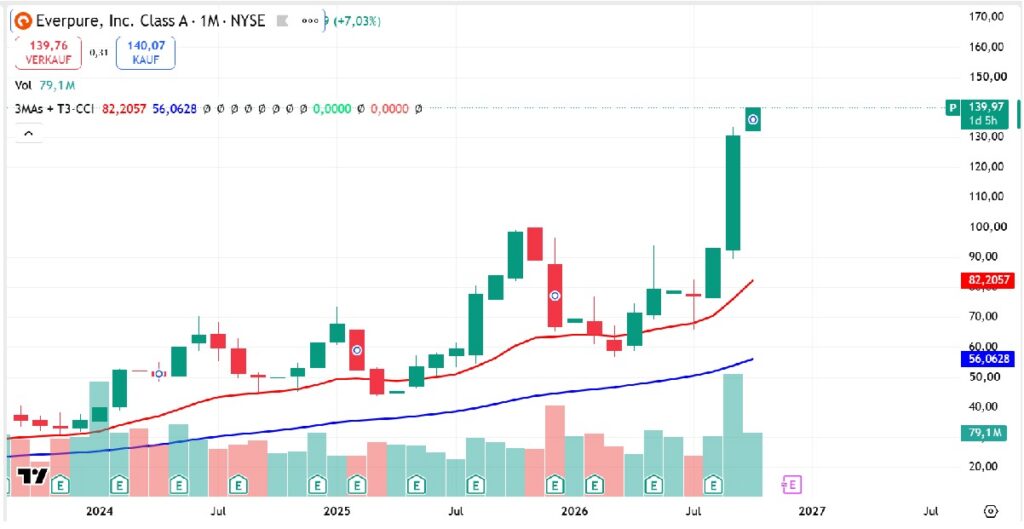
At the approximately $139.94 share price shown in the October 29 TradingView screenshot, Everpure has already experienced a substantial rerating.
The stock has gained approximately 104.5% year to date and 96.9% over six months, according to the supplied performance data.
The relevant question is how much future success the market is already discounting.
VALUATION SNAPSHOT · OCTOBER 29, 2026
Equity market capitalisation
~$46.7B
Enterprise value
~$45.9B
EV / FY2027 guided sales
~9.1×
EV / FY2028 projected sales
~6.4×
Market data around 11:42 a.m. ET, October 29. EV multiples calculated by FRL using management’s revenue guidance midpoints, not consensus estimates. StockAnalysis.com+1
This creates an interesting valuation paradox.
On current-year revenue, Everpure trades at a premium multiple reflecting considerable expectations of structural growth.
If management delivers its preliminary FY2028 outlook, that multiple becomes materially less demanding without any change in the share price.
Furthermore, at approximately $45.9 billion enterprise value, Everpure trades at roughly 25.5 times the midpoint of management’s preliminary FY2028 non-GAAP operating-income outlook of $1.8 billion.
That is not an earnings multiple, and non-GAAP operating income excludes expenses that matter to shareholders. Nevertheless, it illustrates the scale of operating growth embedded in the investment thesis.
Everpure’s valuation can become more reasonable through earnings growth rather than a falling share price.
But the reverse is equally important.
If the FY2028 outlook proves too ambitious, the market could revise its valuation downward even while reported revenue continues growing.
Why stock-based compensation deserves attention
Everpure’s reported first-half FY2027 stock-based compensation of approximately $282 million is not trivial relative to the cash-flow and profitability numbers.
The company intends to use share repurchases partly to offset dilution.
Such repurchases can protect existing shareholders from a rising share count, but they also consume capital that cannot simultaneously be deployed into research, acquisitions or business expansion.
The test for shareholders is not simply whether non-GAAP operating profit grows. It is whether growth produces more economic value after the cost of equity compensation and the cash required to offset dilution.
Management has established an ambitious operating outlook. Shareholders still need evidence that incremental earnings can become sustainable incremental free cash flow. sec.gov+1
4. Three Scenarios Through December 31, 2026
Bull case — Operating momentum exceeds already elevated expectations
Third-quarter revenue and operating income exceed guidance, component costs remain manageable, and management reinforces the FY2028 growth framework. Evidence of improving working-capital conversion would provide an additional reason for the market to sustain a premium valuation.
Confirmation: stronger guidance, stable margins and better cash-conversion visibility.
Base case — Strong business, limited near-term valuation upside
Revenue remains close to guidance, hyperscaler adoption progresses, but cash-flow concerns and elevated valuation constrain further multiple expansion. Operating fundamentals improve without necessarily generating another substantial share-price advance before year-end.
Confirmation: guidance delivered, no material margin deterioration, but limited evidence of accelerating cash generation.
Bear case — Expectations outrun cash economics
Revenue or guidance disappoints, component inflation reduces gross margins, or hyperscaler deployment timing proves less favourable than anticipated. Persistent working-capital pressure would challenge the assumption that rapid growth automatically produces superior returns.
Confirmation: weaker guidance, declining profitability, continued cash absorption and adverse management commentary.
These scenarios are analytical conditions, not probability-weighted forecasts or unsupported share-price targets.
The asymmetry is meaningful. Following a powerful rally, a company can meet operational expectations yet still experience valuation compression. Conversely, credible evidence that working-capital requirements are temporary could strengthen investor confidence without an extraordinary revenue surprise.
5. What Changes the Case?
The next decisive event is now confirmed: Everpure will report third-quarter fiscal 2027 results after the US market closes on November 18, 2026. investor.everpuredata.com
| Indicator | Strengthens the thesis | Weakens the thesis |
|---|---|---|
| Q3 revenue | Above management’s $1.325–$1.335B guidance | Below guidance or lower forward expectations |
| Operating profitability | Exceeds the $265–$275M non-GAAP guidance range | Margin compression despite revenue growth |
| Cash conversion | Operating cash flow recovers as working capital normalises | Continued material cash absorption |
| Hyperscaler execution | Further evidence of deployment progress and economically attractive volumes | Delays, component-cost escalation or unfavourable mix |
| FY2028 outlook | Management reinforces $7.0–$7.3B revenue expectations | Materially weaker growth or profitability outlook |
The November earnings release is particularly important because it will arrive when investors already have considerable evidence of commercial success.
A conventional earnings beat may therefore carry less information than the accompanying commentary about cash requirements, product economics and the durability of demand.
6. Can Everpure Remain an Attractive Investment Through Year-End?
The fundamental answer is more positive than the near-term valuation answer.
Everpure possesses several characteristics associated with businesses capable of compounding value over extended periods: differentiated technology, expanding market access, recurring revenue, deepening enterprise integration and substantial operating leverage potential.
Its entry into hyperscale storage is particularly significant because it represents a potentially different route to growth from simply competing for enterprise hardware replacement budgets.
However, investors evaluating the period between October 29 and December 31 face a considerably narrower horizon.
That distinction changes the analytical emphasis.
The longer-term thesis depends on whether Everpure can build a larger and more profitable business over several years.
The year-end thesis depends on whether new information arriving over the next two months can exceed what investors already expect.
At approximately $140 per share, after a near doubling over six months, those expectations are not modest.
The stock’s strong price momentum does not invalidate its investment case. Neither does it establish that the share price offers a sufficient margin of safety.
FRL Research Assessment
Structural business outlook
Positive
Growth execution
Strong
Valuation attractiveness
Demanding
Cash-flow visibility
Not yet convincing
Risk/reward through year-end
Selective / cautious
This is an FRL analytical classification based on available evidence, not a trading signal.
The study finds a fundamentally attractive growth business whose current valuation leaves less room for disappointing execution than it did earlier in 2026.
Conclusion — The Market Is Buying Tomorrow’s Economics
Everpure’s transformation is credible. Revenue acceleration, a second hyperscaler design win and ambitious multi-year guidance indicate that its addressable market and growth opportunities have changed materially.
Yet the same expansion makes its financial structure more complicated.
Hyperscaler success can increase revenue while simultaneously increasing procurement commitments, component-price exposure and working-capital demands. Strong adjusted operating earnings therefore cannot be treated as interchangeable with distributable cash generation.
For the remainder of 2026, the most useful evidence will not be another statement about AI-related storage demand. It will be the degree to which the business demonstrates that its next stage of growth can become profitable, scalable and cash-generative.
The investment case remains structurally attractive. The immediate share-price case is considerably more demanding.
WIEDER WAS GELERNT
One of the most common mistakes in growth-stock analysis is to assume that a larger addressable market necessarily creates proportionally greater shareholder value.
Everpure illustrates why the relationship is more complicated.
A business can expand into a highly attractive new market and simultaneously acquire a different economic structure. Large customers may provide exceptional revenue opportunities but require greater purchasing commitments, lower unit margins or additional working capital.
Conventional analysis often misses this transition because revenue growth, operating margins and cash flow are examined separately. Yet their interaction ultimately determines how much economic value the business creates.
The transferable lesson is to examine the financial consequences of winning new customers before assigning a premium valuation to those wins.
This applies equally to semiconductor suppliers, industrial manufacturers, cloud infrastructure providers and other businesses expanding into large, concentrated customer markets.
The strongest investment cases are not simply those where demand accelerates. They are those where incremental demand produces sustainable incremental cash.
Growth explains the opportunity. Cash economics determine its value.
Disclaimer
This publication constitutes general financial-market and investment research for informational purposes only. It does not constitute investment or financial advice, portfolio management, or a recommendation to buy or sell any security or financial instrument. Forward-looking statements, management forecasts and scenarios are subject to uncertainty and may differ materially from actual outcomes. Market valuations are time-sensitive.