 LWAYS OPEN

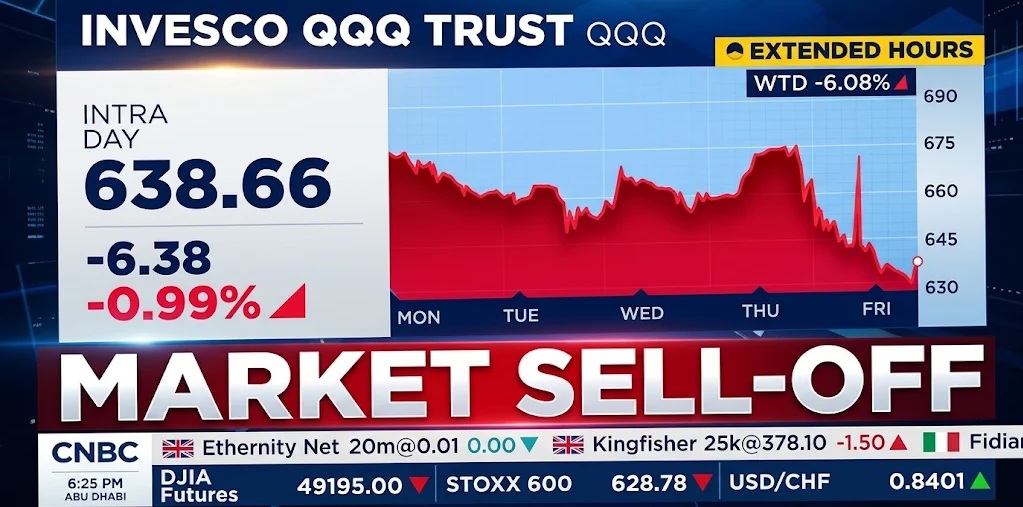
Anthropic’s historic IPO was supposed to restore confidence in artificial intelligence. Instead, semiconductor stocks weakened, Treasury yields fell and defensive equities diverged. The market may be signalling something more significant than a technology correction: a reassessment of earnings expectations, capital allocation and the durability of the AI investment cycle.
A Successful IPO, a Failed Market Rally
The most revealing development in global financial markets is not that technology stocks are falling. It is that two developments normally expected to support them—a highly successful AI initial public offering and declining government bond yields—have failed to restore confidence.
Anthropic entered public markets on 19 November with extraordinary demand. Its shares finished their first session approximately 17% above the offering price. Yet the broader US equity market suffered another substantial decline. The S&P 500 closed 2.02% lower, the Nasdaq Composite lost 2.25%, and selling extended across all eleven major S&P 500 sectors.
By Friday, the pressure had crossed the Atlantic. European semiconductor manufacturers were falling sharply while consumer staples attracted selective defensive demand.
This combination matters because it challenges the simplest explanation for the correction: that higher interest rates alone are depressing technology valuations.
If discount rates were the dominant problem, falling Treasury yields should offer at least some relief. If enthusiasm for artificial intelligence remained sufficiently strong, a record-breaking industry IPO should reinforce confidence in associated companies.
Neither development has produced a convincing broad recovery.
The market is therefore raising a more difficult question: Are investors simply reducing the price they are willing to pay for AI growth, or are they beginning to question the future economic returns on the investment itself?
1. The Event Was Positive. The Market’s Response Was Not.
The contrast between Anthropic’s successful flotation and the broader market decline is unusually informative.
CONFIRMED DEVELOPMENT
On Thursday, 19 November, the S&P 500 finished at 7,175.83, down 2.02%. The Nasdaq Composite closed at 23,879.20, down 2.25%, while the Dow Jones Industrial Average declined 2.19%.
The selling was not concentrated exclusively in artificial intelligence. Every major S&P 500 sector finished lower, demonstrating that weakness had spread beyond the original technology leadership.
Source: Associated Press, 19 November market close
MARKET REACTION
The initial optimism surrounding Anthropic’s listing did not generate sustained demand for other companies associated with the AI infrastructure boom.
This distinction is critical.
Demand for shares in a newly listed AI company does not necessarily imply that investors are equally willing to finance the entire ecosystem of semiconductor manufacturers, infrastructure suppliers, cloud operators and data-centre businesses at prevailing valuations.
INTERPRETATION
The market may increasingly differentiate between owning an AI business with exceptional growth prospects and owning the companies required to finance, construct and operate the infrastructure supporting that growth.
The two investment propositions are related, but their cash-flow economics are different.
An AI platform can experience extraordinary revenue growth while some infrastructure providers face increasing capital intensity, pricing pressure or uncertain returns on investment.
The successful listing demonstrates investor appetite for particular AI assets. It does not establish that the broader AI investment cycle is economically attractive at every valuation.
That is the first important distinction emerging from this week’s trading.
2. The Bond Market Is Sending a Different Message
A second divergence is developing between government bonds and equities.
CONFIRMED DEVELOPMENT
US Treasury yields declined on Friday as investors sought government bonds amid the equity selloff.
The benchmark ten-year Treasury yield fell below 5%, reaching approximately 4.99% during the European morning.
At the same time, Reuters reported that markets were pricing an approximately 98.4% probability of a Federal Reserve interest-rate increase at its December meeting.
Sources: MarketWatch, 20 November | Reuters, 20 November
MARKET REACTION
Bond prices strengthened, while technology shares remained under pressure.
These movements are not contradictory.
Government bond yields can decline because investors expect weaker economic activity, because inflation expectations ease, or simply because demand for relatively safe assets increases.
Those explanations have very different implications for equities.
THE SECOND-ORDER CONSEQUENCE
Consider the following transmission mechanism:
- Concerns about AI profitability encourage reductions in high-growth equity exposure.
- Demand for government bonds rises as market participants seek defensive assets.
- Treasury yields decline, providing theoretical valuation support for long-duration growth businesses.
- Technology shares nevertheless remain weak, indicating that lower yields are not yet sufficient to offset the perceived risks.
INTERPRETATION
This pattern is consistent with a market in which confidence in future earnings and investment returns is becoming at least as important as the discount rate used to value them.
It does not prove that AI earnings will disappoint. Export restrictions, political uncertainty, positioning and broader risk aversion are also plausible explanations.
The distinction can be tested.
If Treasury yields continue falling while semiconductor shares underperform, the case for an exclusively interest-rate-driven correction becomes less convincing.
If lower yields eventually coincide with improving semiconductor leadership and broader market participation, the interpretation must change.
3. Europe Shows Where Investors Are Seeking Protection
The European market provides a clearer picture of the relative sector movements.
CONFIRMED DEVELOPMENT
In a Reuters observation at 09:26 GMT on Friday, 20 November:
- The STOXX Europe 600 was down approximately 1.3%, at 630.22.
- European technology shares had declined approximately 3.7%.
- ASML, ASM International and STMicroelectronics had each fallen more than 5%.
- Nestlé, Unilever and British American Tobacco were each trading more than 1% higher.
Source: Reuters, European markets, 20 November 2026
These are time-specific observations, not closing prices.
WHAT THE PRICE ACTION REVEALS
Investors were not abandoning equities indiscriminately throughout Friday’s European morning.
Companies associated with relatively stable household consumption attracted demand while businesses linked to the semiconductor cycle experienced substantial selling pressure.
The economic distinction is understandable.
Demand for essential consumer products is generally less dependent on capital investment budgets than demand for advanced semiconductor manufacturing equipment.
However, a defensive stock outperforming a falling index does not automatically establish a sustainable defensive rally.
There are three separate market conditions:
Relative resilience: A sector declines less than the overall market.
Selective defensive demand: Several related companies produce positive absolute returns while the benchmark declines.
Confirmed defensive leadership: The sector sustains outperformance across subsequent sessions, supported by broader participation.
Friday’s observed gains in several European consumer-staples companies support the second condition. They do not yet establish the third.
This distinction prevents an important analytical error: interpreting every move away from technology as evidence of a healthy new equity-market leadership cycle.
4. Not Every Technology Company Is Receiving the Same Treatment
The correction also contains evidence that the market is differentiating between technology business models.
On 19 November, Palo Alto Networks benefited from an improved annual revenue outlook, helping lift other cybersecurity companies.
Reuters reported gains in Palo Alto Networks and several industry peers, including CrowdStrike, Zscaler and Fortinet.
Source: Reuters, cybersecurity sector, 19 November 2026
This development is strategically important because cybersecurity expenditure is supported by a different set of operational requirements from those driving large-scale AI infrastructure construction.
Companies may be able to delay certain discretionary technology investments. Protecting networks, data and critical systems can be considerably more difficult to postpone.
INTERPRETATION
The divergence suggests that investors may be distinguishing between technology businesses with identifiable near-term customer demand and businesses whose valuations depend more heavily on the anticipated returns from substantial future capital spending.
That does not make cybersecurity immune to a technology correction. It also does not establish that the entire cybersecurity sector will outperform on 20 November.
The confirmed observation concerns the previous session’s earnings-related response.
Nevertheless, it provides a useful counterargument to the claim that investors are rejecting technology as a whole.
The evidence is more consistent with selective repricing than with the disappearance of demand for every technology-related business.
5. MARKET INTELLIGENCE EDGE — The Divergence That Reveals a Possible Regime Change
Three developments are occurring simultaneously:
First: A major positive AI catalyst has failed to reverse weakness across the broader technology ecosystem.
Second: Falling government bond yields have not yet restored demand for the companies most closely associated with the AI infrastructure investment cycle.
Third: Selective demand is emerging for businesses with different earnings drivers, including defensive consumer companies and certain cybersecurity providers.
Individually, these observations might appear unremarkable.
Together, they suggest that the market’s central concern may be shifting.
During much of an investment boom, rising expectations allow investors to overlook the time required for projects to generate satisfactory returns. Revenue growth, capital expenditure and addressable-market estimates can dominate the investment narrative.
As expectations become more demanding, the questions change.
How much additional capital will be required? How quickly can it generate revenue? What operating margins will remain after competition intensifies? Can the expected returns justify the valuations already assigned to the business?
THE NON-OBVIOUS SIGNAL
The market may be moving from rewarding exposure to AI investment growth toward demanding clearer evidence of economic returns on that investment.
This is a change in the basis on which risk is priced, not necessarily evidence that the underlying technology revolution has ended.
It also explains why a positive industry event can coexist with falling share prices.
The market can continue believing in the long-term commercial importance of artificial intelligence while becoming less willing to pay exceptional multiples for every company connected to it.
SCENARIO, NOT CONFIRMED OUTCOME
If this interpretation is correct, future recoveries may become narrower and more dependent on demonstrable cash-flow generation, earnings revisions and capital discipline.
If it is incorrect, stabilising yields and renewed semiconductor leadership should help restore broader market participation.
The distinction will become clearer through observable price behaviour, not through the enthusiasm surrounding the next major announcement.
6. WHAT TO WATCH NEXT
Five indicators are particularly useful for distinguishing a temporary correction from a more persistent change in market leadership.
1. Semiconductor performance relative to defensive consumer stocks
Indicator: VanEck Semiconductor ETF relative to Consumer Staples Select Sector SPDR ETF.
Confirmation: Continued relative weakness in semiconductors despite stable or improving equity benchmarks would support the repricing thesis.
Invalidation: A sustained recovery in semiconductor relative performance, accompanied by improving industry breadth, would challenge it.
Why it matters: This comparison measures whether market leadership is actually changing, rather than simply identifying which stocks have fallen the most.
2. US Treasury yields versus technology performance
Indicator: Ten-year US Treasury yield and semiconductor equity performance.
Confirmation: Further yield declines without a corresponding improvement in semiconductor shares would reinforce the view that discount rates are not the only concern.
Invalidation: A sustained technology recovery alongside lower or stable yields would point toward restored valuation support.
Why it matters: The same bond-market movement can reflect either improving financial conditions or deteriorating risk appetite.
3. US equity-market breadth
Indicator: S&P 500 advancing versus declining constituents, together with participation across the eleven major sectors.
Confirmation: Continued negative breadth, particularly if rallies depend on only a few large companies, would indicate unresolved selling pressure.
Invalidation: Several sessions of positive breadth, with participation from cyclical sectors and smaller companies, would provide evidence of broader demand.
Why it matters: An index rebound without participation does not necessarily mean the underlying correction has ended.
4. Equity volatility and credit-market conditions
Indicators: VIX and US high-yield corporate credit spreads.
Confirmation: Persistent equity volatility accompanied by widening credit spreads would indicate that financial stress is spreading beyond equity valuations.
Invalidation: Declining volatility, stable credit spreads and improving breadth would favour a less severe interpretation.
Why it matters: A technology valuation correction is fundamentally different from a broader deterioration in financing conditions.
High-yield ETF prices may offer a supplementary indication, but should not be confused with directly measured credit spreads.
5. The quality of the next technology earnings response
Indicators: Earnings revisions, free-cash-flow expectations and post-results performance among semiconductor, infrastructure and cybersecurity companies.
Confirmation: Strong reported earnings followed by persistent selling across several related companies would suggest elevated expectations remain a significant obstacle.
Invalidation: Improving forecasts accompanied by sustained gains across multiple companies would indicate that investors are regaining confidence in future returns.
Why it matters: Market reactions reveal whether newly available information is better or worse than expectations already embedded in valuations.
7. Conclusion — What the Market Is Actually Telling Us
The developments of 19–20 November do not establish that the AI investment cycle is ending.
They do establish that investor enthusiasm for individual AI success stories is no longer sufficient to guarantee broad support for the companies surrounding them.
Government bonds are attracting defensive demand. Semiconductor shares are struggling. Certain consumer-staples companies are demonstrating relative strength, while specific technology businesses continue to benefit from identifiable earnings catalysts.
The resulting market is neither a straightforward technology correction nor a confirmed defensive-sector bull market.
It is a market testing the relationship between expectations, capital investment and future economic returns.
The central question is therefore no longer simply whether artificial intelligence will continue expanding.
It is whether the economic value created by that expansion will justify the prices and financial commitments already associated with it.
The answer must ultimately emerge from earnings, financing conditions and sustained market leadership—not from the success of any single headline event.
WIEDER WAS GELERNT
One of the most valuable lessons in market analysis is that the reaction to good news can reveal more than the news itself.
A successful IPO, strong earnings announcement or decline in bond yields may appear reassuring when considered in isolation. But markets continuously compare new information with expectations already embedded in prices.
When an apparently favourable catalyst fails to produce sustained buying, the important question is not immediately whether investors are behaving irrationally. It is what additional risk they may be recognising.
That question encourages a more disciplined approach: compare the event with the response, examine participation beyond the headline stocks, and seek confirmation from bonds, credit and competing equity sectors.
The principle is transferable well beyond the current AI correction. It applies whenever a supposedly positive development produces a surprisingly negative reaction.
The market’s response to good news is often a more useful measure of confidence than the good news itself.
DISCLAIMER
This publication provides general financial-market research and market intelligence for informational purposes only. It does not constitute investment advice or a recommendation to buy or sell any financial instrument.
Market observations reflect information available during the European afternoon of 20 November 2026, before the regular US equity-market opening. Intraday market conditions may change materially thereafter.
© 2026 Final Resurrection Limited | FRL DEEP RESEARCH