 LWAYS OPEN

Nvidia, Rising Yields and Sector Rotation: The Risk-Migration Test
Why the next phase of the market may reward confirmation over conviction
FRL DEEP RESEARCH
Final Resurrection Limited | TITAN Options Circle
Market Strategy Research | November 12, 2026
The departure of Nvidia’s founder has exposed a deeper market question: is capital broadening into a healthier bull market, or merely relocating to the next apparent winner? We examine semiconductor leadership, AI financing, rising bond yields and market breadth to identify what separates genuine opportunity from temporary relative strength.
The Market’s Most Dangerous Illusion: Mistaking Movement for Progress
The most revealing market move on November 12 was not Nvidia’s decline. It was the simultaneous strength of its competitors and weakness among companies financing the expansion of artificial intelligence infrastructure.
Broadcom and AMD advanced while Nvidia came under pressure. Meanwhile, AI infrastructure companies, including CoreWeave and Nebius, experienced renewed selling pressure.
At first glance, this looks like sector rotation: capital leaving a dominant company and discovering alternative winners.
But there is a potentially more consequential interpretation.
Capital can move away from a specific company without becoming more confident in the industry itself. A supplier can gain market share even while its customers face increasingly difficult financing conditions. And a market index can stabilise while the average investor’s opportunity set becomes less attractive.
This distinction matters especially when Treasury yields are rising, monetary policy expectations are becoming more restrictive and smaller companies are failing to participate.
The question is no longer simply whether Nvidia can recover.
It is whether the wider financial and industrial system supporting the AI investment cycle can remain sufficiently profitable and well funded to justify current expectations.
That is the strategic question behind today’s market.
1. The Market Regime: Selective Strength, Unconfirmed Recovery
The November 12 session offered a useful demonstration of why index performance alone can be misleading.
The S&P 500 ended approximately 0.4% lower, while the Russell 2000 declined around 1.7%. The divergence matters because a sustainable recovery normally benefits from improving participation beyond the largest companies.
At the same time, energy stocks advanced, semiconductor performance became increasingly uneven, and investors reassessed the implications of Nvidia’s leadership transition.
The bond market provided another warning.
According to the November 12 closing figures reported by The Wall Street Journal, the US two-year Treasury yield reached approximately 4.862%, while the ten-year yield reached 5.102%.
Higher yields matter because equity valuations, corporate financing costs and future investment returns are connected through the cost of capital.
The market was also pricing at least a 25-basis-point Federal Reserve rate increase in December, according to Reuters’ reporting of CME FedWatch expectations.
These observations suggest a market in which investors are reassessing risk rather than uniformly embracing it.
The TITAN interpretation
| Dimension | Observed signal | Strategic meaning |
|---|---|---|
| US equities | Large-cap indices relatively resilient; small caps weaker | Broad risk appetite remains unconfirmed |
| Semiconductors | Nvidia weak; selected competitors strong | Company-specific redistribution rather than universal industry strength |
| Interest rates | Treasury yields rising | Higher discount rates and financing pressure |
| Energy | Relative strength alongside geopolitical oil risks | Not necessarily evidence of stronger economic demand |
| European equities | Record attempts followed by profit-taking | Good corporate results do not guarantee sustained index momentum |
Our market classification: ORANGE — a selective, higher-risk environment rather than a confirmed new uptrend.
This classification is an analytical assessment, not a mechanical trading signal.
The strategic implication is that investors should demand more evidence before treating an individual rebound as proof of a wider market recovery.
2. FACT → SIGNAL → IMPLICATION → ACTION
The TITAN approach begins by distinguishing what has happened from what the market may be implying.
FACT: Nvidia’s leadership structure has changed
Nvidia confirmed that Jensen Huang resigned as chief executive and director, with Colette Kress appointed interim CEO.
The announcement creates genuine uncertainty around leadership, governance and strategic continuity.
But a management transition does not immediately invalidate the company’s technology, installed customer base, software ecosystem or underlying demand.
SIGNAL: The market must reassess the leadership premium embedded in Nvidia’s valuation.
IMPLICATION: A lower valuation may reflect increased uncertainty rather than an immediate deterioration in operating performance.
ACTION FRAMEWORK: Separate governance risk from fundamental business risk. Look for evidence concerning customer commitments, product execution, gross margins and forward demand before interpreting the stock’s recovery or weakness.
FACT: Nvidia’s competitors gained relative strength
AMD and Broadcom benefited from a market reassessment of competitive opportunities.
However, the Philadelphia Semiconductor Index weakened after a strong four-session advance.
SIGNAL: Capital is differentiating among semiconductor companies.
IMPLICATION: Relative winners may not be beneficiaries of a sustainable expansion in total industry demand.
ACTION FRAMEWORK: Distinguish market-share opportunity from sector-wide earnings growth. Relative price strength is a screening signal, not sufficient evidence of superior long-term risk-adjusted returns.
FACT: Smaller companies underperformed
The Russell 2000’s decline exceeded that of the S&P 500.
SIGNAL: The appetite for economically sensitive and financing-dependent companies remains fragile.
IMPLICATION: A rally concentrated in highly liquid, financially stronger businesses may coexist with deteriorating conditions elsewhere.
ACTION FRAMEWORK: Require participation from smaller companies, financials and cyclical sectors before interpreting an index recovery as a broad-based improvement.
FACT: Interest-rate expectations became more restrictive
Higher Treasury yields and expectations of additional Federal Reserve tightening increased the importance of financing conditions.
SIGNAL: The valuation environment is becoming less forgiving.
IMPLICATION: Growth expectations that were acceptable under easier financing assumptions may need to be recalculated.
ACTION FRAMEWORK: Evaluate earnings durability, cash generation and refinancing exposure alongside expected revenue growth.
3. TITAN EDGE — THE RISK-MIGRATION TRAP
What the market may be missing
The strongest analytical insight from November 12 is that capital rotating between companies does not necessarily mean that the underlying investment risk has disappeared.
Consider the artificial intelligence ecosystem.
Its economic structure involves several connected layers:
- Semiconductor designers and manufacturers supplying computing capacity.
- Cloud and data-centre operators purchasing that capacity.
- Financial institutions and investors providing the capital required for infrastructure expansion.
- Electrical equipment suppliers, industrial companies and utilities supporting the physical infrastructure.
- Enterprises that must ultimately generate sufficient economic value from AI applications.
These businesses may belong to different stock-market sectors, but their future cash flows can depend on the same underlying investment cycle.
This creates a problem for conventional diversification analysis.
An investor might reduce exposure to a semiconductor company and increase exposure to an industrial electrification business, believing the portfolio has become less dependent on artificial intelligence.
Yet if a significant part of the industrial company’s expected growth comes from data-centre investment, the underlying economic exposure may remain surprisingly similar.
The portfolio has changed its sector classification without necessarily changing its sensitivity to AI capital expenditure.
The financing transmission mechanism
The second-order risk becomes clearer when the cost of capital rises.
Imagine a hypothetical sequence:
First: Higher interest rates increase the financing costs of capital-intensive infrastructure.
Second: Data-centre operators face more demanding investment economics.
Third: Expansion projects are delayed, resized or subjected to stricter profitability requirements.
Fourth: Equipment suppliers experience changes in order timing, even if long-term AI adoption continues.
Fifth: Equity markets reassess future growth assumptions across businesses that initially appeared unrelated.
This is a possible transmission mechanism, not a claim that all AI infrastructure investments are financially unsustainable.
Reuters has reported growing scrutiny of financing relationships between Nvidia and companies connected to its customer ecosystem. That makes the distinction between genuine end-market demand and financing-supported expansion particularly important.
The unexpected consequence
A semiconductor competitor can become a relative stock-market winner without the overall investment cycle becoming healthier.
Similarly, an industrial company can produce excellent current results while remaining exposed to a future slowdown in the same technology spending that generated those results.
This produces the central TITAN conclusion:
Diversification should be evaluated by the economic drivers of future cash flows, not merely by company names or sector classifications.
That is where the distinction between genuine rotation and risk migration becomes strategically valuable.
4. Europe: Quality Is More Important Than the Record High
European equity markets delivered a different but complementary signal.
Germany’s DAX moved above 27,000 points for the first time on November 12, but subsequently surrendered much of its advance, closing around 26,772.
A record high is evidence of price strength. It is not, by itself, evidence of a healthy or durable market advance.
Two European earnings developments help illustrate the distinction.
Siemens: Exceptional orders, but still exposed to the investment cycle
Siemens reported fourth-quarter orders of €34.8 billion, an increase of 58%, and revenue of €23.7 billion, up 11%.
Those are substantial operational achievements.
However, the strong order development included contributions from Smart Infrastructure and data-centre-related demand.
The market therefore needs to consider two separate questions.
First, how much of the order growth represents durable structural demand?
Second, how much may depend on an unusually strong investment phase that could normalise?
For investors, the appropriate distinction is between the quality of the business and the price paid for expected growth.
A strong order book improves visibility. It does not eliminate valuation or timing risk.
Allianz: A different source of earnings quality
Allianz reported nine-month operating profit of €14.1 billion and raised the upper end of its 2026 outlook to approximately €18.6 billion.
Its earnings drivers are fundamentally different from those of a semiconductor manufacturer.
Insurance underwriting, asset management, investment income and capital strength provide alternative sources of profitability.
That makes established insurance businesses useful subjects for comparative research when technology-related uncertainty rises.
However, insurers are not immune to market risk. Claims inflation, catastrophe losses, credit deterioration and financial-market volatility remain material considerations.
The point is not to declare one sector safe and another dangerous.
It is to identify companies whose earnings are supported by different economic mechanisms, then assess whether their valuations offer sufficient compensation for their specific risks.
The European lesson
European industrial quality and insurance quality may both be attractive research categories, but they are not interchangeable.
Their business risks, interest-rate sensitivities and growth assumptions require different analytical frameworks.
5. Why Higher Interest Rates Change the Strategy
The market’s interest-rate regime deserves as much attention as Nvidia’s leadership crisis.
When yields rise, three mechanisms become especially important.
Valuation compression: The present value of expected future cash flows generally becomes more sensitive to discount-rate assumptions.
Financing discipline: Highly leveraged or capital-intensive businesses may face a higher required return on new investment.
Relative opportunity costs: Higher bond yields can alter the attractiveness of equities, especially where earnings visibility is limited.
This does not mean that rising yields must produce falling equity prices.
Some businesses benefit from stronger nominal growth or higher reinvestment yields. Others can maintain returns through pricing power, recurring revenue or operational efficiency.
The important analytical question is how rising yields interact with the source and timing of a company’s cash flows.
There is also a second-order connection involving energy.
Oil strength driven by geopolitical supply concerns can support energy producers while simultaneously complicating the inflation outlook.
If higher energy prices reinforce restrictive monetary-policy expectations, the market may experience stronger energy shares alongside weaker long-duration growth assets.
That would be a change in relative leadership, not necessarily an improvement in the overall economic environment.
6. How Do We Approach It? The TITAN Strategy Framework
In the current environment, the objective is not to predict every market fluctuation.
It is to establish conditions under which taking additional risk becomes more or less justified.
Phase One — Preserve optionality
When market breadth is weak and important macroeconomic data are approaching, the value of flexibility increases.
A commitment made before new information arrives carries additional event risk.
For analytical purposes, preserving optionality means maintaining the ability to respond to new evidence without depending on one specific market outcome.
It does not imply indiscriminate liquidation of fundamentally sound long-term investments.
An important distinction must be maintained between:
- Temporary price volatility in a fundamentally healthy business.
- Structural deterioration in the business itself.
- Excessive concentration in a common economic risk factor.
These conditions may require different responses.
Phase Two — Demand confirmation
A single positive session is insufficient to establish that a market correction has ended.
More persuasive evidence would combine improving market breadth, stabilising Treasury yields, better relative performance from economically sensitive companies and declining stress among AI infrastructure businesses.
The important point is simultaneous confirmation.
If only one indicator improves while the others deteriorate, confidence in the broader interpretation should remain limited.
Phase Three — Evaluate the opportunity asymmetry
When an investment idea becomes more attractive, the next question is not simply how far its price has fallen.
It is whether the potential return has improved relative to the risks that remain.
For established quality businesses, this requires examining earnings resilience, valuation, capital allocation and the durability of competitive advantages.
For high-growth technology businesses, it requires additional scrutiny of revenue concentration, customer investment capacity and the sustainability of future growth assumptions.
A lower share price is an opportunity only when the expected future economics justify the price.
7. Three Realistic Market Scenarios
The following scenarios are conditional analytical frameworks, not probability forecasts.
| Scenario | Trigger and confirmation | Market consequence | Invalidation |
|---|---|---|---|
| A. Genuine recovery | Nvidia stabilises, semiconductor participation broadens, Treasury yields stop rising and small caps recover | Greater confidence in a sustainable equity advance | Renewed weakness in breadth or deterioration in earnings expectations |
| B. Selective rotation | Large-cap quality and defensive sectors remain resilient, while technology and small caps remain uneven | Relative performance diverges sharply across industries and companies | Broad synchronised strength or a new deterioration across defensive sectors |
| C. Financing-driven correction | Inflation pressures persist, yields rise further and AI infrastructure financing comes under greater stress | Valuation compression and weaker investment expectations spread beyond semiconductor stocks | Improving financing conditions, resilient customer spending and stronger fundamental guidance |
Our base interpretation
Scenario B currently offers the most useful working framework.
This is not a statistical forecast that selective rotation must occur.
It reflects the combination of uneven sector performance, fragile market breadth, stronger relative performance among selected established businesses and continuing uncertainty about financing conditions.
The principal risk to this assessment is a faster-than-expected improvement in Nvidia’s outlook together with broad participation across the market.
The opposite risk is that what currently appears to be selective weakness develops into a more general earnings and financing problem.
Both possibilities must remain open.
8. The Role of Options and Volatility
Options can provide useful information about market expectations, but they should not be introduced into an investment strategy merely because uncertainty has increased.
Event-driven volatility around Nvidia, inflation releases and semiconductor earnings can raise the cost of option protection.
An investor evaluating derivatives should therefore distinguish between the direction of a market thesis and the price of expressing that thesis.
A correctly anticipated decline can still produce an unattractive options outcome if implied volatility falls or the movement arrives too late.
Defined-risk structures, such as debit spreads, may reduce the initial premium required compared with outright long options, but they also limit potential returns.
Collars may reduce downside exposure while sacrificing some upside participation. Their usefulness depends on the existing underlying exposure, execution costs, volatility skew, time horizon and individual circumstances.
The TITAN principle is straightforward:
An options structure should solve a clearly identified risk problem, not manufacture a trading opportunity out of uncertainty.
Where there is no measurable informational or risk-management advantage, observation may be more rational than additional complexity.
9. WHAT TO WATCH — Five Signals That Matter
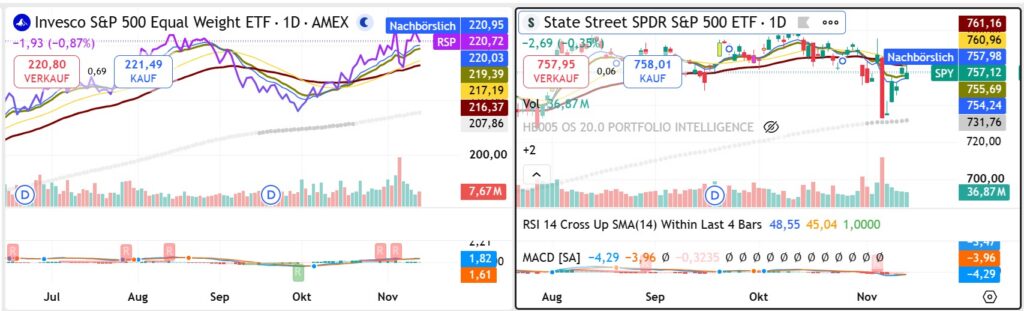
1. Market breadth: Equal-weight versus capitalisation-weight
Monitor the relative performance of the Invesco S&P 500 Equal Weight ETF (RSP) against the SPDR S&P 500 ETF Trust (SPY).
A sustained increase in the RSP/SPY ratio would indicate that the broader group of S&P 500 constituents is outperforming the largest companies.
A persistent decline would suggest that market leadership remains concentrated.
This measure should be evaluated alongside small-cap performance, because equal-weight large-cap strength does not necessarily mean the entire equity market is healthy.
2. Russell 2000 versus S&P 500
Watch whether smaller US companies begin participating in market recoveries.
The relevant signal is not a single positive Russell 2000 session.
It is sustained relative improvement, particularly when accompanied by stabilising yields and better financial-sector participation.
Continued weakness would challenge the argument that investors are becoming comfortable with broader economic risk.
3. Treasury yields and Federal Reserve expectations
Follow both the two-year and ten-year Treasury yields, the US dollar and changes in market-implied Federal Reserve policy.
The October Producer Price Index, scheduled for Friday, November 13 at 8:30 a.m. Eastern Time, is an immediate test.
A softer inflation reading could ease pressure on yields, but only if the market’s interpretation and subsequent bond-market reaction confirm it.
A higher-than-expected inflation reading could reinforce financing concerns.
The data release itself is less important than the combined reaction of yields, equities and market breadth.
4. Semiconductor leadership versus AI infrastructure financing
Compare the relative performance of Nvidia, AMD and Broadcom with businesses more directly dependent on financing continued data-centre expansion.
The central question is whether competitive redistribution occurs alongside stable industry demand or against a backdrop of weakening customer economics.
The November 12 Applied Materials earnings call and Nvidia’s November 17 fiscal third-quarter results are important opportunities to examine this distinction.
Particularly relevant will be forward guidance, customer demand, capital-expenditure visibility and management commentary on business continuity.
5. European earnings quality and sector confirmation
Continue examining the difference between genuine earnings improvements and short-lived price momentum.
Siemens provides a test of order durability and industrial investment demand.
Allianz provides a contrasting test of established operating profitability, capital resilience and earnings diversification.
For both businesses, the important evidence will be the sustainability of operating results relative to valuation expectations—not simply the direction of the next trading session.
10. Strategic Conclusion — Confirmation Has Become More Valuable
The events of November 12 do not prove that the artificial intelligence investment cycle has ended.
Nor do they establish that a new, diversified market advance has begun.
They demonstrate that investors are beginning to differentiate more aggressively among leadership risk, competitive opportunity, financing exposure and earnings durability.
The most important change may therefore be analytical rather than directional.
When interest rates are rising and market participation is uneven, successful investment research requires a clearer understanding of the economic relationships linking companies across different sectors.
For the TITAN framework, the appropriate response is disciplined selectivity: preserve flexibility, distinguish strong businesses from attractive valuations, examine indirect concentration risks and require confirmation before upgrading a temporary rebound into a durable market thesis.
The opportunity is not necessarily in identifying the next stock to rise.
It may lie in understanding which risks the market is still failing to distinguish.
WIEDER WAS GELERNT
A portfolio can become more diversified by sector while remaining concentrated in the same economic risk.
This is one of the less obvious lessons from the current AI investment cycle.
Traditional diversification begins with industries, geographic regions and individual company weights. These classifications are useful, but they can obscure dependencies that run across sectors.
A semiconductor designer, a data-centre operator, an electrical equipment manufacturer and a financing institution may appear fundamentally different. Yet all four can depend, directly or indirectly, on the profitability and availability of capital for the same investment cycle.
The practical lesson is to examine not only what a company sells, but also who ultimately finances the demand for its products.
When financing conditions tighten, relationships that appeared insignificant during expansion can become powerful channels of risk transmission.
This way of thinking applies beyond artificial intelligence—to property, energy, infrastructure and credit cycles.
True diversification begins where shared economic dependencies end.
Disclaimer
This article is general financial-market research and analytical discussion prepared by FRL DEEP RESEARCH for Final Resurrection Limited and the TITAN Options Circle. It is provided for informational and educational purposes only.
It does not constitute investment or financial advice, portfolio management, or a recommendation to buy, sell or hold any financial instrument. Market interpretations and forward-looking scenarios are uncertain and may prove incorrect. Investment decisions remain the sole responsibility of each individual investor.
Research verification: NVIDIA’s management transition is documented in its SEC filing; US market performance and Fed expectations were cross-checked against Reuters and AP; yields against The Wall Street Journal; European corporate figures against Siemens and Allianz primary releases.