 LWAYS OPEN
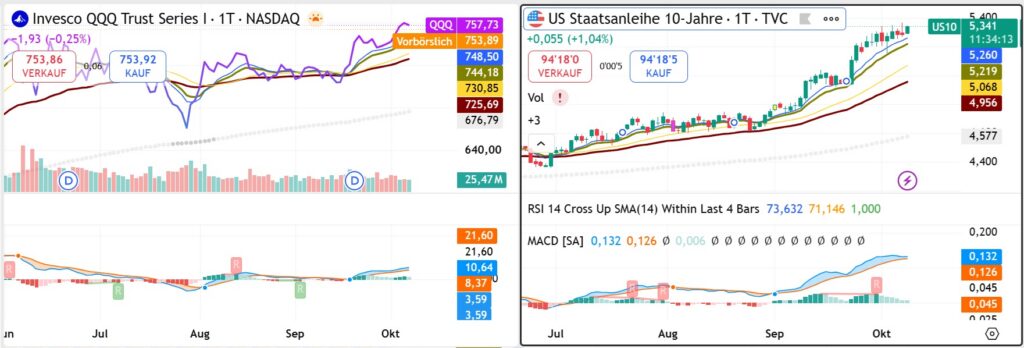
TRACKING THE MARKETS | MARKET INTELLIGENCE | OCTOBER 8, 2026 – Wall Street’s technology rally is surviving a bond market that should be making life increasingly difficult for growth stocks. With Treasury yields above 5.3%, semiconductor leadership intact and volatility unusually subdued, the real question is whether investors are correctly anticipating extraordinary earnings growth—or underestimating the cost of capital.
The Market Is Not Ignoring Higher Rates. It Is Making a Much Bigger Bet.
A 5.34% yield on the 10-year US Treasury should be difficult to reconcile with an equity market still rewarding some of its longest-duration growth assets. Yet that is precisely the tension confronting investors on October 8, 2026.
The Nasdaq-100 ETF, QQQ, is trading around $754. The Philadelphia Semiconductor Index stands near 13,066. NVIDIA remains around $236, supported by a powerful long-term growth narrative. Meanwhile, the VIX sits at approximately 15.69, suggesting remarkably little immediate demand for broad equity-market protection.
Something does not fit the conventional narrative.
Higher government bond yields increase the opportunity cost of owning equities and can compress the valuation multiples investors are willing to pay for future earnings. Semiconductor stocks, whose valuations often depend on expectations of exceptional future growth, should be particularly sensitive.
But they have not broken.
The most important question is therefore not why technology shares remain strong. It is what investors must believe about future earnings, margins and capital spending to justify that strength.
The answer may explain both the resilience of the rally and its greatest vulnerability.
1. The Market Snapshot: Strength Where Weakness Might Be Expected
October 8, 2026 — indicative market observations supplied for this report; not independently verified live quotations.
| Indicator | Reference level | Market interpretation |
|---|---|---|
| QQQ — Nasdaq-100 ETF | ~$754 | Technology leadership intact |
| SOX — Semiconductor Index | ~13,066 | AI infrastructure remains strong |
| NVIDIA | ~$236 | Long-term uptrend, shorter-term fatigue |
| US 10-year Treasury yield | ~5.34% | Significant valuation pressure |
| VIX | ~15.69 | Limited immediate volatility stress |
| Crude oil | Above $93 | Potential inflation headwind |
| S&P 500 | Elevated | Broad-index resilience; breadth unconfirmed |
These observations establish a market tension, not yet proof of an imminent reversal.
The distinction matters. A market that continues rising despite a recognised risk can remain resilient for considerably longer than a valuation model suggests. Conversely, the longer that resilience depends on increasingly demanding earnings assumptions, the more sensitive prices can become to even modest disappointments.
Three developments deserve particular attention.
First, bond yields are becoming a direct competitor to equity valuations.
Second, semiconductor leadership is keeping the growth narrative alive.
Third, implied volatility is not signalling the same degree of concern as the macroeconomic backdrop.
The combination is more revealing than any individual market level.
2. The Bond Market Is Challenging the Equity Market’s Assumptions
A Treasury yield of 5.34% is not merely another macroeconomic statistic. It changes the financial arithmetic behind virtually every asset valuation.
At higher risk-free rates, the present value of distant cash flows generally declines, unless expected earnings growth, profitability or the equity risk premium adjusts sufficiently to compensate.
This creates a particular challenge for businesses whose market capitalisations reflect many years of future expansion.
But there is an important complication.
Not every increase in Treasury yields has the same meaning.
If yields rise because economic growth expectations are improving, stronger corporate earnings may partially offset the valuation headwind.
If yields rise because inflation expectations are becoming less anchored, the implications are more troubling. Companies face higher financing costs, potentially more persistent input-cost pressures and a central bank with less room to ease policy.
If yields rise because investors demand greater compensation for holding long-term government debt, equity valuations can face pressure even without a corresponding improvement in economic growth.
These explanations cannot be distinguished from the 10-year yield alone.
The relevant evidence includes real Treasury yields, inflation breakevens, term-premium estimates and movements across the yield curve.
This is the first critical distinction for investors: the level of interest rates matters, but the reason they are rising may matter even more.
3. Semiconductors Are Acting as the Market’s Earnings Shock Absorber
The Philadelphia Semiconductor Index remaining near 13,066 while Treasury yields approach 5.4% is arguably the most consequential observation in the current market.
Semiconductor stocks are not simply being valued as conventional cyclical technology businesses. Many are increasingly priced around the expectation that AI infrastructure investment will translate into substantial revenue growth, pricing power and future cash generation.
This helps explain why higher yields have not necessarily produced an immediate sector-wide collapse.
Consider NVIDIA.
At approximately $236, the shares remain associated with expectations of continued demand for accelerated computing, AI networking and data-centre infrastructure. The market is therefore not simply discounting a distant technological opportunity. It is also evaluating the possibility of unusually rapid near-term earnings expansion.
That distinction matters.
A company capable of delivering exceptional earnings growth can absorb some valuation compression without necessarily experiencing a falling share price.
However, this resilience has limits.
The more investors rely on extraordinary earnings expansion to offset higher discount rates, the less tolerance remains for slower growth, weaker margins or reduced customer capital expenditure.
And there is a second-order risk.
The companies purchasing AI infrastructure must eventually demonstrate sufficient economic returns on that investment.
Strong semiconductor revenue is evidence of spending by customers. It is not, by itself, proof that the customers are generating attractive returns.
That gap between infrastructure demand and end-user monetisation may become increasingly important if financing conditions remain restrictive.
4. THE DIVERGENCE THAT MATTERS: Equities Are Pricing Earnings Resilience While Bonds Are Pricing Financial Restraint
The strongest signal is not that technology stocks are rising while Treasury yields rise.
It is that the two markets may be expressing different expectations about the same economic environment.
The bond market, through elevated yields, is imposing a higher cost of capital on the economy.
The equity market, particularly in semiconductors, is behaving as though the strongest companies can continue delivering earnings growth sufficient to overcome that cost.
Both expectations can be correct for a period.
But they create an increasingly demanding equilibrium.
THE TRANSMISSION MECHANISM
Higher Treasury yields
Higher discount rates and financing costs
Earnings offset succeeds
AI earnings and margins grow fast enough to absorb valuation pressure
Earnings offset fails
Earnings expectations soften while discount rates remain elevated
Rally survives
Repricing risk rises
This framework produces an important non-obvious insight.
The apparent immunity of AI-related equities to higher interest rates may actually reveal their increasing dependence on flawless earnings execution.
That does not make the rally irrational.
It makes the conditions required to sustain it more demanding.
A healthy continuation would involve rising earnings expectations, expanding participation across the equity market and evidence that higher yields are primarily associated with stronger economic growth.
A more fragile continuation would involve increasingly concentrated index gains, deteriorating momentum and rising yields driven by inflation or term-premium pressure.
Without verified market-breadth and earnings-revision data, it would be premature to declare which regime has already prevailed.
But the distinction provides a practical framework for interpreting what happens next.
5. Why the VIX May Be Sending an Incomplete Message
At approximately 15.69, the VIX is not displaying the level of near-term volatility concern that might be expected alongside a 5.34% Treasury yield and oil prices above $93.
That does not necessarily mean investors are complacent.
The VIX measures the market’s expectation of S&P 500 volatility over approximately the next 30 days, inferred from option prices. It is not a direct measure of economic uncertainty, equity valuation risk or the probability of a market crash.
Low implied volatility can coexist with substantial longer-term risks.
It can also reflect relatively stable realised volatility, option-market positioning or demand-and-supply conditions in volatility markets.
The important signal is therefore conditional.
If Treasury yields continue rising while the VIX remains subdued, the market may be expressing confidence that earnings and liquidity conditions can absorb the pressure.
If the VIX begins rising sharply while semiconductor leadership deteriorates, the market may be transitioning from recognising macroeconomic risk to actively repricing it.
That transition would matter more than the absolute VIX level alone.
6. Oil Above $93 Complicates the Growth Narrative
Oil prices introduce another important dimension.
Higher crude prices can reflect stronger global demand, geopolitical supply risks or both.
Those explanations have very different consequences.
Demand-driven oil strength may be compatible with improving corporate revenues and economic resilience.
Supply-driven oil strength, especially when accompanied by geopolitical tensions, can increase inflation pressure without providing a corresponding improvement in real economic activity.
This creates a potentially difficult combination for equities:
Higher energy costs may pressure household purchasing power and corporate margins, while persistent inflation may restrict the Federal Reserve’s flexibility.
For technology companies, the effect is not limited to direct energy expenses.
Energy costs influence data-centre economics, electricity infrastructure, cooling requirements and the wider inflation environment.
A simultaneous increase in oil prices and Treasury yields would therefore deserve particular scrutiny, especially if accompanied by weaker economic-growth indicators.
The critical question is whether higher nominal prices reflect productive growth or an increasingly expensive economic environment.
7. Three Plausible Market Regimes From Here
The current divergence does not justify a single deterministic forecast. It creates three scenarios whose probabilities should be updated as evidence changes.
| Scenario | Confirmation | Implication |
|---|---|---|
| Earnings-led continuation | Yields stabilise, SOX remains strong, earnings revisions improve | Technology leadership can continue |
| Narrow, fragile advance | Yields remain elevated, breadth weakens, a few mega-caps support indices | Rising vulnerability beneath index strength |
| Cross-asset repricing | Yields break higher, SOX weakens, VIX rises, credit spreads widen | Broader equity valuation pressure |
The most dangerous transition would not necessarily begin with a dramatic economic announcement.
It could begin with an apparently ordinary session in which semiconductor stocks stop responding positively to favourable news.
That would suggest a change in the market’s willingness to pay for expected growth.
Price action relative to news is often more informative than either in isolation.
8. WHAT TO WATCH NEXT
Five indicators will determine whether the current divergence resolves through continued earnings-led resilience or a broader valuation adjustment.
| Indicator | Constructive confirmation | Warning signal |
|---|---|---|
| US 10-year yield | Sustained retreat below 5.20% | Renewed move above 5.40% |
| SOX semiconductor index | Holds 13,000 and establishes higher highs | Sustained break below 12,300 |
| QQQ and market breadth | QQQ holds above 750 with broader participation | QQQ loses 742 while breadth deteriorates |
| VIX | Remains below 18 with stable credit spreads | Rises above 20 alongside wider spreads |
| Oil and earnings revisions | Energy stabilises and forward earnings improve | Oil rises while earnings forecasts decline |
These are analytical reference levels, not mechanically established support or resistance zones. The SOX 12,300 and QQQ 742 thresholds are wider regime-warning levels; losing 13,000 or 750 would be earlier signs of deterioration rather than definitive trend reversals.
The key is confirmation across markets.
A brief move above 5.40% in Treasury yields would not automatically invalidate the equity rally. A sustained move accompanied by weaker semiconductors, falling breadth and higher volatility would be substantially more consequential.
Conversely, declining yields alongside improving earnings expectations could restore a more favourable environment for growth equities.
The immediate catalyst: Treasury demand
The October 7 Treasury auction offers an important reminder that the bond market is not moving in one direction without resistance.
According to Reuters, the 10-year yield briefly reached approximately 5.364% before retreating after strong demand at the $39 billion Treasury auction. The reported bid-to-cover ratio was 2.77, indicating substantial demand despite the elevated yield environment.
Reuters
+1
This is meaningful because it demonstrates that higher yields can attract buyers and temporarily relieve valuation pressure.
However, one successful auction does not establish that the broader bond-market selloff has ended.
The next test is whether subsequent Treasury issuance can attract similarly strong demand without another significant increase in yields.
9. The Next Market Move May Be Decided Outside the Stock Market
There is a revealing disagreement between market pricing and professional forecasts.
A Reuters survey conducted October 5–7 found that fixed-income strategists expected the US 10-year Treasury yield to decline toward 5.00% by year-end, despite repeatedly underestimating the rise in yields during 2026.
Reuters
This creates two different paths for equity valuations.
If bond strategists are correct and yields decline because inflation pressures ease without a serious deterioration in growth, technology stocks could benefit from both earnings expansion and lower discount rates.
If yields decline because the economy weakens sharply, the benefit from lower discount rates may be offset by deteriorating corporate earnings.
And if yields remain elevated because inflation and government financing pressures persist, the valuation challenge will continue.
The direction of yields alone is therefore insufficient. Investors must understand the economic circumstances producing that direction.
Conclusion: A Rally With an Increasingly Demanding Burden of Proof
The US equity market has not yet demonstrated that elevated Treasury yields must end the technology rally.
It has demonstrated something more interesting: investors continue to assign substantial value to the prospect that AI-related earnings growth can overcome unusually restrictive financial conditions.
That expectation may prove justified.
But the longer bond yields remain elevated, the more important actual earnings delivery becomes relative to technological enthusiasm.
The defining market signal of October 8 is therefore not an imminent crash warning.
It is the growing distance between what the bond market demands from capital and what the equity market expects from growth.
The rally can survive that distance.
It cannot ignore the underlying economics indefinitely.
WIEDER WAS GELERNT
One of the most useful lessons in financial markets is that an asset’s failure to respond to an apparent threat can reveal more than its response to favourable news.
When Treasury yields rise sharply, conventional analysis expects growth-stock valuations to suffer. If those stocks remain strong, it is tempting to conclude that interest rates no longer matter.
That conclusion misses the deeper signal.
The market may simply be increasing its expectations for earnings growth, assigning greater value to near-term cash generation or concentrating capital in businesses perceived as unusually resilient.
The absence of an immediate negative reaction does not mean the underlying risk has disappeared. It means another force is temporarily offsetting it.
The practical lesson is to identify that offsetting force and monitor whether it remains credible.
In future market episodes, the better question is not merely why prices are rising despite bad news, but which expectations must continue to hold for that behaviour to remain rational.
Markets can defy a warning for a long time, but they cannot defy the economics behind it forever.
Research note: Prepared October 8, 2026, before the regular US equity session. The article uses indicative equity, volatility and commodity levels provided for this report. The Treasury-market discussion is additionally supported by October 7 reporting and auction results. Reference levels are not presented as independently verified live quotations or closing prices.
Disclaimer: This publication provides general financial-market research and market intelligence for informational purposes only. It does not constitute investment advice or a recommendation to buy or sell any financial instrument. Market scenarios are conditional and inherently uncertain.