 LWAYS OPEN

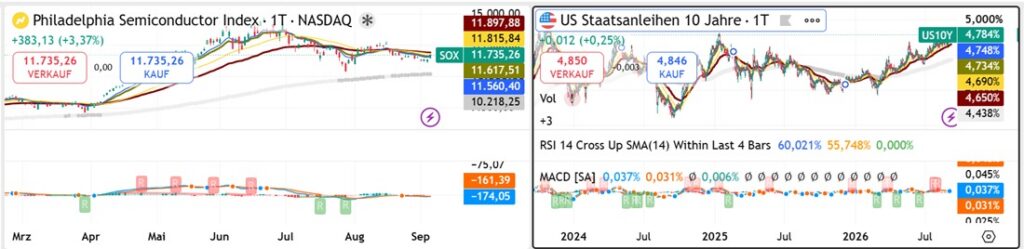
South Korea’s KOSPI surged 4.6% and Japan’s Nikkei 2.1% as semiconductor shares exploded higher — even while oil, rate expectations and currencies signalled tighter financial conditions. The important message is not simply that AI is back. It is that hardware is attempting to reclaim market leadership against a hostile macro backdrop.
The strongest signal today did not come from the market that was open
A 4.6% jump in South Korea’s KOSPI looks like an Asian semiconductor story. It is not.
The more consequential signal began on Wall Street before the Labor Day weekend.
On Friday, the S&P 500 fell 0.38%, the Dow lost 0.51% and the Nasdaq Composite slipped 0.29% after U.S. payrolls increased by 162,000 — nearly three times the 56,000 consensus forecast — pushing markets toward a higher probability of another Federal Reserve rate increase. Yet in that decidedly unfriendly environment, the PHLX Semiconductor Index rose 3.4%.
Then Asia amplified the move.
On Monday, with U.S. cash markets closed for Labor Day, the KOSPI jumped 4.6% to 6,995.39 and Japan’s Nikkei 225 gained 2.1% to 66,399.84. Samsung Electronics rose 5.7%, SK Hynix more than 8%, and Tokyo Electron 4.7%.
That changes the interpretation.
This is not merely Asian investors chasing an AI headline while Americans are away.
Semiconductors are attempting to establish relative leadership precisely when the macro environment says they should be struggling.
That is tomorrow’s real test.
1. WHAT HAPPENED: The semiconductor complex separated from the broader market
Friday’s U.S. employment report materially changed the interest-rate conversation.
Nonfarm payrolls increased by 162,000 in August, unemployment remained at 4.1%, and previous payroll estimates were revised higher by a combined 55,000. Futures subsequently priced roughly a 58% probability of a 25-basis-point Federal Reserve hike at the September meeting, up from about 49% a day earlier.
The conventional chain was straightforward:
stronger employment → less room for monetary accommodation → higher rate expectations → pressure on long-duration equities.
And the broader U.S. equity market behaved largely as expected.
But semiconductors did not.
The PHLX Semiconductor Index gained approximately 3.4% on Friday. Technology managed a modest gain even as the broader market fell, while software and services dropped 2.1%.
Then Monday brought a much larger Asian confirmation.
South Korea’s KOSPI finished at 6,995.39, up 4.6%, with Samsung Electronics gaining roughly 5.7% and SK Hynix around 8.3%. The rally extended beyond the two giants into Korean semiconductor equipment, materials and component suppliers.
Japan showed a similar pattern, with the Nikkei gaining 2.1% and chip-related companies among the leaders.
This is the first important distinction:
The move was not broad global risk-on.
It was disproportionately concentrated in AI-linked semiconductor hardware.
2. THE OBVIOUS NARRATIVE: AI enthusiasm has returned
There is a straightforward explanation for the move.
Renewed expectations for AI-compute and memory demand have revived interest in the semiconductor supply chain. Korean memory producers are particularly exposed because high-bandwidth memory and advanced DRAM have become critical inputs for increasingly compute-intensive AI systems.
That narrative is credible.
But it is incomplete.
If today’s move were simply a generalized return of speculative appetite, other markets should have confirmed it much more clearly.
They did not.
Hong Kong’s Hang Seng fell about 0.9%. Shanghai was nearly unchanged. European markets finished broadly flat, with Germany’s DAX down 0.2%.
Energy was one of Europe’s few clear areas of strength because oil prices were rising.
Meanwhile, the Japanese yen surged.
That is not the signature of an indiscriminate global risk rally.
It is much closer to selective capital rotation into semiconductor earnings exposure despite deteriorating macro conditions.
That difference matters.
3. FACT → REACTION → SIGNAL → IMPLICATION
FACT
U.S. job creation was much stronger than expected. Oil is close to $100 per barrel. Multiple major central banks are again considering higher rates.
REACTION
Broad U.S. equities fell Friday, European markets were subdued Monday, and currencies reflected changing rate expectations.
Yet semiconductor shares rose sharply in both the United States and Asia.
SIGNAL
Investors are distinguishing between duration-sensitive growth and earnings-supported AI infrastructure exposure.
IMPLICATION
If that relative strength persists when Wall Street reopens Tuesday, the market may be signalling that semiconductor earnings expectations are currently powerful enough to overcome at least part of the macro valuation headwind.
But one session in Asia is not enough to establish that conclusion.
Tuesday must confirm it.
4. THE SIGNAL BEHIND THE HEADLINE: Hardware is behaving differently from “technology”
This may be today’s most useful market signal.
Investors often discuss technology as if it were one trade.
Friday showed why that framework can fail.
The semiconductor index gained 3.4%.
Software and services fell 2.1%.
The S&P 500 declined.
That is a substantial internal divergence.
Higher interest rates hurt assets whose valuation depends heavily on distant future cash flows. But semiconductor companies exposed to the AI infrastructure cycle are simultaneously experiencing unusually powerful near-term revenue, pricing and capital-expenditure demand.
The market may therefore be separating two forms of “growth”:
duration growth, where valuation depends heavily on future expectations,
and
physical infrastructure growth, where current customers are spending extraordinary amounts of capital today.
That distinction can explain why semiconductors are attempting to outperform even as rate expectations become less supportive.
It also explains why the move deserves more attention than the headline “Asian chip stocks surge.”
And then what?
If this becomes a persistent pattern, technology leadership could narrow toward companies where earnings revisions can outrun multiple compression.
And then what?
The most important question stops being whether the Nasdaq rises or falls.
It becomes:
Which parts of technology continue outperforming when Treasury yields rise?
That is a much more informative test of market regime.
5. The rally also contains a warning
There is an important counterargument.
Friday’s 3.4% gain in the PHLX Semiconductor Index looks impressive in isolation.
But Reuters notes that semiconductors were still down 17.8% for the quarter after Friday’s advance.
That changes the context substantially.
Today’s Asian surge is therefore occurring after a meaningful semiconductor correction.
Some portion of the move could represent:
- short covering;
- tactical repositioning;
- investors buying a heavily corrected leadership group;
- renewed AI enthusiasm after a crowded trade was partially cleansed.
This means a large percentage move is not automatically evidence of a new sustainable trend.
Indeed, the magnitude of the rally may partly reflect how much positioning had already been reduced.
Market Intelligence implication
A genuine leadership signal requires more than a dramatic rebound.
It requires follow-through.
The market should show that investors are willing to continue buying semiconductors after the initial short-covering and positioning effects are exhausted.
That is why Tuesday matters.
6. The macro environment is becoming harder, not easier
Nothing in Monday’s cross-asset market says the macro backdrop has suddenly become friendly to growth equities.
Brent crude rose to roughly $97.50 per barrel, its highest level in seven weeks, after gaining almost 8% during the previous week. Reuters reported that Brent was roughly 35% above late-February levels.
That matters because energy creates a second inflation channel precisely when labor-market strength is already reducing the Federal Reserve’s tolerance for inflation.
Markets now price roughly a 58% probability of a September Fed increase, while expectations for additional tightening have also risen.
The ECB is widely expected to raise rates by 25 basis points on Thursday.
Markets also attach a high probability to a Bank of Japan increase later this month.
This is not a synchronized global easing environment.
It is increasingly close to the opposite.
That makes semiconductor strength more informative.
The stocks are not rallying because falling rates are lifting every long-duration asset.
They are rallying despite monetary headwinds.
7. The yen may be telling us something semiconductor investors should not ignore
One of Monday’s largest cross-asset moves occurred in foreign exchange.
The dollar fell below ¥155 and reached approximately ¥154.05, its weakest level against the yen since February. The yen has been supported by growing expectations of Bank of Japan tightening, potential capital repatriation and an unwind of yen-funded carry positions.
This matters beyond Japan.
Yen-funded carry trades have provided cheap financing for global risk positions. A persistent strengthening of the yen can therefore become a signal that rising Japanese and U.S. rates are beginning to alter global asset allocation.
That creates an interesting contradiction:
Japanese semiconductor stocks are rallying at the same time one of the traditional sources of cheap global liquidity is becoming less benign.
For now, semiconductor momentum is winning.
But if the yen continues strengthening rapidly while bond yields rise, the liquidity environment becomes progressively more difficult.
That would make continued semiconductor outperformance even more significant — or eventually harder to sustain.
8. Oil is the second market Wall Street must reconcile
Oil may prove more important this week than today’s equity rally.
Brent’s move toward $100 is not merely an energy-sector event.
The causal chain is:
geopolitical supply risk → higher oil and diesel → inflation persistence → less central-bank flexibility → higher expected policy rates → higher discount rates → pressure on equity valuations.
That is why Monday’s European market was so revealing.
Energy stocks gained about 1.2%, while the broader STOXX 600 finished essentially flat despite better-than-expected euro-area economic data.
Good economic news was not sufficient.
The market was already looking through it toward the inflationary consequence of energy prices and monetary policy.
This is the macro hurdle semiconductor leadership must clear.
9. Tomorrow is not simply about whether NVIDIA rises
When U.S. cash trading resumes on Tuesday, the easiest mistake will be to watch NVIDIA alone.
The better test is breadth within the semiconductor complex.
A convincing continuation should include more than one mega-cap AI leader.
Investors should look for participation across:
- memory;
- semiconductor equipment;
- foundries;
- networking silicon;
- analog and power semiconductor exposure;
- AI-linked infrastructure suppliers.
Why?
Because narrow participation can reflect company-specific enthusiasm or positioning.
Broad semiconductor participation says something more important:
the market is upgrading the underlying hardware cycle.
Friday provided an encouraging first signal. The SOX gained 3.4%, and Monday’s Asian rally broadened across memory and equipment names.
Tuesday determines whether U.S. investors agree.
10. What would genuine confirmation look like?
A positive U.S. semiconductor session by itself would be insufficient.
The quality of the move matters.
Strong confirmation
The semiconductor index extends Friday’s gains and materially outperforms the Nasdaq and S&P 500 even if Treasury yields remain elevated.
That would suggest investors are prioritizing earnings momentum over duration pressure.
Better confirmation
The advance broadens beyond the largest AI names into memory, equipment, foundry and networking exposure.
That would strengthen the argument for a semiconductor-cycle signal rather than a single-stock momentum event.
Strongest confirmation
Semiconductors hold leadership while the 10-year Treasury yield rises or remains near recent highs.
That would reveal genuine fundamental relative strength.
Conversely, if semiconductor shares reverse sharply as soon as U.S. liquidity returns, Monday’s Asian move would look much more like temporary positioning than a regime signal.
11. WHAT TO WATCH NEXT
1. PHLX Semiconductor Index relative to the S&P 500
This is the most important immediate equity-market indicator.
Confirmation: SOX continues outperforming the S&P 500 after Friday’s 3.4% advance.
Invalidation: semiconductor relative strength disappears quickly once U.S. cash markets reopen.
The absolute index level matters less than the relative performance.
2. U.S. 10-year Treasury yield
This is the cleanest stress test for the semiconductor rally.
If semiconductors can outperform while long yields remain elevated, the market is telling us that earnings momentum is overpowering some of the valuation pressure.
If rising yields immediately reverse semiconductor leadership, the old duration relationship remains dominant.
3. Friday’s U.S. CPI report
This is potentially the week’s regime-setting event.
The strong payroll report already increased the probability of a September Fed hike. Reuters reports that markets currently place that probability around 58–60%.
A hotter inflation reading would reinforce the higher-for-longer or renewed-tightening interpretation.
A softer number would remove one of the largest obstacles facing growth equities.
The interesting test is therefore not simply whether CPI is hot or cool.
It is how semiconductors react to it.
4. Brent crude around the $100 area
Oil is now part of the equity discount-rate story.
Continued gains above recent seven-week highs would strengthen the inflationary case for tighter monetary policy.
A meaningful oil reversal would reduce that pressure.
Semiconductor investors therefore need to watch an apparently unrelated commodity market.
5. USD/JPY and the yen carry trade
The yen’s move through ¥155 represents more than an FX technical event.
Persistent yen appreciation could signal repatriation and unwinding of leveraged carry positions.
A disorderly acceleration would potentially tighten global financial conditions.
Stabilization would remove one emerging source of cross-asset stress.
12. What the market may actually be pricing
The most interesting interpretation is not that investors have suddenly stopped caring about interest rates.
They clearly have not.
Instead, the market may be introducing a hierarchy.
At the top are companies and industries where earnings growth is strong enough to withstand a higher discount rate.
Below them are long-duration assets whose valuation requires monetary relief.
And below those are economically sensitive assets vulnerable simultaneously to higher input costs and higher financing costs.
If this interpretation is correct, the coming market regime may not be characterized by simple growth versus value rotation.
It may increasingly become:
earnings certainty versus duration dependency.
AI semiconductor hardware currently sits unusually high on the first side of that distinction.
Tuesday will tell us whether Wall Street agrees.
Conclusion
Monday’s Asian semiconductor surge matters — but not because a 4.6% KOSPI rally automatically predicts higher U.S. technology stocks.
It matters because it extends an unusual divergence that had already appeared Friday.
The U.S. labor market surprised to the upside.
Rate-hike expectations increased.
Broad equities fell.
Yet semiconductors gained 3.4%.
Then Korean and Japanese semiconductor stocks accelerated sharply while oil approached $100 and the yen strengthened.
The market is therefore testing a proposition:
Can AI-hardware earnings momentum remain powerful enough to overcome increasingly restrictive macro conditions?
That is the signal worth following.
Tuesday’s U.S. session is not simply another trading day after a holiday.
It is the first opportunity to determine whether Asian semiconductor strength represents a local momentum burst — or the beginning of renewed global market leadership.
Today’s lesson is that the most useful market information often appears in what refuses to react the way it should.
A strong payroll report raised interest-rate expectations and pushed the broader U.S. market lower. Conventional analysis would therefore label the event negative for growth stocks and move on. But semiconductors rose sharply anyway — and Asian hardware shares extended that move.
That divergence contains more information than either headline alone.
When a market, sector or asset repeatedly withstands a catalyst that should theoretically hurt it, investors should investigate the source of that relative strength before assuming the conventional relationship still dominates. The same method works with banks versus yields, cyclicals versus economic data, commodities versus currencies or defensives during market stress.
The objective is not to predict every reversal. It is to identify where price is challenging the prevailing narrative.
Markets reveal their changing priorities when the expected reaction stops occurring.
Disclaimer
This publication provides general financial-market research and market intelligence for informational and educational purposes only. It does not constitute investment or financial advice, portfolio management, an offer or solicitation, or a recommendation to buy, sell or hold any security or financial instrument.