 LWAYS OPEN

FRL DEEP RESEARCH | Market Intelligence | November 12, 2026
The departure of NVIDIA’s founder and CEO triggered a violent selloff, but the broader market’s response tells a more complicated story. Rival chipmakers gained, AI-financing beneficiaries weakened, and rising Treasury yields added pressure. The central question is whether the market is repricing leadership risk—or the economics of the AI boom itself.
The shock was enormous. The market’s response was surprisingly selective.
The most revealing development on Wall Street today was not NVIDIA’s collapse following Jensen Huang’s resignation. It was the market’s refusal to treat his departure as proof that the artificial-intelligence investment cycle is over.
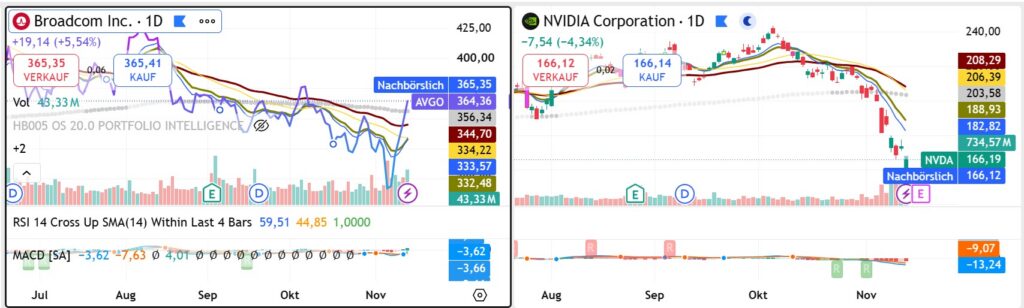
NVIDIA shares plunged more than 14% intraday before recovering much of their losses. Meanwhile, competitors Advanced Micro Devices and Broadcom moved sharply higher. The major US equity indices finished lower, but their losses were relatively modest compared with the initial shock to NVIDIA.
That divergence matters.
If investors believed Huang’s departure fundamentally impaired global demand for AI computing, the damage should have spread more uniformly across semiconductor suppliers and AI infrastructure businesses.
Instead, market participants distinguished between companies positioned to capture AI spending and businesses whose valuations depend heavily on NVIDIA’s leadership, financing relationships and continued expansion.
Yet there is an uncomfortable second layer: the rebound occurred while Treasury yields remained elevated and expectations of another Federal Reserve rate increase strengthened.
The emerging signal is not the death of the AI trade. It is a more discriminating market that is beginning to question who ultimately captures its economic value. Reuters+2
1. What Actually Happened: A Leadership Crisis, Not an Earnings Collapse
On November 12, 2026, NVIDIA officially announced that Jensen Huang had resigned as President, Chief Executive Officer and board member, effective immediately.
The company appointed longtime CFO Colette Kress as interim CEO and named Harvey Jones as its first independent board chair. The search for a permanent successor has begun.
The resignation followed media reports concerning Huang’s personal relationships and questions involving a suspected foreign-intelligence connection. These allegations require careful separation from established facts. NVIDIA’s official transition announcement did not establish that company technology or intellectual property had been compromised. NVIDIA Newsroom+1
The investment implications fall into three distinct categories:
- Confirmed: NVIDIA has lost the executive who personally shaped much of its commercial strategy, product direction and industry relationships.
- Not established: That GPU demand, order books or customer contracts have deteriorated because of his resignation.
- Uncertain: Whether NVIDIA’s new management will maintain the same financing, investment and ecosystem-development strategy.
The third question may ultimately matter more than the first.
2. The Price Action: Panic, Absorption and an Incomplete Recovery
November 11 close
$173.73
Before the resignation
November 12 low
$148.80
Intraday selloff
Late-session snapshot
$166.04
TradingView, approximately 4:12 PM ET
USD per share. The last value is from the supplied TradingView screenshot, not an independently verified official closing auction price. Stock Titan+1
NVIDIA’s intraday recovery was substantial. But recovering from a liquidation low is not equivalent to restoring the previous market valuation.
The distinction is critical.
Fact: Buyers absorbed a significant portion of the initial selling. According to Reuters, citing Vanda Research, retail investors purchased an estimated net $111 million of NVIDIA shares during the first half-hour, a record opening inflow for the stock. Reuters+1
Reaction: The stock stabilized, recovered from its extreme low and traded near $166 toward the end of the session.
Signal: Demand exists at lower prices, but a meaningful valuation discount remains.
Implication: Investors are willing to distinguish NVIDIA’s technological franchise from its leadership crisis. They are not yet willing to assume that the crisis has no economic consequences.
The rebound also needs context: NVIDIA was already under pressure before Thursday’s resignation. Rising discount rates, AI infrastructure financing concerns and regulatory uncertainty had contributed to an earlier repricing.
The Thursday recovery therefore cannot establish that the preceding downtrend has ended.
3. The Wider Market Did Not Confirm a Systemic AI Collapse
The broad indices showed considerably less stress than the headline stock.
| US benchmark | November 12 preliminary close |
|---|---|
| S&P 500 | −0.34% |
| Nasdaq Composite | −0.40% |
| Dow Jones Industrial Average | −0.36% |
Reuters preliminary closing data, November 12, 2026. Reuters
This does not mean the broader market was strong. It means the shock was partially contained.
The more revealing evidence came from within the technology sector.
Broadcom predicts AI chip revenue to double in 2027
Broadcom and AMD — potential beneficiaries
Both advanced sharply, with Reuters reporting gains of roughly 5% for Broadcom and 7% for AMD during the session. The market was considering whether NVIDIA’s disruption could improve competitors’ commercial opportunities.
AI Cluster Solutions for Scalable Compute | Hypertec
CoreWeave and Nebius — funding-sensitive infrastructure
Both were under significant pressure. Nebius also faced company-specific earnings and capacity-expansion concerns, so its decline cannot be attributed exclusively to NVIDIA.
YPF Sociedad Stock: From Deep Value To Fairly Priced Execution Play (NYSE:YPF) | Seeking Alpha
Energy — an alternative source of index support
The S&P 500 energy sector was the day’s strongest major sector as crude prices rose. This helped cushion equity indices, although its strength also reflected geopolitical developments rather than simply defensive investor positioning.Reuters+1
This pattern does not support a clean, uniform rotation out of technology. It suggests selective redistribution within AI, alongside a separate rotation into energy.
It also explains why index resilience alone is insufficient evidence of improving market breadth. A handful of large winners can offset substantial weakness elsewhere.
4. MARKET INTELLIGENCE EDGE: The Market Is Separating AI Technology From AI Financing
The most important development may concern a relationship that rarely appears in conventional semiconductor analysis.
NVIDIA is not merely a supplier of AI computing hardware. Under Jensen Huang, it also became an important participant in financing the infrastructure through which its products are deployed.
That creates two different kinds of economic exposure.
One involves the ability to develop and sell competitive processors. The other involves the funding mechanisms that allow customers to purchase, deploy and operate enormous volumes of computing capacity.
Reuters reported that NVIDIA’s most recent disclosures included approximately $164.5 billion in financial commitments, spanning different forms of obligations and guarantees. This figure should not be mistaken for immediately payable debt or an equivalent amount of cash already spent. Reuters
Nevertheless, the distinction is commercially important.
The potential second-order transmission mechanism
NVIDIA leadership transition
Uncertainty over investment commitments and credit support
Potentially higher financing costs or tighter funding for AI infrastructure
Possible delays in data-center deployment and GPU purchases
Risk of weaker future AI revenue growth and valuation multiples
Scenario analysis, not a confirmed sequence of developments.
This mechanism creates an unusual possibility: NVIDIA might maintain its technological leadership while part of the wider AI investment ecosystem still encounters financial stress.
That is why the relative performance of AMD and Broadcom versus AI infrastructure operators deserves attention.
The market is potentially distinguishing businesses that sell scarce, competitive technology from businesses whose expansion depends on continued access to abundant capital.
A change in NVIDIA’s capital-allocation strategy could be positive for the company’s own financial discipline while negative for some of its customers.
That is the central non-obvious risk: a decision that strengthens NVIDIA’s balance sheet could simultaneously weaken a portion of the demand ecosystem supporting its growth.
The reverse is also possible. If new management maintains existing commitments and customer financing remains stable, today’s financing concerns may prove excessive.
Neither outcome has been established.
5. The Macro Problem Has Not Disappeared
The leadership crisis arrived during an already difficult interest-rate environment.
During Thursday’s session, the US 10-year Treasury yield traded back above 5%, reaching approximately 5.07% in a Reuters market update. The dollar also strengthened to a roughly 19-month high.
Meanwhile, futures markets fully priced at least a 25-basis-point Federal Reserve rate increase in December, with Reuters reporting approximately a 15% probability of a 50-basis-point increase. Reuters+1
This matters for technology in two ways.
First, higher discount rates reduce the present value of distant future earnings, particularly for companies valued on aggressive growth expectations.
Second, higher borrowing costs affect the economics of capital-intensive AI infrastructure.
A data-center operator that must finance servers, electrical infrastructure and long-term capacity commitments faces a different economic problem from a semiconductor designer with stronger cash generation.
The key risk is therefore not simply a falling technology valuation multiple. It is a potential interaction between tighter capital markets and the future pace of AI spending.
The rise in energy shares and crude oil also illustrates why markets cannot currently be understood through NVIDIA alone. Oil strength linked to geopolitical risk can keep inflation expectations elevated, complicating the Federal Reserve’s decisions even if some growth-sensitive companies are weakening.
The combined regime is challenging: strong technology demand may coexist with restrictive financing conditions.
6. What the Market May Be Pricing Next
Three interpretations remain plausible.
| Scenario | What it would mean | Evidence required |
|---|---|---|
| Contained leadership shock | NVIDIA’s business remains fundamentally intact; investors gradually remove the additional uncertainty discount | Stable customer commitments, reassuring earnings guidance, stronger price participation |
| Selective AI reallocation | AI demand persists, but market share and capital increasingly shift toward alternative suppliers and financially stronger operators | Sustained AMD/AVGO outperformance, weak financing-sensitive AI stocks, stable semiconductor earnings expectations |
| Broader AI investment slowdown | Higher rates, regulatory risks and reduced funding support cause weaker infrastructure expansion | Falling sector breadth, deteriorating customer capex plans, weaker guidance and tighter credit conditions |
The second scenario best describes today’s observable relative-price behavior. It is not yet proof of a lasting structural shift.
A leadership crisis can temporarily produce exactly the same stock-price pattern as a genuine market-share transition.
Time, financial guidance and relative performance will distinguish the two.
7. WHAT TO WATCH NEXT
The following five observations can help distinguish a relief rally from a more durable improvement.
1. November 13 — US Producer Price Index and Treasury yields
The October PPI release is scheduled for 8:30 a.m. ET. Cooling price pressure accompanied by falling 2-year and 10-year yields would reduce macro pressure on growth valuations. A stronger inflation reading alongside another rise in yields and the dollar would challenge the recovery. Bureau of Labor Statistics
2. NVIDIA relative to Broadcom and AMD
Monitor whether NVIDIA stabilizes while its competitors continue to outperform. A narrowing performance gap, accompanied by NVIDIA regaining lost price levels, would support the contained-shock interpretation. Persistent divergence would strengthen the selective-reallocation hypothesis.
3. Semiconductor breadth and the AI infrastructure chain
Compare the Philadelphia Semiconductor Index with the Nasdaq and monitor CoreWeave, Nebius and other data-center operators. Broader semiconductor participation and stabilizing infrastructure stocks would indicate improving confidence. Continued concentration in a few rival-chip winners would suggest that financing and demand risks remain unresolved.
4. VIX, market breadth and small-cap participation
Watch the VIX together with the Russell 2000, NYSE advancing-versus-declining stocks and new 52-week lows. A falling VIX with improving breadth would confirm wider risk absorption. A quiet index hiding deteriorating breadth or rising volatility would invalidate the idea of a healthy market recovery.
5. November 17 — NVIDIA earnings and management guidance
NVIDIA has confirmed its fiscal third-quarter 2027 results for November 17, followed by an earnings call. The decisive questions concern product demand, future revenue guidance, customer financing and the strategic direction of the leadership transition. Reaffirmed guidance and continued commitments would support confidence. Unexpected changes to financial commitments or deteriorating customer orders would suggest a more fundamental repricing. NVIDIA Newsroom
Conclusion: A Resilient Market Is Not Necessarily a Healthy Market
NVIDIA’s rebound demonstrates that buyers remain willing to absorb substantial company-specific uncertainty.
AMD and Broadcom’s strength suggests that the market does not consider the AI semiconductor opportunity fundamentally destroyed by Jensen Huang’s departure.
But weakness among financing-sensitive AI businesses and the restrictive interest-rate environment argue against declaring the broader adjustment complete.
The key distinction is between an ecosystem losing confidence in a leading company and an ecosystem beginning to question the financial structure supporting its own expansion.
Today’s evidence points toward selective repricing, not universal capitulation.
The next meaningful confirmation must come from earnings, funding conditions and sustained market breadth—not simply from another sharp intraday recovery.
WIEDER WAS GELERNT
A powerful market lesson emerged from NVIDIA’s leadership shock: the direction of the most prominent stock is not necessarily the direction of the economic opportunity it represents.
An investor concentrating solely on NVIDIA’s initial collapse could conclude that confidence in artificial intelligence was disappearing. An investor concentrating solely on its recovery could conclude that the crisis had already passed.
Neither interpretation captures the full market information.
The stronger method is to identify which related assets should move together if the prevailing explanation is correct—and then investigate those that do not.
When competitors rise as the market leader falls, the market may be redistributing expected profits rather than abandoning an industry. When financially dependent customers fall at the same time, a separate question about the sustainability of investment becomes visible.
This distinction applies far beyond technology: leadership changes, banking crises, commodity shocks and policy surprises can all produce misleading headline reactions.
The most valuable market signal is often found in the assets that refuse to follow the headline.
Disclaimer: This article provides general financial-market research and market intelligence for informational purposes only. It does not constitute investment advice or a recommendation to buy or sell any financial instrument. Market prices, economic expectations and forward-looking scenarios are subject to change.