 LWAYS OPEN
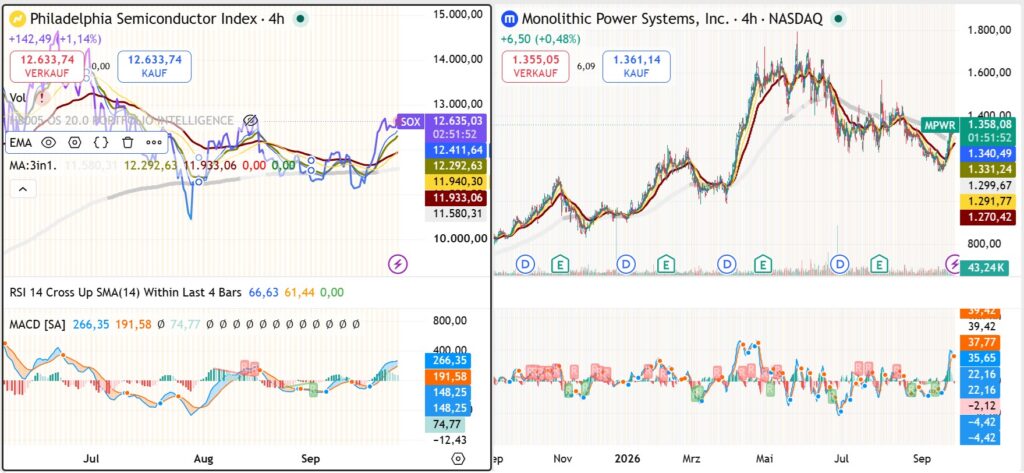
Monolithic Power Systems has surged roughly 15% in five trading days even as Treasury yields again moved above 5%. That divergence contains an important market message: investors are increasingly distinguishing between speculative AI duration and companies positioned at physical bottlenecks of the AI buildout.
The Stock That Should Be Struggling — But Isn’t
A semiconductor stock with a high earnings multiple, a beta above 2 and enormous exposure to AI infrastructure should not be an obvious winner when the U.S. 10-year Treasury yield is above 5%.
Yet Monolithic Power Systems is doing exactly that.
MPWR has gained roughly 15% over the past five trading days and about 47% year-to-date. On September 22 alone, the shares jumped 8.1%, following gains of 4.9% on September 21 and 4.1% on September 18.
Meanwhile, the bond market is sending almost the opposite message. The 10-year Treasury yield has surged through 5%, reaching around 5.20% on September 24 and briefly exceeding 5.22% overnight — levels not seen since 2007.
That divergence is more important than MPWR’s rally itself.
The market is not simply buying “semiconductors.”
It appears to be distinguishing between companies whose AI valuations depend primarily on distant future earnings and companies whose products solve physical constraints that are becoming more severe as AI infrastructure expands.
Monolithic Power sits directly inside one of those constraints:
power.
And that may be telling us something important about the next phase of the AI trade.
WHAT HAPPENED?
The immediate price action is striking.
MPWR closed at $1,217.80 on September 18, climbed to $1,277.68 on September 21 and then surged to $1,380.62 on September 22. That three-session move alone amounted to more than 13%.
The broader semiconductor sector was strong as well. The Philadelphia Semiconductor Index rose 4.3% on September 21 and another 2.1% on September 22.
But MPWR’s move was stronger.
And the important point is that this rally did not begin with a new quarterly earnings report.
The company’s latest earnings were released almost two months earlier.
Nor was there a single new corporate announcement on September 22 capable of explaining the entire move.
Instead, the market appears to have rediscovered several existing pieces of information simultaneously.
That is often how meaningful market repricing begins.
THE OBVIOUS NARRATIVE: AI IS BACK
The simplest explanation is that the AI trade recovered.
On September 21, falling oil prices and lower Treasury yields helped produce a major technology rally. The Nasdaq Composite rose 2.3%, the S&P 500 gained 1.5%, and the semiconductor index jumped 4.3%.
Meta’s new Muse AI system helped revive enthusiasm around AI demand, while AMD, Intel, Arm and other semiconductor names rallied sharply.
That explanation is correct.
But it is incomplete.
Because something more interesting happened afterwards.
Treasury yields reversed upward again.
Oil recovered.
The U.S. 10-year yield returned above 5% and subsequently approached 5.2%.
Normally that combination should be particularly uncomfortable for expensive, high-beta technology equities.
Yet MPWR remained near the levels reached during the AI rally and was again advancing on September 25.
That resilience is the signal.
THE SIGNAL BEHIND THE HEADLINE: AI IS BECOMING A POWER-ELECTRONICS STORY
The market has spent several years treating AI primarily as a compute story.
More AI meant more GPUs.
More GPUs meant Nvidia.
Then the investment chain broadened.
More GPUs required HBM memory, networking, optical connectivity, advanced packaging and data-center construction.
MPWR suggests that investors may now be moving one step further down that chain.
More compute requires dramatically more sophisticated power delivery.
This is not simply about generating enough electricity for a data center.
The electricity entering a data center must be converted, regulated and delivered efficiently to increasingly power-dense processors.
As AI accelerators become more powerful, power management becomes more technically difficult.
That is precisely where Monolithic Power operates.
And the company’s financial statements show how quickly that opportunity is becoming economically relevant.
THE NUMBER THAT EXPLAINS MPWR BETTER THAN ITS SHARE PRICE
Monolithic Power reported Q2 2026 revenue of $980.6 million, up 47.6% year over year.
That is already impressive.
But the composition matters far more.
Enterprise Data revenue reached $380.6 million, compared with only $144.0 million a year earlier.
That is growth of 164.3%.
Enterprise Data now represents 38.8% of company revenue, up from 21.7% a year earlier.
Management explicitly attributed the increase primarily to higher sales of power-management solutions for AI and server applications.
This is the critical distinction.
MPWR is not rising because investors hope AI power demand eventually materializes.
It is already visible in reported revenue.
AND THEN WHAT?
This is where the market signal becomes more interesting.
If AI data-center construction continues, the power-management opportunity does not simply grow in proportion to the number of GPUs.
It can potentially grow with the electrical complexity surrounding each generation of GPUs.
Higher compute density creates:
more current,
more heat,
more voltage-conversion complexity,
greater efficiency requirements,
and greater economic penalties for power losses.
In other words, the relevant variable is not merely the number of accelerators deployed.
It is the increasing amount of engineering required to power each unit of compute efficiently.
That creates a second-order AI investment chain:
AI models → compute demand → accelerators → power density → power conversion → thermal constraints → electrical infrastructure.
MPWR sits much further down this causal chain than the companies that dominate AI headlines.
That may explain why investors are increasingly willing to treat it as AI infrastructure rather than simply an analog semiconductor company.
THE MARKET IS BEGINNING TO PRICE THE BOTTLENECKS
The same phenomenon is appearing elsewhere.
AI infrastructure increasingly faces constraints not in model development but in electricity generation, grid connections, cooling, optical connectivity and power delivery.
Recent estimates cited by the Financial Times suggest U.S. data-center electricity demand could face a substantial supply shortfall as AI infrastructure expands.
At the same time, political attention is shifting toward who pays for the additional electrical infrastructure required by large data centers. The U.S. House recently passed legislation addressing the allocation of those costs.
These developments appear unrelated to a semiconductor company selling power-management chips.
They are not.
They are different manifestations of the same underlying constraint:
AI is becoming increasingly power-limited.
The investment implications therefore extend far beyond utilities.
Power generation matters.
Transmission matters.
Cooling matters.
Voltage conversion matters.
Power semiconductors matter.
And efficiency increasingly matters.
MPWR’s price action may be reflecting recognition of that chain.
WHY THE GLOBALFOUNDRIES AGREEMENT MATTERS
There is another piece of evidence.
On September 9, Monolithic Power and GlobalFoundries announced a long-term manufacturing agreement.
MPS will deploy its proprietary process technology at GlobalFoundries’ advanced 300mm manufacturing facility in Singapore, with volume production expected in early 2027.
The products are expected to include next-generation power solutions for automotive systems, industrial automation and smart power stages for AI and cloud infrastructure.
This matters because rapidly growing demand is only valuable if a semiconductor supplier can manufacture enough product to capture it.
Monolithic Power had already stated in July that it was expanding its capacity objective to significantly beyond $6 billion to support future growth.
Management also said it had begun sampling high-voltage AC-to-DC products for 800V data-center architectures, extending the company beyond its existing AI and server-core power products.
Put these developments together:
Demand is accelerating.
The product opportunity is expanding.
And manufacturing capacity is being increased.
The market may therefore be pricing not one quarter of strong AI demand, but the possibility that power management becomes a structurally larger component of AI infrastructure spending.
A SECOND SIGNAL: AI SPENDING IS BROADENING, NOT COLLAPSING
This matters for the wider market.
Only days ago, semiconductor stocks were hit by renewed concerns about AI development, safety and the sustainability of investment.
On September 14, the semiconductor index suffered a sharp selloff as AI-related concerns combined with a U.S. 10-year Treasury yield moving above 5%.
The subsequent response has been revealing.
By September 21, the SOX had rebounded 4.3%.
On September 22 it gained another 2.1%.
Even after modest declines on September 23 and 24, the SOX closed September 24 at approximately 12,493 — far above its September 14 low.
MPWR’s recovery has been even more pronounced.
This suggests that the market has not abandoned the AI capital-expenditure thesis.
Instead, it appears to be becoming more selective about where within that ecosystem earnings visibility is strongest.
That is an important distinction.
THE DIVERGENCE THAT MATTERS: MPWR VS. TREASURY YIELDS
Perhaps the strongest market-intelligence signal is not MPWR versus Nvidia.
It is MPWR versus the bond market.
The U.S. 10-year yield has moved above 5%.
The 30-year yield has reached levels not seen in more than two decades.
Oil remains an inflation risk.
Markets are again pricing meaningful odds of another Federal Reserve rate increase.
Those conditions normally compress valuations for long-duration growth stocks.
Yet MPWR has rallied.
This does not mean interest rates have stopped mattering.
It means earnings expectations may currently be rising faster than the valuation headwind created by higher discount rates.
That is an entirely different market regime from indiscriminate multiple expansion.
And it gives investors a useful framework for identifying leadership.
When rates rise and a high-multiple stock rises anyway, ask:
What fundamental expectation is improving fast enough to overwhelm the discount-rate headwind?
For MPWR, the answer appears to be AI power infrastructure.
BUT THIS IS NOT YET A BROAD RISK-ON SIGNAL
There is an important limitation.
MPWR should not be interpreted as evidence that the entire equity market has entered a clean risk-on regime.
Market breadth remains less convincing than headline index performance.
Treasury volatility is unusually high.
The 10-year yield surged roughly 20 basis points in two sessions this week, reaching above 5.22% overnight.
Oil remains capable of rapidly changing inflation expectations.
And Reuters notes that rising bond yields and narrowing market participation remain potential threats to the U.S. equity rally heading into the coming employment and inflation data.
The message is therefore more specific:
The market is willing to tolerate macro risk where it sees unusually strong earnings acceleration.
That is selective risk appetite, not indiscriminate risk appetite.
The distinction matters.
MPWR MAY BE A BETTER AI SENTIMENT INDICATOR THAN NVIDIA ALONE
Nvidia remains the dominant reference point for AI semiconductor demand.
But its enormous market capitalization and central role in major indices make its price increasingly influenced by broad index flows, positioning and macro factors.
MPWR offers a different lens.
Its business is several steps removed from the AI model itself.
If MPWR, optical-networking companies, memory suppliers, cooling providers and electrical-infrastructure companies begin outperforming together, that would indicate something more powerful than renewed enthusiasm for Nvidia.
It would suggest that investors believe the physical AI infrastructure buildout is broadening.
That is precisely the signal worth watching.
The AI trade becomes structurally healthier when earnings growth spreads outward from the accelerator itself into the surrounding infrastructure.
WHAT THE MARKET MAY BE TELLING US
The strongest interpretation of MPWR’s recent move is therefore not:
“AI stocks are going up again.”
It is:
The market is increasingly valuing companies according to their proximity to unavoidable physical AI bottlenecks.
Compute remains important.
But compute cannot operate without electricity.
Electricity cannot reach processors efficiently without increasingly sophisticated power conversion.
Large GPU clusters cannot scale without networking.
Networking cannot scale without optical infrastructure.
And none of it works without sufficient cooling and data-center capacity.
The market may therefore be transitioning from the first generation of the AI trade — buy the accelerator — toward a broader second generation:
identify the bottlenecks created by the accelerator.
MPWR is one of the clearest current examples.
WHAT TO WATCH NEXT
1. MPWR Relative to the SOX
This is perhaps the cleanest confirmation signal.
MPWR outperforming while the broader semiconductor index consolidates would suggest that investors are specifically rewarding AI power exposure rather than simply buying semiconductors indiscriminately.
If MPWR begins materially underperforming SOX, the recent move looks more like temporary momentum.
2. U.S. 10-Year Treasury Yield
The current stress point is roughly 5% and above.
MPWR remaining resilient with US10Y around 5.0–5.2% would be meaningful evidence of fundamental earnings momentum overpowering valuation pressure.
A sustained further increase in yields would provide a much harder test.
3. Enterprise Data Revenue
This is the fundamental confirmation.
Q2 Enterprise Data revenue was $380.6 million, up 164.3% year over year.
Q3 company revenue guidance is $1.14–1.16 billion, implying another major sequential increase from Q2’s $980.6 million.
The next earnings report therefore matters enormously.
The market needs evidence that AI power demand remains strong enough to support the valuation.
4. SOX Breadth
A healthy AI infrastructure expansion should eventually extend beyond Nvidia and a handful of mega-cap semiconductor companies.
Watch power, networking, memory, optical and foundry-related names.
Broad participation would strengthen the argument that AI capex is diffusing across the supply chain.
Narrowing leadership would weaken it.
5. Oil and Treasury Yields Together
This relationship has become unusually important.
Higher oil raises inflation expectations.
Higher inflation expectations pressure bonds.
Higher Treasury yields raise the discount rate applied to technology earnings.
If oil falls and Treasury yields retreat while semiconductor earnings expectations remain intact, the macro headwind against AI infrastructure equities would diminish.
If both rise together, the market’s tolerance for expensive growth stocks will face a much tougher test.
Conclusion
Monolithic Power Systems is interesting today not because it gained approximately 15% in a week.
It is interesting because of when it did so.
A high-beta semiconductor company is showing unusual strength while long-term Treasury yields are above 5%, oil remains an inflation risk and macro uncertainty has not disappeared.
That tells us the market is not simply returning to indiscriminate technology speculation.
It appears to be searching for AI businesses where demand is already translating into revenue and where future infrastructure constraints could make the product more important rather than less.
MPWR’s Enterprise Data business grew 164% year over year.
Its manufacturing capacity is expanding.
Its technology is moving toward 800V data-center architectures.
And its products sit directly between electricity and increasingly power-hungry AI processors.
The larger message is therefore not merely about Monolithic Power Systems.
The market may be telling us where it believes the next bottleneck in AI economics is forming.
And that bottleneck is increasingly measured in watts.
WIEDER WAS GELERNT
Markets often reveal more through relative strength under adverse conditions than through rallies during favorable conditions.
A technology stock rising when yields fall tells us relatively little: the macro environment is helping it. A high-duration semiconductor stock remaining strong while Treasury yields surge above 5% is more informative. Something else must be offsetting the valuation pressure.
The analytical task is then to identify that force.
In MPWR’s case, the evidence points toward rapidly accelerating AI power-management demand and a broader market recognition that the AI buildout increasingly depends on physical infrastructure surrounding the GPU.
This principle applies far beyond semiconductors. When macro conditions should hurt an asset but price refuses to behave accordingly, investigate the fundamental variable strong enough to overwhelm the expected reaction.
The most useful market signal is often not what moves — but what refuses to move the way it should.
Disclaimer: This report provides general financial-market research and market intelligence for informational purposes only. It does not constitute investment or financial advice, portfolio management, or a recommendation to buy or sell any financial instrument.