 LWAYS OPEN
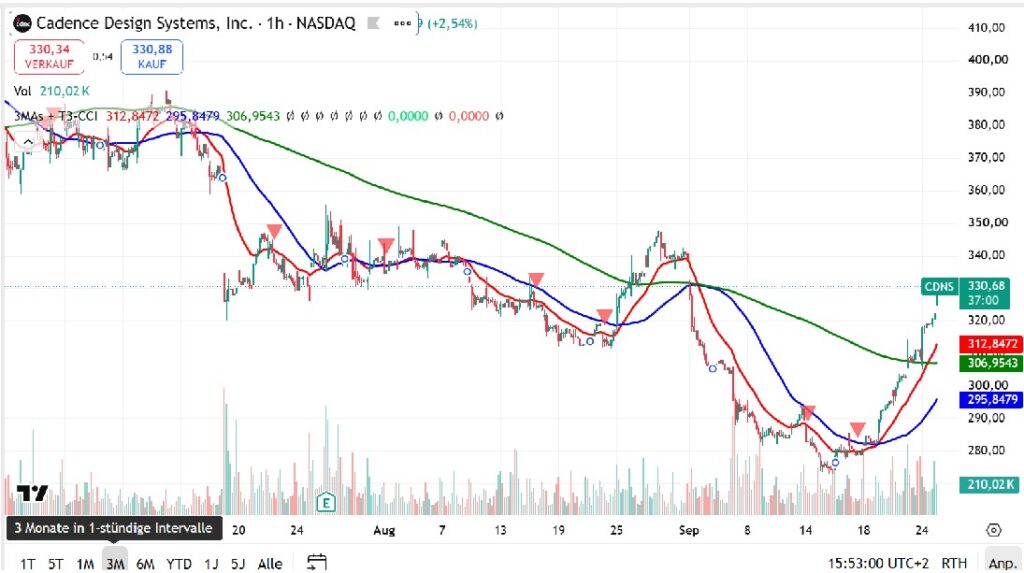
Cadence Design Systems has gained roughly 17% in five trading days. The obvious explanation is AI enthusiasm. The more important question is whether agentic chip design can change Cadence’s economic role in semiconductor development — enough to justify another valuation regime.
The Market May Be Repricing Something Bigger Than an AI Product Launch
Cadence Design Systems has suddenly become one of the more interesting second-order AI trades.
The shares rose from $282.90 on September 18 to $322.00 on September 24, a gain of almost 14% in four sessions, and were trading around $329 on September 25. The five-day gain reached roughly 17%. Yet there was no earnings surprise, major acquisition or single financial announcement large enough to explain the entire move.
That is precisely what makes the move interesting.
On September 22, Cadence introduced a new RTL Generation Agent for its ChipStack AI Super Agent. In early evaluations, the system generated functionally accurate RTL while delivering average reductions of 24% in chip area and 18% in power versus pure foundation-model-generated code.
The market appears to be connecting this announcement with something already visible in Cadence’s financial results: AI is no longer merely increasing demand for the chips designed with Cadence software. AI is beginning to change how the chips themselves are designed.
That distinction may ultimately matter much more than this week’s share-price move.
Why Did CDNS Rise So Fast?
There is no single explanation. The rally appears to have been produced by three reinforcing developments.
1. The Semiconductor Environment Turned Stronger
The rally began before the September 22 product announcement.
CDNS rose 4.24% on September 21 as semiconductor and technology stocks rallied broadly. The Nasdaq reached a record closing high that day and the Philadelphia Semiconductor Index rose 4.3%, supported by renewed enthusiasm surrounding AI infrastructure and lower long-term Treasury yields.
That matters because Cadence occupies an unusual position in the AI supply chain.
It does not need to predict whether Nvidia, AMD, Broadcom, hyperscalers or custom-silicon startups ultimately dominate particular AI workloads. Increasing semiconductor design complexity itself creates demand for electronic-design automation.
The first part of the rally was therefore macro and semiconductor-driven.
But that does not explain everything.
2. Cadence Introduced an Agent That Moves AI Further Up the Chip-Design Stack
On September 22, Cadence expanded ChipStack AI with an RTL Generation Agent capable of turning specifications into register-transfer-level designs and optimizing them for power, performance and area.
This is significantly more consequential than adding a generative-AI assistant to conventional engineering software.
RTL sits near the beginning of digital chip implementation. Decisions made there propagate through synthesis, physical implementation, verification and ultimately silicon economics.
Cadence says its early evaluations produced:
- 24% average area reduction versus pure foundation-model-generated RTL;
- 18% average power reduction;
- 100% functional accuracy in those evaluations.
Honda is among the companies evaluating the technology.
The numbers remain early-stage results rather than proof of performance across the semiconductor industry. But they demonstrate the strategic direction.
Cadence is attempting to connect generative AI directly to the deterministic engineering tools required to determine whether an AI-generated design actually works.
That distinction is critical.
3. Investors Already Had Evidence That AI Demand Was Reaching Cadence’s Financial Statements
The September announcement did not arrive in isolation.
Cadence’s second-quarter revenue reached $1.584 billion, up from $1.275 billion a year earlier. Non-GAAP operating margin expanded to 45.5%, while management raised its 2026 revenue-growth outlook to approximately 19%, non-GAAP EPS to $8.10 and operating cash flow to approximately $2 billion at the midpoint.
More importantly, backlog reached a record $8.1 billion, including approximately $4.2 billion of remaining performance obligations expected to be recognized within twelve months.
The growth is also broad.
Core EDA revenue increased 18% year over year in Q2. Semiconductor IP revenue increased more than 40%. System Design and Analysis increased 37%. Cadence also reported another record hardware quarter.
This makes the AI narrative materially different from many software-AI stories.
Cadence already has accelerating revenue, expanding margins and record contracted business before the latest generation of autonomous design agents becomes financially significant.
WHAT EVERYONE KNOWS
The conventional Cadence thesis is straightforward.
Semiconductors are becoming more complicated. AI accelerators require advanced nodes, chiplets, high-bandwidth memory, sophisticated packaging and increasingly complex power and thermal engineering.
More complexity requires more EDA.
Cadence and Synopsys occupy exceptionally strong positions in that ecosystem.
Therefore AI semiconductor growth benefits Cadence.
All of that is broadly correct.
But it may no longer be the most interesting part of the investment case.
WHAT THE DATA ACTUALLY SHOWS
Cadence increasingly operates across three connected layers.
Core EDA represented approximately 68% of Q2 revenue. Semiconductor IP represented 15%, while System Design and Analysis contributed another 17%.
The company is therefore expanding beyond the historical definition of EDA.
Cadence now participates in digital implementation, verification, analog design, semiconductor IP, advanced packaging, PCB design, computational fluid dynamics, structural simulation and other system-level engineering disciplines.
The acquisition of Hexagon’s Design & Engineering business accelerates that expansion further.
Cadence paid approximately €2.7 billion for the business, combining cash and newly issued shares, extending the company’s addressable market further into system-level engineering and physical simulation.
The consequence is subtle but important:
Cadence is trying to own more of the feedback loop between silicon architecture and the physical system in which that silicon operates.
AI may make that feedback loop dramatically more valuable.
THE HIDDEN VARIABLE: AI MAY INCREASE THE VALUE OF VERIFICATION FASTER THAN IT REDUCES THE COST OF DESIGN
The obvious assumption about generative AI and engineering software is productivity.
Engineers become faster. Fewer hours are required. Design cycles shorten.
But there is a second-order effect.
If AI makes generating candidate chip architectures dramatically cheaper, engineers can explore far more possible designs.
And then what?
Every additional AI-generated architecture still needs to be tested against extremely demanding physical constraints:
Does it function correctly?
Can it meet timing?
How much power does it consume?
How much silicon area does it require?
Can it be manufactured?
Can it be packaged?
Will thermal constraints destroy the theoretical performance advantage?
This creates a counterintuitive possibility:
AI may commoditize parts of design generation while increasing the economic importance of trusted verification, simulation and signoff infrastructure.
This is where Cadence’s position becomes particularly interesting.
A generic large language model can generate RTL.
But producing RTL is not the same as producing manufacturable silicon.
Cadence’s advantage is not simply having an AI model. Its potential advantage is connecting AI generation to decades of deterministic EDA infrastructure capable of testing whether the output actually satisfies semiconductor engineering constraints.
That makes the September 22 announcement strategically more important than it initially appears.
ChipStack does not merely generate RTL. Cadence is connecting generation, verification, debug and PPA optimization into an increasingly autonomous engineering loop.
The moat therefore may not be the AI agent itself.
The moat may be the closed-loop engineering environment that tells the agent whether it is right.
That is the hidden variable in the Cadence investment case.
AI FOR DESIGN AND DESIGN FOR AI ARE REINFORCING EACH OTHER
Cadence benefits from AI through two different mechanisms.
The first is Design for AI.
Nvidia, hyperscalers, semiconductor companies and custom-silicon developers require increasingly sophisticated design tools to create AI infrastructure.
The second is AI for Design.
Cadence inserts artificial intelligence directly into the engineering process to automate optimization, verification and increasingly design generation itself.
These mechanisms reinforce each other.
More AI computing demand creates more sophisticated silicon.
More sophisticated silicon increases design complexity.
Greater complexity increases the value of automation.
Better automation makes additional design exploration economically possible.
That generates still more verification, simulation and optimization workloads.
This is potentially a positive feedback loop rather than simply another semiconductor cycle.
Cadence’s recent financial performance suggests that the first half of this loop is already occurring. The investment question is whether the second half — agentic engineering — becomes commercially significant.
Why the $8.1 Billion Backlog Matters
The backlog deserves more attention than the weekly share-price movement.
At June 30, Cadence reported $8.1 billion of remaining performance obligations, including approximately $900 million of non-cancelable customer commitments where final product selection had not yet been determined.
Against expected 2026 revenue of roughly $6.3 billion, that provides unusual visibility.
This matters because high-growth technology companies normally require investors to make aggressive assumptions about future demand.
Cadence already has substantial contracted demand.
That does not eliminate valuation risk, but it changes its character.
The principal question is less whether semiconductor design spending disappears and more whether Cadence can convert its unusually strong position into sustained double-digit growth without investors paying too much in advance for that outcome.
The Valuation Problem Has Not Disappeared
This is where the investment case becomes more difficult.
At approximately $329, Cadence is worth roughly $90 billion.
Consensus data before the latest rally pointed to approximately $8.1 of 2026 adjusted EPS and around $9.6 for 2027.
At $329, that implies approximately:
40–41× 2026 earnings
and
34–35× 2027 earnings.
Those are not distressed multiples.
The market is already assigning Cadence a substantial premium for durability, competitive positioning and future growth.
This is particularly important after the recent rally.
CDNS traded at $273.96 on September 15.
At approximately $329 ten days later, the shares have gained roughly 20%.
The underlying company did not become 20% more profitable in ten days.
What changed was the market’s willingness to capitalize the future opportunity.
That distinction should not be ignored.
But The Stock Is Still Far Below Its 2026 High
There is another side to the valuation argument.
CDNS reached an all-time high of $416.69 on June 2, 2026. Even around $329, the stock remains approximately 21% below that level.
This explains why the recent rally does not automatically mean the stock has entered unprecedented valuation territory.
It is partly recovering from a significant derating.
The shares fell as low as approximately $273 during September following pressure from higher Treasury yields and broader weakness in high-duration technology equities.
The recent move therefore combines two forces:
fundamental AI optimism + reversal of a previous valuation compression.
That is very different from a stock simply becoming 17% more expensive without any prior correction.
The Balance Sheet Has Changed
There is another issue investors should not overlook.
Cadence finished June with approximately $1.44 billion of cash and $2.48 billion of long-term debt.
Cash had fallen from approximately $3.0 billion at the end of 2025, largely reflecting acquisition activity.
Goodwill increased to approximately $4.9 billion and acquired intangible assets to approximately $1.87 billion following Cadence’s expansion strategy.
This does not create an obvious balance-sheet problem given the company’s cash generation.
But it changes the quality of the story slightly.
Future returns will increasingly depend not only on organic EDA dominance but also on management successfully integrating acquired engineering businesses and turning them into a broader computational-design platform.
That is a different execution challenge.
China Remains a Real Structural Risk
Cadence also carries an unusual geopolitical exposure.
China represented approximately 15% of revenue in Q2 2026, compared with 9% a year earlier.
The company has already experienced the consequences of export-control risk.
In 2025 Cadence reached settlements with the U.S. Department of Justice and Bureau of Industry and Security relating to historical export-control violations involving Chinese entities. The company agreed to penalties and forfeitures exceeding $140 million.
The historical case has been resolved, but the structural risk has not disappeared.
Advanced EDA software is strategically sensitive because access to leading-edge design tools affects a country’s ability to develop advanced semiconductors.
Any renewed tightening of U.S. technology restrictions could therefore affect part of Cadence’s addressable market.
Investors should treat China exposure as a persistent geopolitical variable rather than a closed legal episode.
BULL / BASE / BEAR FRAMEWORK
BULL CASE — Cadence Becomes the Operating System for AI-Driven Engineering
The strongest scenario is not simply continued semiconductor growth.
It is that agentic AI materially changes chip and system design.
ChipStack, ViraStack and InnoStack increasingly automate workflows across RTL generation, verification, analog design and implementation. Customers run more design iterations because AI dramatically reduces engineering friction.
Cadence’s deterministic verification and simulation infrastructure becomes more valuable as AI generates more candidate designs.
Meanwhile, semiconductor IP, advanced packaging and system simulation broaden the revenue opportunity.
Confirmation would include: sustained high-teens Core EDA growth, strong adoption of AI agents, continued backlog expansion, increasing cross-selling between EDA and System Design & Analysis, and evidence that AI products support pricing or wallet-share gains.
BASE CASE — Excellent Business, Gradual AI Monetization
AI improves engineering productivity but does not fundamentally transform EDA economics immediately.
Cadence continues benefiting from increasing semiconductor complexity, custom silicon, advanced packaging and hyperscaler investment.
Revenue growth gradually moderates from the current unusually strong rate while margins remain high.
The company remains structurally attractive, but valuation becomes increasingly dependent on earnings growth rather than multiple expansion.
In this scenario, the recent rally has anticipated part of the fundamental improvement.
BEAR CASE — AI Narrative Runs Ahead of Monetization
The risk is not necessarily that Cadence’s technology fails.
It may simply take longer to monetize than investors expect.
Customers could use AI primarily to improve engineering productivity without proportionally increasing software spending.
Generic AI models could commoditize parts of front-end design faster than Cadence can monetize agentic workflows.
Semiconductor capital spending could slow, export restrictions could tighten, acquisition integration could disappoint or high Treasury yields could compress premium software valuations.
At 30–40 times forward earnings, even continued earnings growth can coexist with poor share-price performance if the valuation multiple contracts.
WHAT CHANGES THE CASE?
Five measurable developments now matter disproportionately.
1. AI-agent monetization
Cadence should increasingly disclose evidence that ChipStack, ViraStack and InnoStack are generating incremental contract value rather than merely improving customer engagement.
2. Core EDA growth
Q2 Core EDA growth of 18% provides an unusually strong benchmark. Sustained mid-to-high-teens growth would support the structural AI thesis; material deceleration would challenge it.
3. Backlog and remaining performance obligations
The current $8.1 billion backlog is one of the strongest pieces of evidence supporting revenue visibility. The direction of this number may matter more than individual quarterly EPS surprises.
4. Operating leverage
AI should theoretically increase the economic productivity of Cadence’s software platform. If revenue remains strong but margins stop expanding, investors should investigate whether hardware, acquisitions or AI-development costs are changing the business mix.
5. China and export controls
China’s contribution and any new U.S. restrictions on advanced semiconductor-design technology remain material external variables.
So Is There Still Economic Upside After the 17% Rally?
The research leads to a more nuanced conclusion than either “the stock has run too far” or “AI means it keeps going.”
Cadence’s fundamental position appears stronger than a conventional EDA analysis captures.
Record backlog, approximately 19% expected 2026 revenue growth, strong Core EDA growth, expanding semiconductor IP and system-design businesses, and the emergence of agentic design workflows provide real evidence behind the narrative.
But the stock’s rapid recovery has reduced the valuation asymmetry that existed around $274.
Around $329, investors are again paying a substantial premium for future growth.
The investment case therefore increasingly depends on something more demanding than “AI semiconductor spending remains strong.”
Cadence must demonstrate that AI changes the economics of engineering design, not merely the interface through which engineers use existing EDA tools.
If that happens, today’s earnings multiple may ultimately underestimate the duration of growth.
If it does not, the recent rerating has already captured a meaningful portion of the easier upside.
The next decisive evidence is likely to come not from another AI product announcement, but from customer adoption, backlog, revenue growth and monetization.
Conclusion
Cadence’s September rally is understandable, but its importance is easy to misinterpret.
The interesting development is not that Cadence has added generative AI to semiconductor software.
It is that AI-generated engineering creates a new bottleneck: trust.
As machines generate more designs, the economic value may migrate toward the systems capable of proving which designs actually work.
Cadence already owns important parts of that verification, implementation, simulation and signoff infrastructure.
That creates a credible path from AI beneficiary to AI engineering infrastructure provider.
Whether that transition deserves another major valuation expansion remains unproven.
But it is now the question that matters.
WIEDER WAS GELERNT
The transferable lesson from Cadence is that investors should not ask only whether AI makes an existing product more productive. They should ask where the bottleneck moves after productivity improves.
Generative AI can make producing candidate solutions dramatically cheaper. But when generation becomes abundant, validation can become scarce and therefore more valuable. In semiconductor design, faster RTL generation does not eliminate verification, physical implementation, thermal analysis or signoff; it may create more work for those systems because engineers can explore many more designs.
This analytical framework applies well beyond EDA. In software development, biotechnology, industrial engineering and autonomous systems, AI may commoditize creation while increasing the value of verification, proprietary data, simulation and trusted infrastructure.
When AI removes one bottleneck, the investment opportunity may lie in the bottleneck it creates next.
Disclaimer: This report provides general financial-market and investment research for informational purposes only. It does not constitute investment or financial advice, portfolio management, or a recommendation to buy, sell or hold any financial instrument.